Talha Badar, Hematology/Oncology Specialist at Mayo Clinic, shared on LinkedIn:
“Should we transplant TP53-mutated MDS patients?
A question I debated recently at IWMDS2026. My position: selective alloHCT, not molecular nihilism.
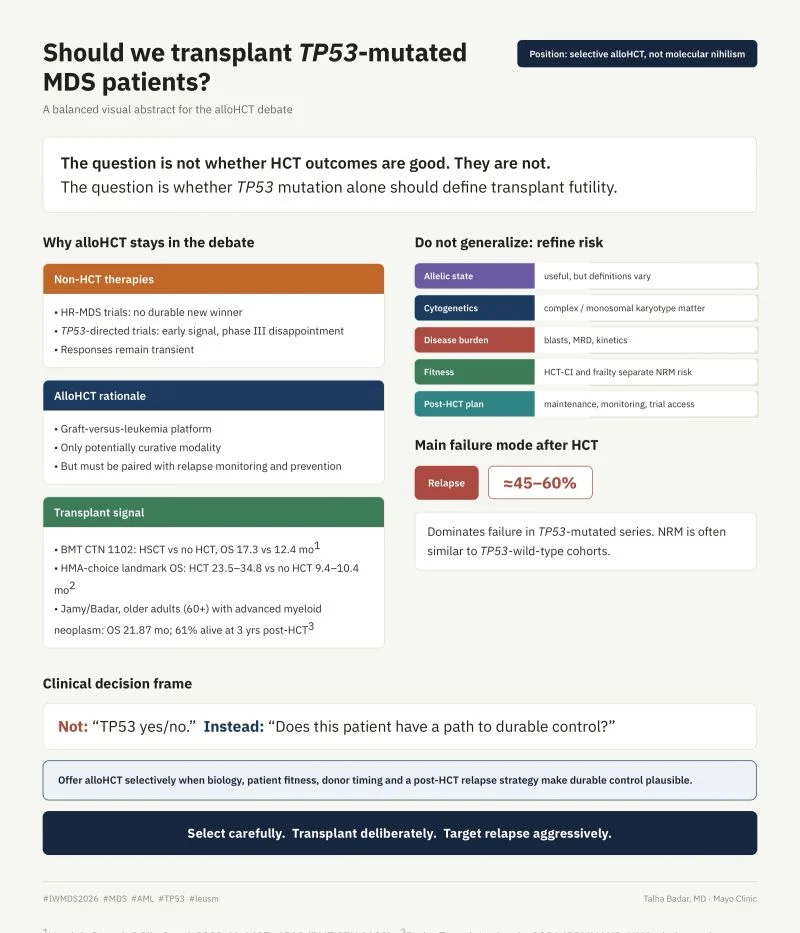
The question is not whether HCT outcomes are good in TP53-mutated MDS. They are not. The real question is whether TP53 mutation alone should define transplant futility.
WHY ALLOHCT STAYS IN THE DEBATE
Two decades of drug development in higher-risk MDS have not produced a durable winner. Azacitidine (2004) remains the backbone.
Since then: S1117, ONTIME, INSPIRE, PANTHER, STIMULUS, VERONA, eprenetapopt + AZA, magrolimab + AZA (ENHANCE). No consistent OS advantage. Endpoints often missed. Responses remain transient, especially in TP53-mutated disease.
Against that backdrop, transplant is the one intervention that keeps showing a survival signal:
- BMT CTN 1102 (Versluis et al, J Clin Oncol 2023): HSCT vs no HCT, median OS 17.3 vs 12.4 mo (P=.02)
- Our COMMAND registry HMA-choice study (Badar et al, Leukemia 2026): landmark OS 23.5-34.8 mo with HCT vs 9.4-10.4 mo without
- Our COMMAND transplant cohort (Badar et al, Leukemia 2023, n=370): median OS 24.5 mo post-HCT
- Jamy/Badar (Blood Cancer J 2025), older adults 60+ with advanced myeloid neoplasm: median OS 21.87 mo, 61% alive at 3 years post-HCT
TP53 is not the only bad actor:
Other high-risk features carry similarly sobering numbers after transplant: complex karyotype (3-yr OS 29.8%), monosomal karyotype (2-yr OS 22%), inv(3)/t(3;3) (2-yr OS 26%), therapy-related MDS with wild-type TP53 (3-yr OS 34%). We do not categorically exclude those patients. TP53 should not be treated differently in principle.
What actually drives failure after HCT
Across high-risk biology, relapse, not excess transplant mortality, dominates failure (roughly 45-60% in TP53-mutated series). Non-relapse mortality is often similar to TP53-wild-type cohorts. A “successful transplant” in this disease requires a post-HCT disease-control strategy, not just getting to day 100.
Refine risk, do not generalize
Allelic state (definitions still vary), cytogenetic complexity, disease burden (blasts, MRD, kinetics), fitness (HCT-CI, frailty), and a concrete post-HCT plan (maintenance, monitoring, trial access) all belong in the decision. The question is not ‘TP53 yes or no.’ It is ‘does this patient have a path to durable control?’
Select carefully. Transplant deliberately. Target relapse aggressively.”
You can also read: