
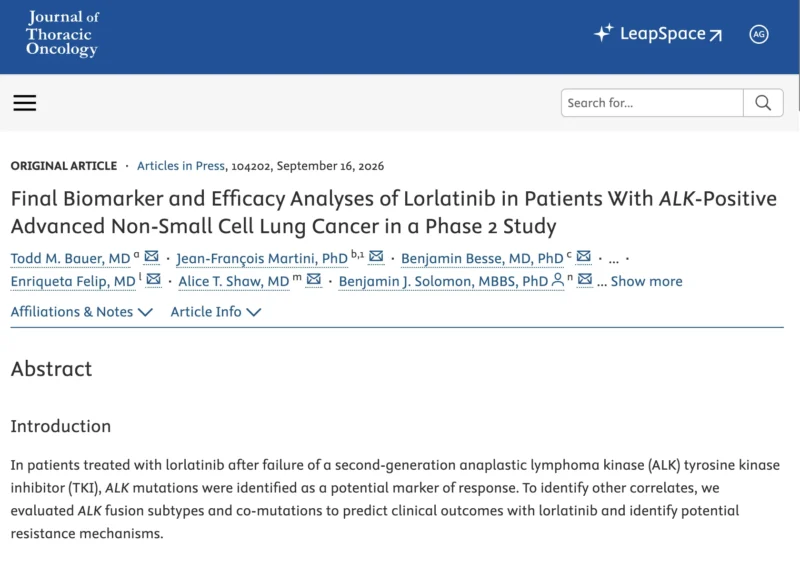
Long-term follow-up from the global phase II lorlatinib study provides a more mature view of how tumor biology influences outcomes in ALK-positive advanced non–small cell lung cancer. Published online September 16, 2026, in the Journal of Thoracic Oncology, the final biomarker and efficacy analysis examined EML4::ALK fusion variants, TP53 co-mutations, circulating tumor DNA, and acquired ALK resistance mutations across treatment-naïve and previously treated patients receiving lorlatinib.
The analysis provides an important distinction between prognostic biology and treatment sensitivity. TP53 mutation was consistently associated with shorter overall survival across treatment cohorts, while EML4::ALK variant 3 was associated with poorer survival than variants 1 or 2 in patients previously treated with crizotinib. Yet neither biomarker identified a population in which lorlatinib lacked substantial activity. After more than five years of follow-up, the investigators concluded that prolonged survival with lorlatinib was observed across biomarker-defined subgroups.
The findings therefore do not support using TP53 or EML4::ALK fusion subtype to exclude patients from lorlatinib. Instead, they provide a more sophisticated biological framework for understanding why outcomes differ among patients who share the same oncogenic driver.
ALK-Positive NSCLC Is Not a Biologically Uniform Disease
The discovery of ALK rearrangements transformed advanced NSCLC by identifying a population highly sensitive to ALK tyrosine kinase inhibition. However, the presence of an ALK fusion alone does not fully explain the considerable variation in clinical outcomes among patients. Different EML4::ALK fusion variants, concurrent genomic alterations, previous ALK inhibitor exposure, and acquired resistance mechanisms may all influence disease behavior.
Earlier analyses had shown that acquired ALK mutations can predict sensitivity to lorlatinib after failure of second-generation ALK inhibitors. The final phase II analysis therefore extended the investigation beyond ALK resistance mutations to examine whether fusion subtype and co-mutations could further explain differences in long-term outcome.
This is particularly relevant because lorlatinib is a potent, brain-penetrant, third-generation ALK TKI designed to inhibit both wild-type ALK and a broad range of resistance mutations. As its use has moved earlier in the treatment sequence, understanding whether resistance biology differs between first-line and later-line exposure has become increasingly important.
Three Cohorts Represented Different Stages of ALK TKI Exposure
Plasma samples were prospectively collected at baseline, during treatment, and at the end of treatment from patients enrolled in the global phase II lorlatinib study. The investigators analyzed three clinically distinct groups. EXP1 included treatment-naïve patients. EXP2–3A included patients previously treated with crizotinib, with or without chemotherapy. EXP3B–5 included more heavily pretreated patients who had received at least one second-generation ALK TKI, with or without chemotherapy.
Circulating tumor DNA and available tumor tissue were analyzed by next-generation sequencing, and baseline genomic findings were correlated with clinical outcomes. This structure allowed the investigators to examine not only whether biomarkers were associated with outcome, but whether their clinical relevance changed according to prior ALK-directed treatment.
EML4::ALK Variant 3 Was Not Uniformly Associated With Poorer Outcomes
EML4 is the most common fusion partner for ALK in NSCLC, but different breakpoint configurations produce biologically distinct fusion variants. Variants 1 and 2 are often considered separately from variant 3, which has previously been associated in several studies with more aggressive biology and different patterns of resistance. The final lorlatinib analysis shows that this relationship depends strongly on treatment context.
Among patients in EXP2–3A, who had previously received crizotinib, those with EML4::ALK variant 3 detected in ctDNA experienced shorter overall survival than patients with variants 1 or 2. However, this difference was not reproduced consistently across the study.
In the treatment-naïve EXP1 cohort, long-term survival remained substantial regardless of fusion variant. Similarly, in the heavily pretreated EXP3B–5 cohort, OS was broadly similar between variant 3 and variants 1/2. The published abstract specifically notes that the shorter survival associated with variant 3 was observed in EXP2–3A, whereas similar survival was seen regardless of variant type in EXP1 and EXP3B–5.
This is an important caution against treating EML4::ALK variant 3 as a universal marker of poor response to lorlatinib. It may identify different tumor biology in specific treatment settings, but the effect appears to be modified by previous therapy and the evolving resistance landscape.
TP53 Was the More Consistent Adverse Prognostic Biomarker
The clearest biomarker signal involved TP53. Across all three treatment cohorts, TP53 mutations were associated with shorter overall survival compared with TP53-wild-type disease. The association was also supported by analyses of tumor tissue, strengthening the signal beyond plasma-based testing alone.
The survival curves shown in the final graphical analysis illustrate the consistency of this relationship. In treatment-naïve patients, individuals with TP53-wild-type disease maintained higher long-term survival probabilities than those with TP53-mutated tumors. The same pattern persisted among patients previously treated with crizotinib and among those exposed to second-generation ALK TKIs.
This is biologically plausible. TP53 loss can promote genomic instability, tumor evolution, and treatment resistance. Across several oncogene-driven NSCLC populations, including EGFR- and ALK-positive disease, TP53 co-mutation has repeatedly emerged as a marker of more aggressive clinical behavior.
The current analysis strengthens that concept in ALK-positive NSCLC after prolonged follow-up.
TP53 Appears Prognostic Rather Than a Marker of Lorlatinib Resistance
The distinction between prognostic and predictive biomarkers is critical. A prognostic biomarker identifies patients with intrinsically better or worse outcomes. A predictive biomarker identifies patients more or less likely to benefit from a specific treatment. The current data strongly support TP53 as a marker of adverse prognosis, but they do not demonstrate that TP53-mutated tumors are uniquely resistant to lorlatinib.
Indeed, the authors’ overall conclusion is that lorlatinib produced substantial activity and prolonged survival regardless of the biomarker subgroup examined. TP53 therefore appears to describe the aggressiveness of ALK-positive disease more than it determines whether lorlatinib should be used.
Clinically, a TP53 mutation may eventually contribute to risk stratification, surveillance strategies, or research into therapeutic intensification, but it should not currently be interpreted as a reason to avoid lorlatinib.
Resistance Biology Was Different in Treatment-Naïve Disease
Perhaps the most mechanistically important finding came from paired ctDNA collected before treatment and at progression or end of therapy. Matched plasma samples were available from:
- EXP1: 8 patients
- EXP2–3A: 17 patients
- EXP3B–5: 64 patients.
Acquired ALK mutations emerged in the previously treated EXP2–3A and EXP3B–5 populations, but they were not detected in treatment-naïve EXP1 patients at the end of lorlatinib treatment. This difference has important biological implications.
When lorlatinib is used after earlier ALK inhibitors, tumor evolution has already occurred under repeated ALK-selective pressure. Resistant subclones containing ALK kinase-domain mutations may therefore be present or emerge as additional treatment pressure is applied. First-line lorlatinib appears to generate a different resistance landscape.
First-Line Lorlatinib May Shift Resistance Away From ALK-Dependent Mechanisms
The absence of newly acquired ALK mutations in treatment-naïve patients suggests that resistance after first-line lorlatinib may depend more heavily on ALK-independent mechanisms. This would represent an important transition in ALK-positive NSCLC.
Earlier-generation ALK inhibitors often selected for secondary ALK kinase-domain mutations that could subsequently be targeted with more potent TKIs. Lorlatinib was specifically designed to overcome many of these mutations.
When the most potent ALK inhibitor is used first, however, tumors may have less opportunity to escape through simple ALK kinase-domain evolution. Resistance may instead emerge through bypass signaling, lineage transformation, alterations outside ALK, or other genomic and epigenetic mechanisms.
The authors explicitly conclude that resistance in treatment-naïve patients did not involve the emergence of ALK mutations. That finding may become increasingly relevant as first-line lorlatinib becomes more widely used.
ctDNA Provides a Window Into Clonal Evolution
The study also illustrates the increasing value of longitudinal circulating tumor DNA in targeted lung cancer. Baseline plasma sequencing can identify fusion variants, co-mutations, and resistance alterations without requiring repeated tissue biopsies. Paired testing at progression adds another dimension by revealing how the tumor evolves during treatment.
In the current analysis, this longitudinal approach made it possible to distinguish between resistance patterns after first-line lorlatinib and after multiple previous ALK inhibitors. That information is clinically relevant because the optimal post-lorlatinib strategy will increasingly depend on identifying the mechanism of resistance.
If resistance remains ALK dependent, another ALK-directed strategy or experimental inhibitor may be rational. If resistance is ALK independent, continuing to intensify ALK inhibition is less likely to succeed, and combination or pathway-directed strategies may be required.
Fusion Variant Should Not Yet Determine Lorlatinib Selection
The EML4::ALK findings also argue against oversimplified biomarker-based treatment selection. Variant 3 has often attracted attention as a potentially unfavorable molecular subtype. Yet the present study demonstrates that its relationship with survival is not consistent across all clinical settings.
Variant 3 was associated with shorter OS after prior crizotinib exposure, but not clearly in treatment-naïve or more heavily pretreated populations. This suggests that fusion subtype interacts with treatment history and acquired resistance rather than operating as a fixed determinant of prognosis.
For current practice, knowing the ALK fusion variant may provide useful biological information, but the evidence does not support choosing or withholding lorlatinib solely on the basis of EML4::ALK variant.
The Five-Year Perspective Is Particularly Important
Targeted therapy studies often report initial response rates and progression-free survival relatively early in development. ALK-positive NSCLC is different. Patients may live for many years, particularly when highly effective CNS-active targeted therapies are available. Biomarkers therefore need to be evaluated against long-term outcomes rather than short-term radiographic response alone.
The current analysis represents more than five years of follow-up from the phase II study and continues to support substantial lorlatinib activity in both treatment-naïve and previously treated ALK-positive advanced NSCLC. The persistence of survival differences according to TP53 status over this period reinforces the importance of co-mutational biology, while the continued benefit across subgroups reinforces the broad activity of lorlatinib.
The Results Also Show the Limits of Single Biomarkers
No single biomarker fully explained outcome. EML4::ALK variant 3 was unfavorable in one treatment cohort but not consistently in others. TP53 was associated with survival across cohorts, but TP53-mutated patients could still achieve meaningful benefit from lorlatinib.
Acquired ALK mutations characterized resistance in previously treated patients but were not the dominant resistance mechanism when lorlatinib was used first. The future of molecular stratification in ALK-positive NSCLC may therefore require integrated models incorporating fusion subtype, TP53 status, baseline and longitudinal ctDNA, prior ALK inhibitors, CNS disease, and mechanisms detected at progression rather than relying on any single alteration.
What Could These Findings Change Clinically?
The immediate clinical implications are primarily interpretative rather than practice changing. First, TP53 status may provide useful prognostic information, particularly when discussing the expected disease trajectory. Second, EML4::ALK variant should be understood as contextual rather than deterministic.
Third, repeat molecular profiling at progression after lorlatinib may become increasingly important because resistance mechanisms differ depending on whether lorlatinib was used first or after earlier ALK TKIs. Finally, the absence of acquired ALK mutations after first-line lorlatinib suggests that development of new therapies after lorlatinib will increasingly need to target ALK-independent resistance mechanisms.
These findings may therefore influence the design of future trials more immediately than routine treatment selection.
Important Limitations
This was a biomarker analysis of a phase II study rather than a prospective trial designed to randomize treatment according to TP53 status or EML4::ALK fusion variant. Several molecular subgroups were small, particularly within the treatment-naïve cohort, making exact subgroup survival estimates imprecise.
The number of patients with paired baseline and end-of-treatment ctDNA was also limited, especially in EXP1. Associations between biomarkers and OS therefore should not be interpreted as proof of causality. Most importantly, the study does not establish that modifying treatment according to these biomarkers improves patient outcomes.
The findings should be viewed as long-term translational evidence that helps define disease biology and future research priorities.
The Bottom Line
The final biomarker analysis of the global phase II lorlatinib study provides a more nuanced molecular picture of ALK-positive advanced NSCLC after more than five years of follow-up. Three findings stand out. TP53 mutation was consistently associated with shorter overall survival across treatment-naïve and previously treated cohorts. EML4::ALK variant 3 was associated with shorter OS after prior crizotinib but did not consistently predict poorer outcomes in treatment-naïve or more heavily pretreated patients.
Acquired ALK mutations emerged after previous ALK TKI exposure but were not detected as a resistance mechanism among treatment-naïve patients receiving lorlatinib. Yet the overarching clinical message is equally important: lorlatinib retained substantial activity and produced prolonged survival across the biomarker subgroups examined.
These biomarkers therefore refine prognosis and our understanding of resistance rather than defining who should or should not receive lorlatinib. As lorlatinib moves earlier in the ALK-positive treatment pathway, the next challenge will be understanding the ALK-independent mechanisms that emerge when the strongest selective pressure is applied from the beginning. That may ultimately prove more important than identifying another individual ALK mutation.
Reference
- Bauer TM, Martini J-F, Besse B, et al. Final Biomarker and Efficacy Analyses of Lorlatinib in Patients With ALK-Positive Advanced Non-Small Cell Lung Cancer in a Phase 2 Study. Journal of Thoracic Oncology. Published online September 16, 2026. doi:10.1016/j.jtho.2026.104202. Todd M. Bauer and Jean-François Martini are listed as co-first authors.