






Sharafat Hussain, Zonal Sales Manager (North) Oncology at Revive Healthcare International, shared a post on LinkedIn:
”What Does ‘CD’ Mean in Oncology? Understanding the Language Behind Targeted Cancer Therapy.
If you’ve ever read about targeted cancer therapies, you’ve probably come across statements such as:
- ‘This antibody binds to CD20.’
- ‘This ADC targets CD33.’
- ‘This immunotherapy recognizes CD19.’
For many healthcare professionals and students, the obvious question is:
What exactly is ‘CD’?
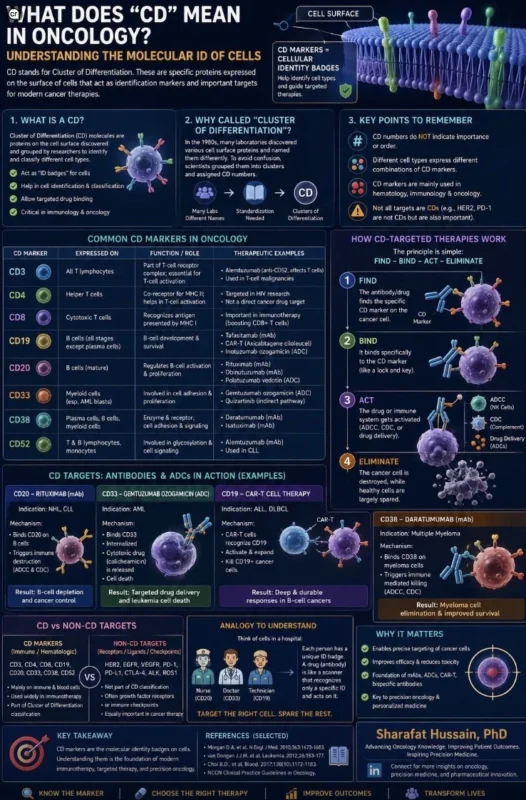
CD stands for Cluster of Differentiation.
These are specific proteins found on the surface of cells that act as biological identification markers. Think of them as the molecular ID cards of our cells. Different cell types express different combinations of CD markers, allowing scientists and clinicians to identify them accurately.
Beyond identifying cells, these markers have become some of the most important therapeutic targets in modern oncology.
For example:
- CD20 is expressed on mature B lymphocytes. The monoclonal antibody Rituximab binds specifically to CD20, enabling the immune system to recognize and eliminate malignant B cells in many lymphomas and leukemias.
- CD33 is commonly expressed on acute myeloid leukemia (AML) cells. Antibody-drug conjugates (ADCs) targeting CD33 deliver a potent cytotoxic payload directly into leukemia cells, maximizing efficacy while minimizing damage to healthy tissues.
- CD19 is another hallmark B-cell marker and has become one of the most successful therapeutic targets, giving rise to monoclonal antibodies, ADCs, bispecific antibodies, and CAR-T cell therapies.
One common misconception is that all therapeutic targets are CD markers. This is not the case.
Many important targets, such as HER2, EGFR, VEGFR, PD-1, and PD-L1, are also proteins on the cell surface, but they belong to different biological families. They are receptors or immune regulatory molecules rather than members of the Cluster of Differentiation classification.
The underlying principle, however, remains the same: identify a unique molecule on cancer cells and design a therapy that selectively binds to it.
This strategy has transformed cancer treatment. Instead of attacking all rapidly dividing cells – as conventional chemotherapy does – targeted therapies focus on specific molecular signatures, improving precision while often reducing off-target toxicity.
Understanding CD markers is therefore much more than learning scientific terminology. It is the foundation for understanding monoclonal antibodies, antibody-drug conjugates (ADCs), bispecific antibodies, CAR-T cell therapy, and the broader era of precision oncology.
As oncology continues to evolve, mastering these molecular targets will become increasingly important for physicians, pharmacists, researchers, and the pharmaceutical industry alike.
Knowledge of cancer biology is no longer optional – it is the language of modern oncology.”
Other articles about CD markers on OncoDaily.