Sendurai Mani, Associate Director of Translational Oncology at the Legorreta Cancer Center, is presenting a series exploring some of the most influential scientific papers that have shaped the field of cancer research on LinkedIn:
I recently shared an AI-generated (Claude) list of the top 200 papers that have shaped cancer research on LinkedIn. Today, I share more about Paper 9.
Paper 9: A Single-Point Mutation That Helped Explain How a Human Oncogene Is Activated
Can changing a single nucleotide turn a normal human gene into a cancer-driving oncogene?
In 1982, Clifford Tabin, Robert Weinberg (my postdoctoral mentor), and colleagues published a landmark paper in Nature that helped answer this question.
Researchers already knew that DNA from certain human cancer cells could transform normal cells in laboratory experiments. But a fundamental mystery remained:
What was actually different about the cancer-causing gene?
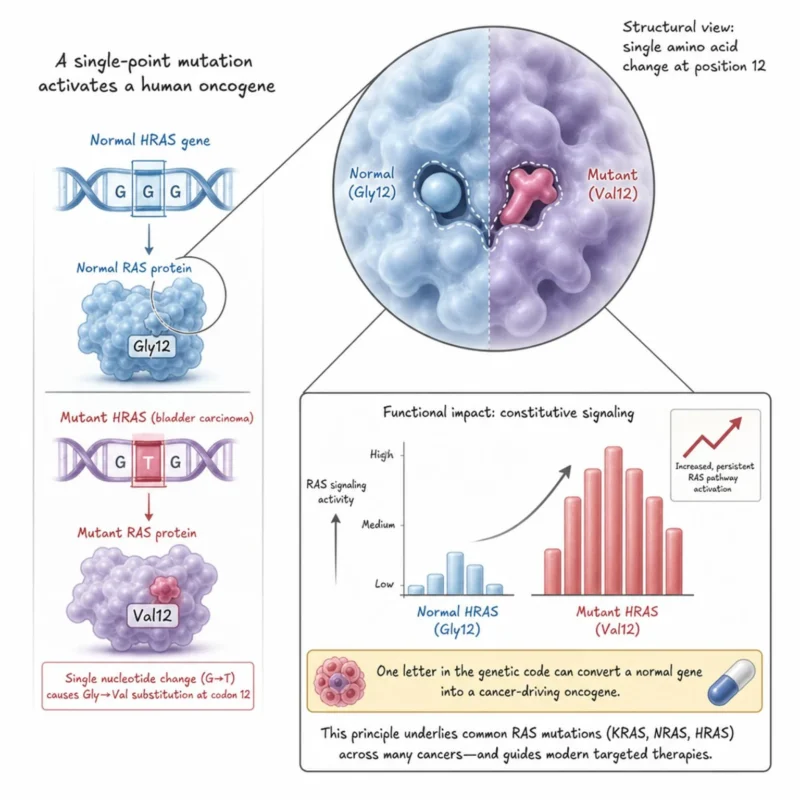
The Weinberg and team compared the transforming HRAS gene from a human bladder carcinoma with its normal counterpart.
The difference was remarkably small.
A single nucleotide substitution changed codon 12 of HRAS, resulting in the replacement of glycine with valine in the RAS protein.
One tiny change in DNA was enough to dramatically alter the gene’s biological behavior. This was a major conceptual advance.
Cancer did not necessarily require the acquisition of completely foreign genes or massive genetic alterations. A normal cellular gene could become oncogenic through something as subtle as a single-point mutation.
The discovery helped establish a principle that now sits at the center of cancer genomics: Specific mutations can activate proto-oncogenes and drive malignant transformation. We now know that RAS pathway mutations are among the most common oncogenic alterations in human cancer, with KRAS, NRAS, and HRAS playing important roles across many tumor types.
And four decades later, the story has come full circle.
RAS was once considered extraordinarily difficult to target therapeutically. Today, drugs targeting specific mutant forms of RAS, particularly KRAS G12C and, more recently, other RAS alterations, have translated this foundational biology into new treatment strategies.
The enduring lesson: sometimes the difference between normal growth and cancer is not an entirely new gene, it can be a single letter in the genetic code.
Title: Mechanism of activation of a human oncogene
Authors: Clifford J. Tabin, Scott M. Bradley, Cornelia I. Bargmann, Robert A. Weinberg, Alex G. Papageorge, Edward M. Scolnick, Ravi Dhar, Douglas R. Lowy, Esther H. Chang