






Sendurai Mani, Associate Director of Translational Oncology at Legorreta Cancer Center, shared on LinkedIn:
“Top 200 most influential cancer papers – Paper number 64: BCR-ABL – proving that the Philadelphia chromosome fusion can cause CML-like leukemia.
I recently shared an AI-generated (Claude) list of the top 200 papers that have shaped cancer research on LinkedIn:
Read the previous post to explore the full list of 200 papers․
Today, I share more about Paper number 64.
Scientists had identified BCR-ABL in CML.
But was the fusion simply associated with leukemia – or could it actually cause the disease?
In 1990, George Daley, Richard Van Etten and David Baltimore published a landmark Science paper providing powerful experimental evidence.
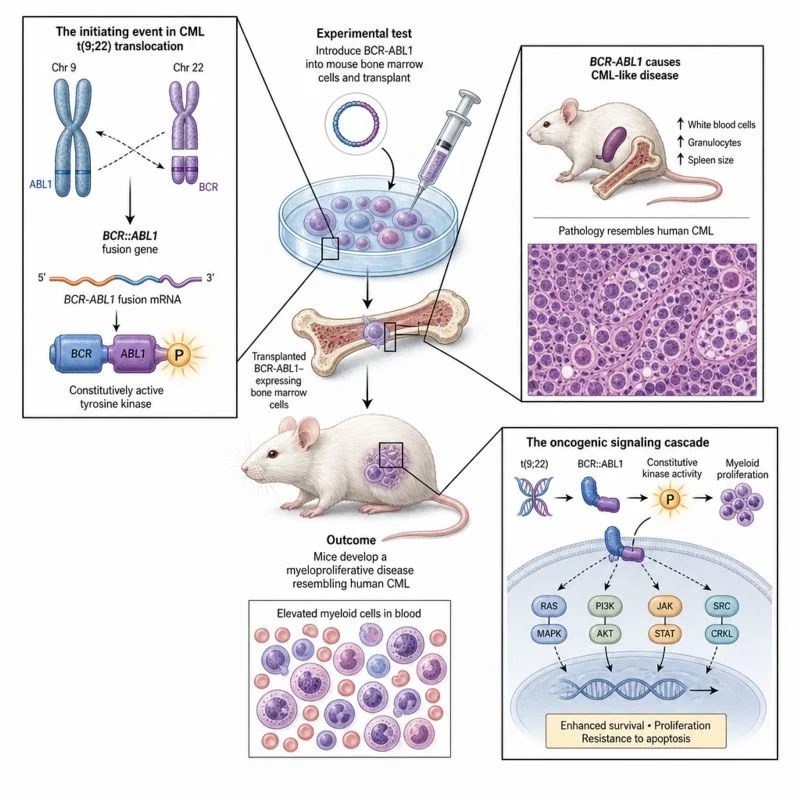
They introduced the BCR-ABL fusion gene into mouse bone marrow cells using a retroviral system and transplanted those cells into mice.
The result was striking.
The animals developed several hematologic malignancies, including a CML-like myeloproliferative disease.
This provided crucial functional evidence that BCR-ABL was not merely a molecular marker.
It was oncogenic.
The chain of evidence had become remarkably complete: Philadelphia chromosome leads to BCR-ABL fusion, leading to abnormal tyrosine kinase activity and leukemia in vivo.
This distinction matters enormously in cancer research.
Finding a recurrent alteration tells us that it may be important.
Demonstrating that the alteration can drive disease provides evidence of causality.
That understanding later made BCR-ABL an exceptionally compelling therapeutic target.
The development of imatinib and subsequent BCR-ABL inhibitors transformed CML from a frequently fatal leukemia into a disease that can often be controlled long-term with targeted therapy.
The progression across Papers number 62-64 is a blueprint for precision oncology: Identify the molecular alteration, understand its function, prove its oncogenic role, and target the dependency.
The enduring lesson: The strongest cancer targets are not simply associated with disease – they sit at the biological heart of what drives it.”
Title: Induction of Chronic Myelogenous Leukemia in Mice by the P210bcr/abl Gene of the Philadelphia Chromosome
Authors: George Q. Daley, Richard A. Van Etten, and David Baltimore
Other articles about chronic myeloid leukemia and BCR-ABL on OncoDaily.