Calculators
 OncoCalendar






Sendurai Mani, Associate Director of Translational Oncology at Legorreta Cancer Center, shared on LinkedIn:
“Top 200 most influential cancer papers – Paper 4: The discovery of PD-1, the second pillar of the checkpoint inhibitor revolution
I recently shared an AI-generated (Claude) list of the top 200 papers that have shaped cancer research. Today, I share more about Paper 4.
What if one of the most important targets in modern cancer therapy was discovered while scientists were studying cell death rather than cancer?
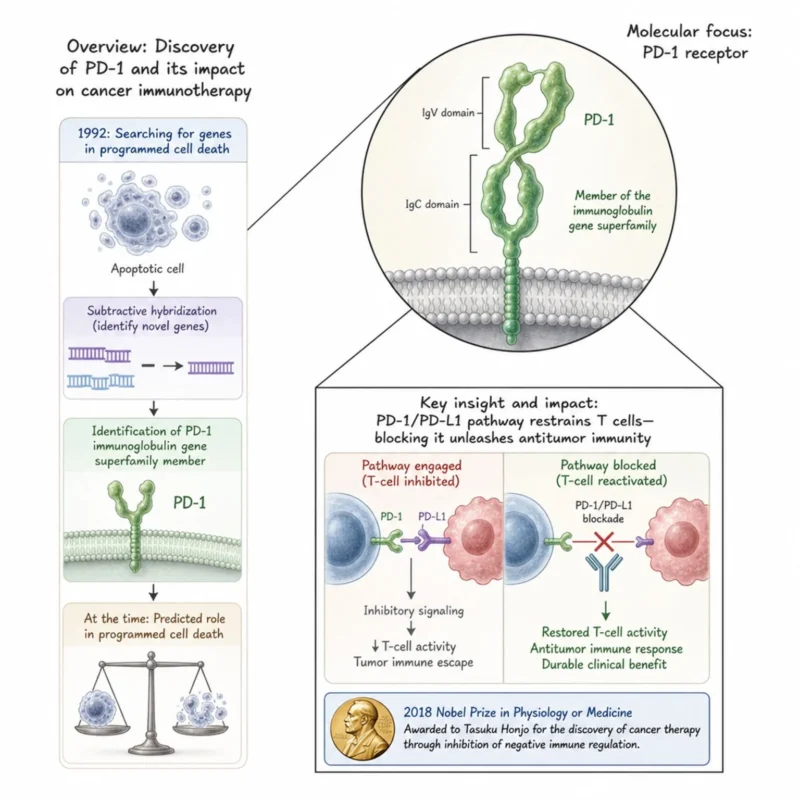
In 1992, Yasumasa Ishida, Yasutoshi Agata, Keiichi Shibahara, and Tasuku Honjo reported the discovery of a previously unknown gene that they called PD-1 (Programmed Death-1).
Using subtractive hybridization, the researchers sought genes associated with programmed cell death. They identified PD-1 in two different mouse cell lines undergoing classical programmed cell death and found that the predicted protein belonged to the immunoglobulin gene superfamily.
At the time, its future importance in cancer was impossible to foresee.
The original paper suggested that PD-1 might participate in programmed cell death. Subsequent work, however, revealed something even more consequential: PD-1 functions as an inhibitory receptor that helps restrain immune responses.
That discovery eventually transformed cancer immunology.
Tumors can exploit the PD-1/PD-L1 pathway to suppress T-cell activity and escape immune attack. Blocking this checkpoint can restore antitumor immune responses, a principle that ultimately led to the development of PD-1/PD-L1 checkpoint inhibitors and durable responses in patients with multiple cancer types.
Together with CTLA-4, PD-1 became one of the central pillars of the immune checkpoint revolution. Tasuku Honjo later shared the 2018 Nobel Prize in Physiology or Medicine for the discovery of cancer therapy through inhibition of negative immune regulation.
The enduring lesson is one of my favorites in science: a discovery need not begin with cancer to transform cancer treatment. Fundamental biology, followed far enough, can open therapeutic doors that were never visible at the start.”
Title: Induced expression of PD-1, a novel member of the immunoglobulin gene superfamily, upon programmed cell death.
Authors: Ishida Y, Agata Y, Shibahara K, Honjo T
____ ____ ____
You can also read ‘PD-L1, MSI, and TMB: How to Think About Immunotherapy Biomarkers in Clinical Practice – A Practical Guide for Residents‘