Revolution Medicines shared on LinkedIn:
“Tomorrow at the 2026 EORTC-NCI-AACR Symposium (ENA), we will present updated results from the Phase 1/2 RMC-GI-102 study investigating our multi-selective RAS(ON) inhibitor in combination with gemcitabine and nab-paclitaxel (GnP) in patients with treatment-naïve metastatic pancreatic cancer.”
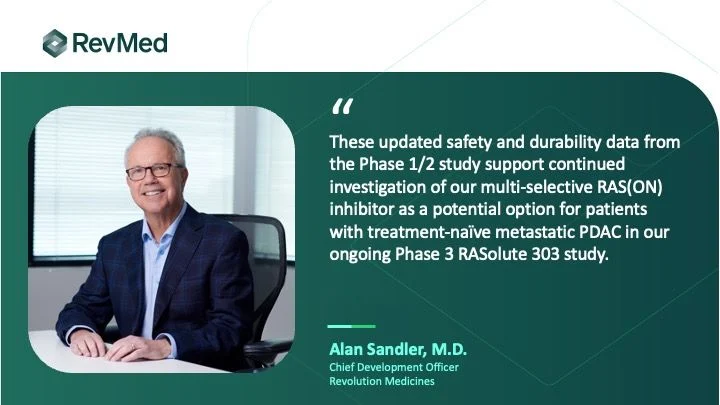
Quoting Alan Sandler, Chief Development Officer of Revolution Medicines:
These updated safety and durability data from the Phase 1/2 study support continued investigation of our multi-selective RAS(ON) inhibitor as a potential option for patients with treatment-naïve metastatic PDAC in our ongoing Phase 3 RASolute 303 study.
Main findings of RMC-GI-102 study
- Revolution Medicines presented updated Phase 1/2 results from the RMC-GI-102 trial evaluating RASONQUE (daraxonrasib) plus gemcitabine and nab-paclitaxel (GnP) as a potential first-line treatment for patients with metastatic pancreatic ductal adenocarcinoma (PDAC) at the 2026 EORTC-NCI-AACR (ENA) Symposium in Barcelona, Spain.
- Daraxonrasib is an oral, direct RAS(ON) multi-selective inhibitor designed to block active RAS signaling, targeting a key cancer-driving mechanism in pancreatic cancer.
- The updated analysis included 61 patients, with a median follow-up of 18.3 months. The combination demonstrated a confirmed objective response rate of 60.7%, including 8.2% complete responses, a disease control rate of 90.2%, and median progression-free survival of 12.8 months.
- The 12-month overall survival rate was 76.6%, while the safety profile remained consistent with the previously established profiles of both agents. These findings support further evaluation in the ongoing Phase 3 RASolute 303 trial, which is investigating first-line treatment options for metastatic PDAC.
You may also be interested in:
Paolo Tarantino: 40 Years of Antibody-Drug Conjugates at the 2026 EORTC-NCI-AACR Symposium
New Daraxonrasib Combination Shows 60.7% Response Rate in Pancreatic Cancer