Ravindra Kolhe, Professor Of Pathology at Medical College of Georgia at Augusta University, shared on LinkedIn:
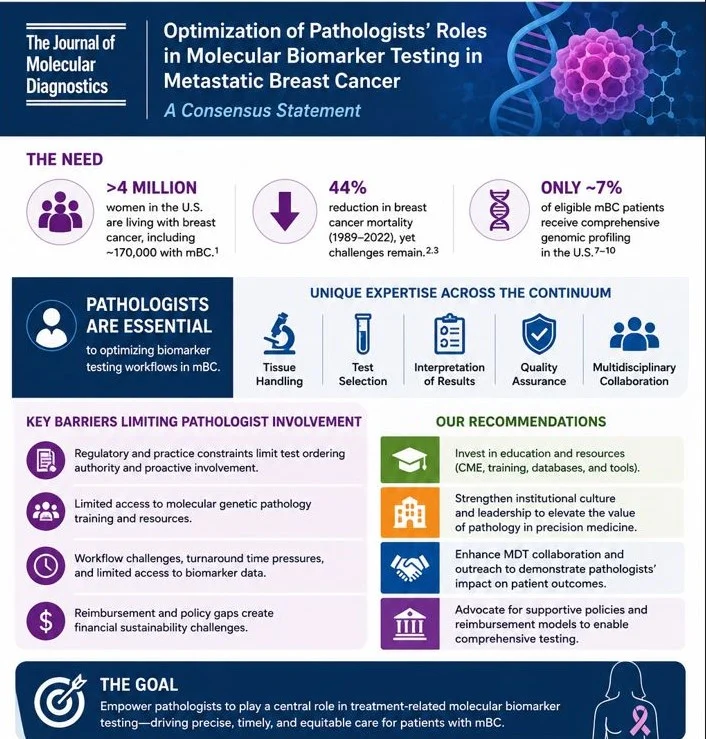
“Only 7% of eligible patients with metastatic breast cancer (mBC) receive comprehensive genomic profiling. The bottleneck isn’t the technology-it’s systemic.
In our newly published consensus statement in The Journal of Molecular Diagnostics, my co-authors (Cansu Karakas, Eric Vail, Georgios Deftereos, and Nikoletta Sidiropoulos) and I address this critical care gap.
While next-generation sequencing (NGS) allows us to target precise mutational landscapes, institutional workflows often restrict pathologists to a backend consultative role. Pathologists are uniquely positioned to manage tissue stewardship and direct assay selection. Ensuring equitable, high-quality cancer care requires integrating our diagnostic insights directly into the active clinical timeline. Through qualitative interviews with US-based pathologists, we identified a clear roadmap to move pathology from passive interpretation to proactive leadership. When pathologists actively lead testing strategy, patients gain preserved tissue, zero redundant testing, and significantly reduced turnaround times.
To close the testing gap, we outline 4 strategic pillars:
- Resources and Education: Integrate molecular pathology into core workflows and bring testing in-house to build local expertise.
- Institutional Leadership: Expand active tumor board participation and advocate for standardized, upfront reflex testing protocols.
- MDT Collaboration: Strengthen proactive outreach between pathology and medical oncology to streamline complex NGS interpretation.
- Policy and Insurance: Deploy economic modeling to prove the long-term cost-effectiveness of comprehensive upfront testing.”
To which Svetlana Nikic, Founder of Precision Oncology Consulting, added:
“Thanks for sharing Ravindra Kolhe.
Molecular tumor boards were absent in 4/19 and additionaly 5/19 pathologists did not participate MTBs – really shocking to learn this is still happening across US healthcare system.
For all of you interested in comprehensive genomic profiling CGP across US, this an important read highlighting key barriers to wider adoption of CGP testing – the authors report that in case of mBC patients only 7% benefit from this comprehensive molecular profiling, while we know that many guidelines already recommend broad/multi/CGP for patients with advanced disease.”
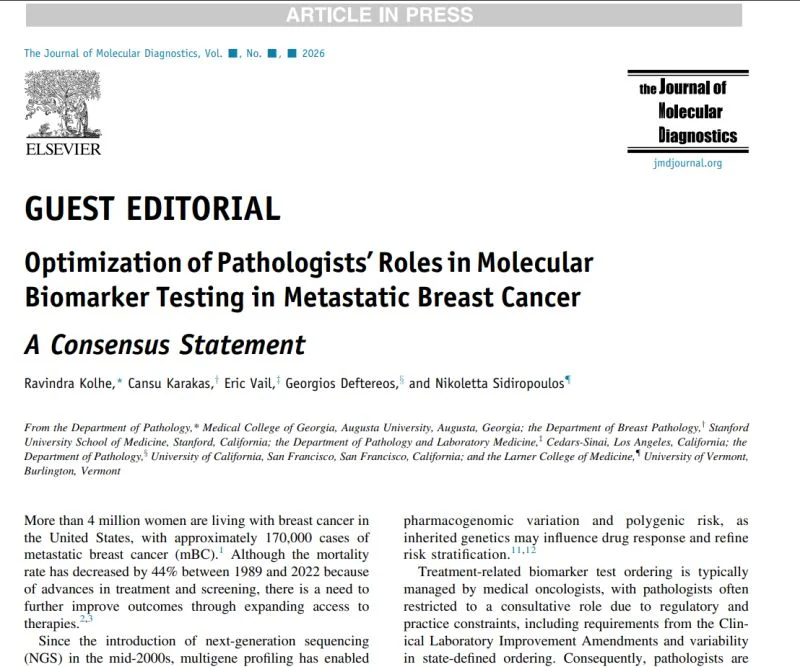
Title: Optimization of Pathologists’ Roles in Molecular Biomarker Testing in Metastatic Breast Cancer
Authors: Ravindra Kolhe, Cansu Karakas, Eric Vail, Georgios Deftereos, Nikoletta Sidiropoulos.
Read the full article.
You might find this interesting: