






Rachel Wang, Founder and Principal Consultant at Polaris BioStrategy, shared a post on LinkedIn:
“ADCs are built to kill tumor cells. My immunologist brain keeps asking a different question: what does the tumor microenvironment look like after the fire?
A major, localized wave of tumor-cell injury is not an immunologically quiet event. What signals are now being exposed or released? Which immune cells nearby have changed state? Has treatment created a new vulnerability that was not obvious in the untreated tumor?
A recent Nature Communications paper on trastuzumab deruxtecan (T-DXd) showed the kind of post-ADC immune landscape I had been curious about. Following DXd-mediated tumor injury, tumor cells released extracellular ATP and HMGB1 and exposed calreticulin – hallmarks associated with immunogenic cell death.
Nearby macrophages did not stay quiet. They upregulated HLA-A2, HLA-DR, CD80, CD40 and CCR7, shifting toward a more activated, antigen-presenting phenotype. The study further connected this myeloid response to tumor-antigen presentation and tumor-specific CD8 T-cell activation.
In other words, the ADC had done more than kill tumor cells. It had created a new immune landscape.
Then comes the question I find especially interesting: can we leverage the immune state that the ADC has just created?
In this study, the authors followed the CD47/SIRPα axis. DXd increased tumor-cell CD47, potentially applying a ‘don’t eat me’ brake just as surface calreticulin and antibody-mediated opsonization were creating a pro-phagocytic context. Disrupting the CD47 axis enhanced macrophage activation, antigen presentation and antitumor activity in their mouse models.
CD47 was a biologically reasoned lever in this system. But the broader question stays with me.
Would a different target, payload, tumor type or treatment context create the same post-ADC immune landscape? Probably not. Even in this study, DXd and DM1 did not create identical post-treatment immune features.
We spend tremendous effort improving tumor penetration, internalization and payload delivery. I wonder whether post-ADC immune characterization deserves equally deliberate attention – not simply to document ‘immune activation,’ but to understand the new immune state created by treatment and identify what may now be limiting it.
After the fire, what did the ADC turn the tumor into – and what newly exposed vulnerability can we leverage next?”
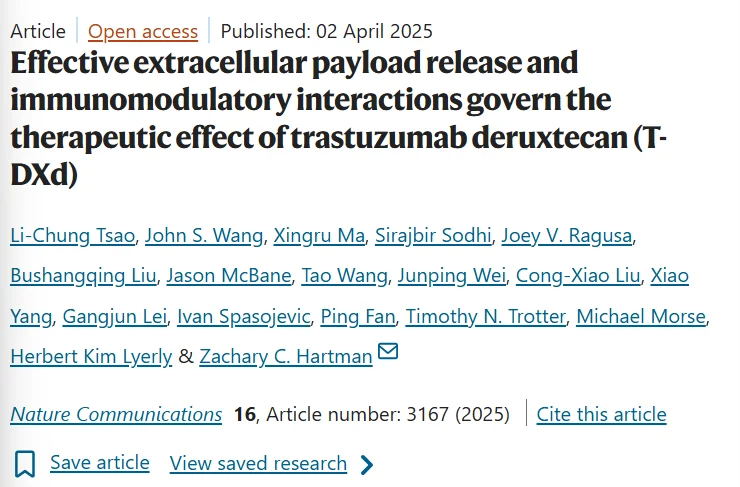
Title: Effective extracellular payload release and immunomodulatory interactions govern the therapeutic effect of trastuzumab deruxtecan (T-DXd)
Authors: Li-Chung Tsao, John S. Wang, Xingru Ma, Sirajbir Sodhi, Joey V. Ragusa, Bushangqing Liu, Jason McBane, Tao Wang, Junping Wei, Cong-Xiao Liu, Xiao Yang, Gangjun Lei, Ivan Spasojevic, Ping Fan, Timothy N. Trotter, Michael Morse, Herbert Kim Lyerly, Zachary C. Hartman
Other articles about Antibody Drug Conjugates (ADCs) on OncoDaily.