Oncogene Cancer Research shared on LinkedIn:
“What happens when osimertinib stops working?
That is a big concern for many people in our EGFR community. For many people living with EGFR-mutated lung cancer, osimertinib can be incredibly effective. But unfortunately, it doesn’t work forever. When the cancer becomes resistant, finding the next treatment can be challenging.
A new study has taken a completely different approach.
Instead of trying to block EGFR again, researchers designed antibodies that remove the EGFR protein from cancer cells altogether.
In laboratory and mouse studies, these antibodies:
- Destroyed EGFR, rather than simply blocking it
- Continued to work in cancer cells that had become resistant to osimertinib
- Performed better than osimertinib alone in preclinical models, with even greater effects when used in combination
This is still early-stage research and it hasn’t yet been tested in people. But it’s exciting because it represents a completely new way of tackling treatment resistance—not just another version of the same type of drug.
Every new discovery like this brings us one step closer to more options for people living with EGFR lung cancer.”
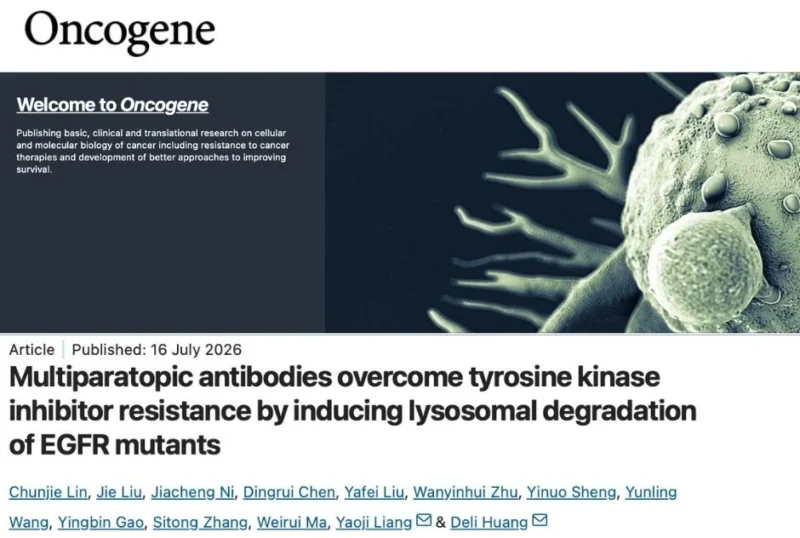
Title: Multiparatopic antibodies overcome tyrosine kinase inhibitor resistance by inducing lysosomal degradation of EGFR mutants
Authors: Chunjie Lin, Jie Liu, Jiacheng Ni, Dingrui Chen, Yafei Liu, Wanyinhui Zhu, Yinuo Sheng, Yunling Wang, Yingbin Gao, Sitong Zhang, Weirui Ma, Yaoji Liang, Deli Huang
Read the full article in Nature Portfolio’s Oncogene.