Olubukola Ayodele, Breast Cancer Lead at University Hospitals of Leicester NHS Trust, shared on LinkedIn:
“The axilla is probably undergoing one of the biggest shifts in breast cancer surgery at the moment.
Axillary surgery is moving from
‘How much surgery does this patient need?’
towards
‘Does this patient need axillary surgery at all, and will the information change what we do?’
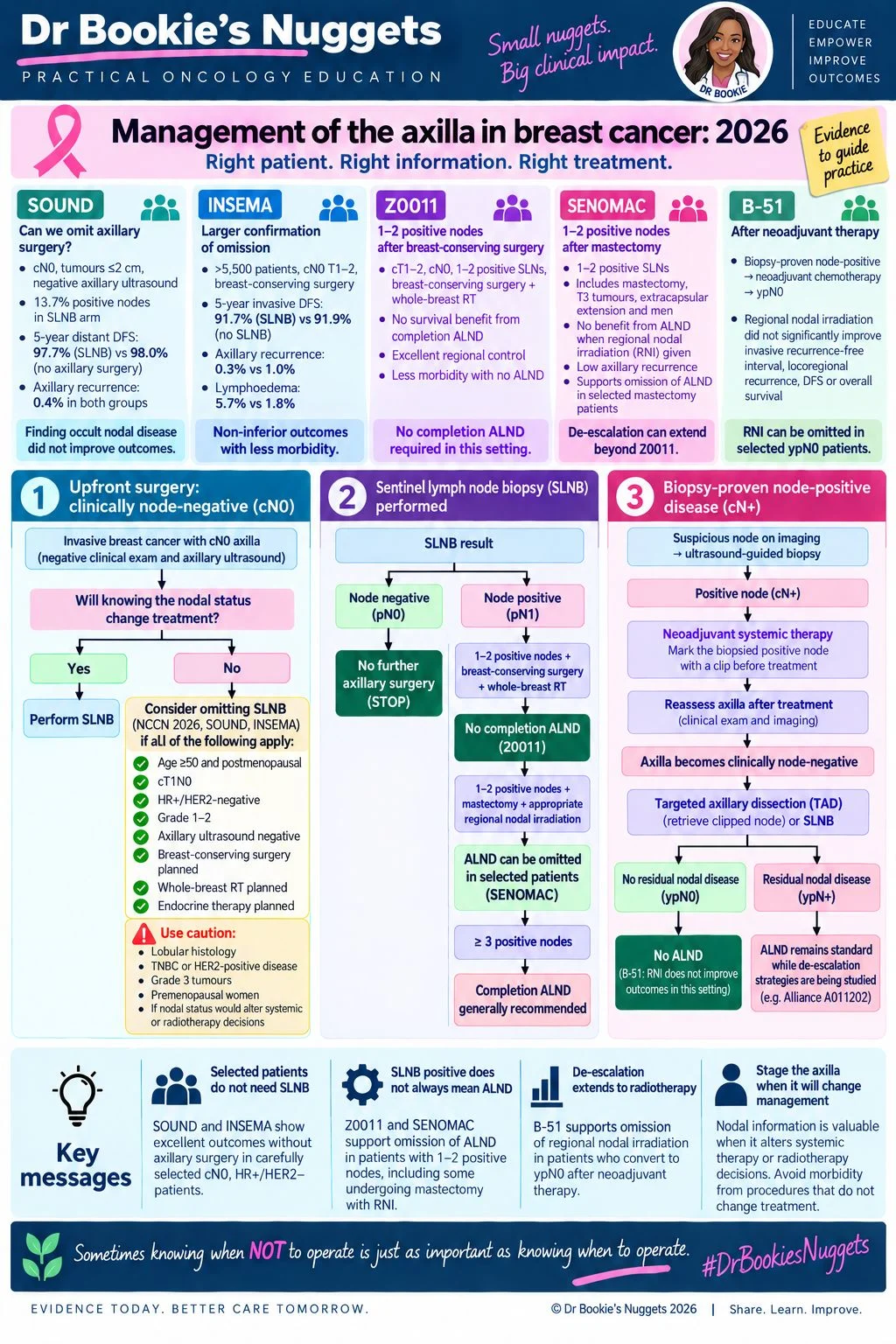
The 2026 NCCN breast cancer guidelines have moved us another step towards axillary de-escalation, and two trials help explain why. SOUND and INSEMA
SOUND enrolled women with tumours ≤2 cm, clinically node-negative disease and a negative axillary ultrasound.
Despite 13.7% of those undergoing sentinel lymph node biopsy (SLNB) having positive nodes, 5-year distant disease-free survival was 97.7% with SLNB vs 98.0% without axillary surgery.
Finding occult nodal disease did not improve outcomes. Then came INSEMA, with over 5,500 patients with cN0 T1–2 disease undergoing breast-conserving surgery.
At 5 years:
- Invasive DFS: 91.7% with SLNB vs 91.9% without
- Axillary recurrence: 0.3% vs 1.0%
- Lymphoedema: 5.7% vs 1.8%
Omitting SLNB was non-inferior, with less arm morbidity. So what has NCCN changed?
The 2026 pathway now allows consideration of omitting SLNB in selected patients who are:
- >50 AND postmenopausal
- cT1N0
- HR+/HER2-negative
- Grade 1–2
- Axillary ultrasound negative
- Receiving whole-breast RT and endocrine therapy
Caution is advised with lobular histology. But where does this fit into everything else we have learned about the axilla?
My 2026 practical algorithm
cN0 + favourable HR+/HER2− disease
- Will nodal status change treatment? If NCCN/SOUND/INSEMA criteria are met and the answer is no: consider omitting SLNB
If SLNB is performed
- Node negative: STOP
- 1–2 positive nodes + breast-conserving surgery/whole-breast RT: no ALND (Z0011)
- 1–2 positive nodes + mastectomy + appropriate regional nodal irradiation: ALND can be omitted in selected patients (SENOMAC)
- ≥3 positive nodes: ALND generally remains standard
Biopsy-proven node-positive → neoadjuvant systemic therapy
- Mark the positive node before treatment
- If the axilla becomes clinically node-negative: targeted axillary dissection/SLNB
- ypN0: no ALND
- ypN+: ALND remains standard while de-escalation is being studied
And B-51 takes us further: in patients converting from biopsy-proven node-positive disease to ypN0 after neoadjuvant chemotherapy, regional nodal irradiation did not improve recurrence or survival outcomes.
For years, we asked:
‘What is in the axilla?’
In 2026, the better question is:
‘Will knowing what is in the axilla change what I do for this patient?’
If the answer is no, we should question the value of performing a procedure simply to obtain information we will not use.
Sometimes knowing when NOT to operate is just as important as knowing when to operate.”
You can also read: