
The FDA’s accelerated approval of camizestrant on September 4, 2026, represents more than the introduction of another endocrine therapy for hormone receptor positive, HER2-negative advanced breast cancer. It introduces a fundamentally different treatment strategy in which emerging endocrine resistance can trigger therapeutic intervention before conventional radiographic progression becomes evident.
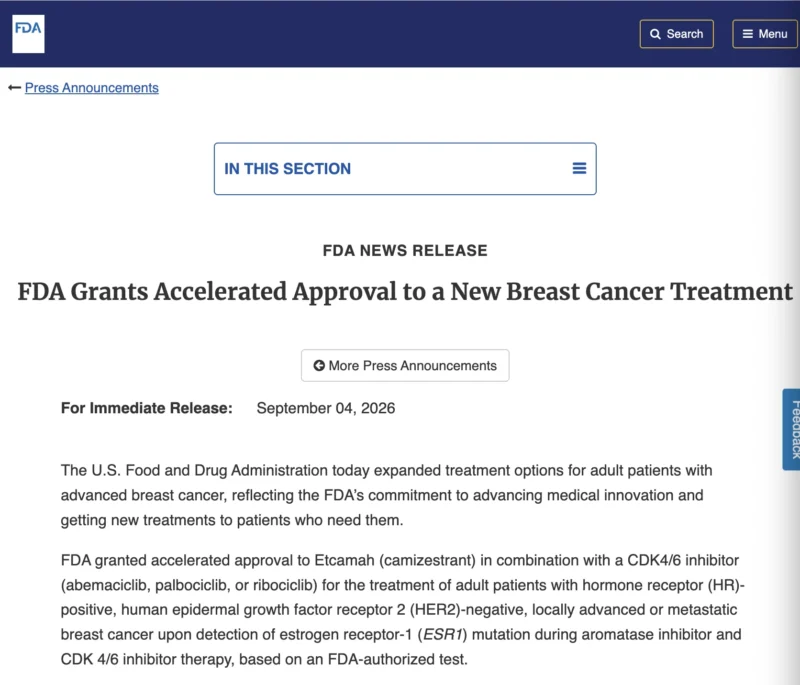
Camizestrant, marketed as Etcamah, was approved in combination with a CDK4/6 inhibitor abemaciclib, palbociclib, or ribociclib, for adults with HR-positive, HER2-negative locally advanced or metastatic breast cancer in whom an ESR1 mutation is detected during treatment with an aromatase inhibitor and a CDK4/6 inhibitor, using an FDA-authorized test. The FDA simultaneously authorized Guardant360 CDx as the companion diagnostic for identifying eligible ESR1 mutations.
The regulatory significance of this decision extends beyond the drug itself. According to the FDA, this is the first cancer therapy approved on the basis of detecting an acquired resistance mutation in circulating tumor DNA before imaging demonstrates disease progression. In practical terms, the approval introduces molecular evolution as a potential trigger for changing systemic treatment.
ESR1 Mutations as an Early Marker of Endocrine Resistance
ESR1 mutations are among the best-characterized mechanisms of acquired resistance to aromatase inhibitors in HR-positive metastatic breast cancer. They are uncommon at the time metastatic disease is initially diagnosed, occurring in fewer than 5% of patients according to the FDA, but become substantially more frequent under the selective pressure of aromatase inhibitor therapy. After progression on an aromatase inhibitor, ESR1 mutations can be detected in nearly 40% of patients.
These mutations alter the estrogen receptor in a way that can enable ligand-independent signaling, thereby reducing dependence on estrogen availability and undermining the therapeutic effect of aromatase inhibition. Importantly, emergence of an ESR1-mutant clone is a dynamic process. A tumor that is ESR1 wild-type at treatment initiation may develop a detectable resistant subclone months or years later.
Historically, clinicians have generally continued aromatase inhibitor plus CDK4/6 inhibition until radiographic or clinical progression, at which point subsequent endocrine therapy is selected according to the molecular and clinical characteristics of the disease. The camizestrant approval challenges this sequence by introducing the possibility that treatment should be adapted when molecular resistance first becomes detectable rather than when it has already produced measurable disease progression.
A Strategy of Early Molecular Intervention
The therapeutic concept underlying the approval is particularly important. When an ESR1 mutation is detected during ongoing aromatase inhibitor plus CDK4/6 inhibitor therapy, the CDK4/6 inhibitor is maintained while the endocrine component is changed from the aromatase inhibitor to camizestrant.
This is not equivalent to conventional second-line treatment after progression. Instead, it represents selective replacement of the component against which resistance is emerging while preserving a treatment component that may still be providing meaningful disease control.
The randomized study supporting the approval compared early switching to camizestrant plus continued CDK4/6 inhibition with continuation of the existing aromatase inhibitor plus CDK4/6 inhibitor strategy. Median progression-free survival, measured from detection of the ESR1 mutation, was 16.0 months with camizestrant plus a CDK4/6 inhibitor compared with 9.2 months with continued aromatase inhibitor plus CDK4/6 inhibition.
The approximately 6.8-month difference in median PFS is clinically relevant, but the most distinctive element of the study is the timing of treatment modification. The intervention occurred while the disease remained radiographically controlled, meaning that molecular evidence of resistance preceded the conventional clinical indication to change therapy.
ctDNA Moves From Genomic Profiling to Dynamic Treatment Guidance
Liquid biopsy has already become an important component of metastatic breast cancer management, particularly for identifying actionable alterations such as ESR1 and PIK3CA mutations. Until now, however, molecular testing has commonly been performed at diagnosis or after documented progression to help select the next treatment.
The camizestrant strategy introduces a different use of ctDNA: longitudinal monitoring of tumor evolution during active therapy.
This distinction is potentially consequential. Imaging determines whether the disease has already changed anatomically, whereas serial ctDNA testing may reveal that the tumor is evolving biologically before that change becomes visible. Treatment can therefore potentially shift from a reactive model, in which therapy is modified after progression, toward an adaptive model in which emerging resistance is intercepted earlier.
The FDA’s authorization of Guardant360 CDx as a companion diagnostic further emphasizes that biomarker testing is not ancillary to this strategy; it is integral to treatment selection. Eligibility for therapy is created dynamically when the relevant resistance mutation becomes detectable.
Molecular Progression and Radiographic Progression Are No Longer the Same Event
The approval also highlights an emerging distinction between molecular and radiographic progression. These events may occur at different points in the natural history of metastatic disease.
An ESR1-mutant clone can become detectable in blood while tumor measurements on imaging remain stable. If that clone subsequently expands, clinical or radiographic progression may follow. The central hypothesis behind early switching is that intervening during this molecular window may prolong the period of disease control.
This approach could redefine how oncologists think about resistance. Instead of asking only whether a tumor has progressed, the clinically relevant question may increasingly become whether the tumor is evolving toward progression in a therapeutically actionable way.
However, that concept also creates new practical questions. The optimal interval for ctDNA monitoring, the significance of very low-level mutations, the reproducibility of serial testing, and the management of molecular changes without radiographic progression will require careful definition. The camizestrant indication provides a validated setting in which ctDNA-guided intervention can now be used, but it should not be extrapolated to every molecular alteration or every malignancy.
Continuing CDK4/6 Inhibition Reflects the Biology of Selective Resistance
Another notable feature of the approval is the continuation of CDK4/6 inhibition after ESR1 mutation detection. The emergence of endocrine resistance does not necessarily mean that all components of the existing regimen have lost activity.
By maintaining abemaciclib, palbociclib, or ribociclib while changing the endocrine partner, the strategy attempts to preserve ongoing cell-cycle suppression while replacing the endocrine therapy against which resistance has evolved.
This approach reflects an increasingly sophisticated understanding of tumor evolution. Resistance may be pathway-specific rather than representing complete failure of an entire combination regimen. As longitudinal molecular monitoring becomes more common, treatment adaptation may increasingly focus on replacing the failing component rather than automatically abandoning the entire therapeutic backbone.
Accelerated Approval Leaves a Critical Question Unresolved
The FDA granted camizestrant accelerated approval on the basis of improvement in progression-free survival after molecular detection of ESR1 resistance. Importantly, the agency also emphasized that it remains uncertain whether changing treatment at the moment of molecular progression, rather than waiting for confirmed radiographic progression, ultimately produces a clinically meaningful long-term benefit.
That uncertainty is fundamental to the interpretation of the approval.
Starting a new treatment earlier can delay the time to the next radiographic progression when measured from the earlier intervention point, but the clinically important question is whether this strategy improves the overall course of disease compared with changing therapy later. Confirmatory studies will therefore need to determine whether early molecular intervention improves outcomes such as time to subsequent progression, quality of life, treatment sequencing, and potentially overall survival.
For this reason, the approval should be regarded as both a therapeutic advance and a test of a broader clinical paradigm.
Safety and Practical Implementation
Camizestrant is administered orally, but the FDA announcement highlights clinically relevant safety considerations. The prescribing information includes a boxed warning regarding the risk of abnormal heart rhythm when camizestrant is used with certain medications, as well as warnings related to bradycardia and embryo-fetal toxicity.
These considerations are particularly important because camizestrant is used in combination with CDK4/6 inhibitors, which themselves have drug-specific safety profiles and potential pharmacologic interactions. Appropriate medication review, cardiac assessment when indicated, and attention to combination-specific toxicity will therefore be essential when incorporating this strategy into clinical practice.
The practical implementation of ctDNA-guided switching will also require a clear testing pathway. Unlike one-time genomic profiling, this model depends on repeated assessment during treatment, meaning that timing, accessibility, reimbursement, and interpretation of serial liquid biopsy will become increasingly relevant aspects of care.
A Broader Shift in Precision Oncology
The deeper importance of the camizestrant approval may lie in what it suggests about the future of precision oncology.
Historically, precision medicine has relied heavily on static tumor characterization: a biopsy is obtained, an actionable alteration is identified, and treatment is selected accordingly. Metastatic cancer, however, evolves continuously under therapeutic pressure. Resistant subclones emerge and expand, often before conventional imaging can demonstrate their clinical consequences.
ctDNA offers the possibility of following that evolution in real time.
In this model, molecular testing is no longer simply a diagnostic event. It becomes part of an ongoing feedback loop in which treatment itself changes tumor biology, molecular monitoring identifies the resulting resistance, and therapy is subsequently adapted.
Camizestrant provides the first FDA-approved example of this concept being used to change cancer treatment before radiographic progression.
The Bottom Line
The FDA’s accelerated approval of camizestrant plus continued CDK4/6 inhibition for ESR1-mutant HR-positive, HER2-negative advanced breast cancer represents an important development in endocrine therapy, but its broader significance lies in the treatment strategy it validates.
In the randomized study supporting the approval, switching from an aromatase inhibitor to camizestrant after ESR1 mutation detection increased median progression-free survival from 9.2 months to 16.0 months, while the existing CDK4/6 inhibitor was continued.
For the first time, an FDA-approved cancer treatment can therefore be initiated on the basis of an acquired resistance mutation detected in circulating tumor DNA before radiographic progression.
The strategy remains under accelerated approval, and confirmatory evidence is required to determine whether intervening at molecular progression ultimately provides meaningful long-term clinical benefit. Nevertheless, the regulatory precedent is significant. Breast cancer treatment is beginning to move beyond using biomarkers solely to describe the tumor at diagnosis or progression and toward using them to monitor how the tumor evolves during therapy.
The next phase of precision oncology may therefore be defined not only by choosing the right treatment for the right tumor, but by identifying the right moment to change treatment before resistance becomes clinically visible.
Reference
- U.S. Food and Drug Administration. FDA Grants Accelerated Approval to a New Breast Cancer Treatment. FDA News Release. September 4, 2026.