Olubukola Ayodele, Breast Cancer Lead at University Hospitals of Leicester NHS Trust, shared on LinkedIn:
“For years, metastatic triple-negative breast cancer (mTNBC) has been one of the most challenging breast cancer subtypes to treat. For patients who are not eligible for immunotherapy, chemotherapy has largely remained the standard first-line treatment.
That landscape has changed dramatically.
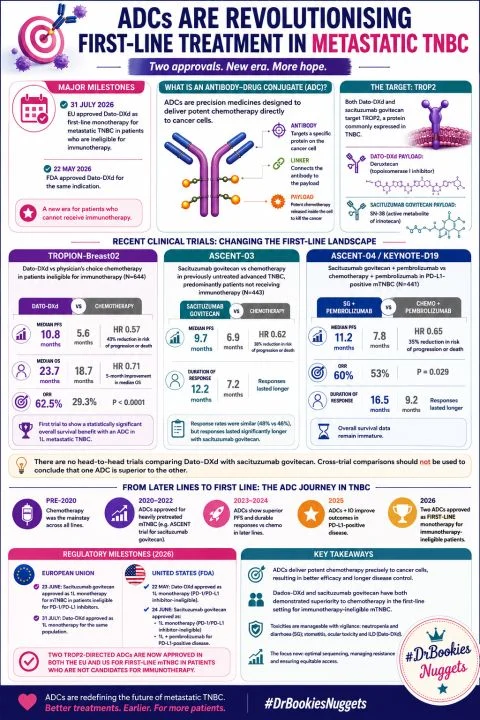
On 31st July 2026, the European Commission approved datopotamab deruxtecan (Dato-DXd) as first-line treatment for patients with unresectable or metastatic TNBC who are not candidates for PD-1/PD-L1 immunotherapy, following FDA approval in May. Earlier this year, both the EU and FDA also approved sacituzumab govitecan in the same setting.
For the first time, we now have two TROP2-directed antibody-drug conjugates (ADCs) approved in the first-line setting for patients ineligible for immunotherapy.
So, what is an ADC?
Think of it as guided chemotherapy (a Trojan horse). An antibody recognises a protein on the cancer cell, delivers a potent chemotherapy payload directly to it, and reduces unnecessary exposure to normal tissues.
The evidence behind this shift is compelling.
TROPION-Breast02 (Dato-DXd vs chemotherapy)
- FS: 10.8 vs 5.6 months (HR 0.57)
- OS: 23.7 vs 18.7 months (HR 0.71)
- ORR: 62.5% vs 29.3%
This was the first ADC to demonstrate a statistically significant overall survival benefit in first-line metastatic TNBC.
ASCENT-03 (Sacituzumab govitecan vs chemotherapy)
- PFS: 9.7 vs 6.9 months (HR 0.62)
- Duration of response: 12.2 vs 7.2 months
- Response rates were similar, but responses lasted substantially longer with sacituzumab govitecan.
ASCENT-04 / KEYNOTE-D19 (Sacituzumab govitecan + pembrolizumab)
- PFS: 11.2 vs 7.8 months (HR 0.65)
- ORR: 60% vs 53%
- Duration of response: 16.5 vs 9.2 months
- Overall survival data are still immature.
These are different clinical trials, so we should not make head-to-head comparisons between Dato-DXd and sacituzumab govitecan. However, together they tell an important story.
We are moving beyond sequential chemotherapy and towards precision drug delivery, selecting treatment based on tumour biology while improving disease control and, increasingly, survival.
ADCs are not ‘chemotherapy without toxicity.’Neutropenia and diarrhoea remain important with sacituzumab govitecan, while stomatitis, ocular toxicity and interstitial lung disease require careful monitoring with Dato-DXd.
The question is no longer whether ADCs have a role in metastatic TNBC. It is obvious. The next challenge is how we sequence them, overcome resistance and ensure equitable access for every eligible patient. It is important that we ensure that these effective agents are available to our patients as soon as possible, as many do not get to second line treatment or beyond.
Approval is only the start, access is the goal!”
TROPION-Breast01 Details Dato-DXd Safety and Patient-Reported Outcomes