The ESMO Congress 2026 is the annual meeting of the European Society for Medical Oncology. It stands as one of the world’s most influential oncology platforms for presenting pioneering cancer research. The event takes place from October 23 to 27, 2026, in Madrid, Spain, at the IFEMA MADRID convention center, utilizing a highly accessible hybrid (in-person and virtual) format.
Nicholas Hornstein, Assistant Professor at Northwell Health, shared his thoughts from ESMO 2026.
“ESMO26 is a wrap. A few thoughts.
It is a privilege to be an oncologist.
To everyone who took the time to meet with me, lend their expertise or mentor me in some way: Thank you. I am grateful. Also, to the patients who contributed their time, hope and lives to allow these studies to happen, thank you.
This is what allows progress.
- ESMO absolutely brought incredible advancements. So did China. This was the first global conference where the USA has clearly been dethroned as the de facto biomedical trial leader (5 of the 7 Presidential Symposium late-breakers focused on new drugs were Chinese developed). Chinese patients will be getting access to the latest biomedical advances, first.
- The molecular era is here for KRAS. Expect it to come to early lines, in every tumor, fast. Expect sexy combos. (I am personally very excited about Genmab + Incyte’s LGR5-EGFR + G12D but also think Verastem’s and RevMed’s G12D’s look great.)
- Some advances look meaningful but are minor. PD1-VEGF beats PD1, but it wasn’t compared to PD1 + VEGF. The benefit looks similar to adding bev (duh).
- Cellular therapy is finally here for solid tumors. Get your systems ready now, it takes years to truly prepare. The 66% response rate for TezR (SL-28) across all-comer solid tumors blew my mind.
- ADCs will hit CRC/GI quickly, and in a few years there will be many questions about sequencing. Please please please stop using the same payloads.
- Medical education is more important than ever with how fast the field is moving. If anyone has advice on how Gut Onc Lab can disseminate information better (like the people at Open Medicine and OncoAlert do), please let me know. Here’s to next year.
Already getting ready for ASCO GI.
Been chewing on non-GI data. This readout is in lung but highly relevant to high grade extrapulmonary NET.
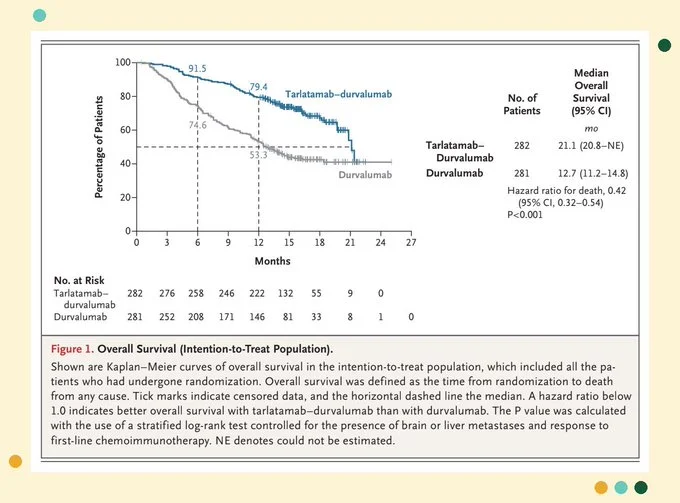
DeLLphi-305 at ESMO26. Tarlatamab, a DLL3 x CD3 T-cell engager, added to durvalumab as 1L maintenance in extensive-stage SCLC.
Design:
- Phase 3, randomized, open-label, n=563
- Durva + platinum/etoposide induction -> Durva + tarlatamab vs durva alone
- OS primary, interim analysis OS 21.1 vs 12.7 mo, HR 0.42, 12-mo OS 79% vs 53%
ES-SCLC survival creeping from around a year, now nearly at 2 years.
DLL3 isn’t a lung target, it’s a neuroendocrine one. (Right Udhayvir Grewal? This is your thing for sure).
Extrapulmonary NEC has the same story SCLC had: a short response to chemo, then minimal on-label options.
The catch is CRS and ICANS, so you need the infrastructure. Maintenance Tarla seem well worth the survival advantage.
Supportive care. Easy win for patients.
Looks like swapping olanzapine out for mirtazapine significantly reduces nausea. Relevant to every oncologist.
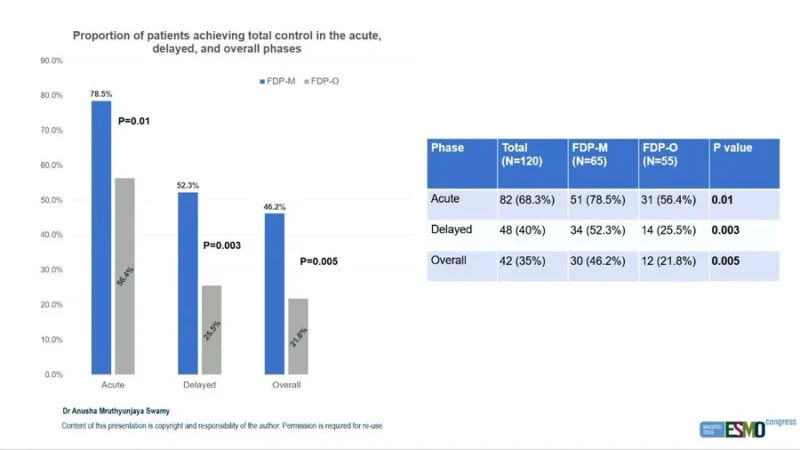
Randomized trial from India at ESMO26. 120 chemo-naive patients starting highly emetogenic chemo, randomized 1:1. Both arms got fosaprepitant + palonosetron + dex. Fourth drug was mirtazapine 15 mg vs olanzapine 5 mg, days 1–4.
Mirtazapine vs olanzapine:
- Acute 78.5% vs 56.4%, p=0.01
- Delayed 52.3% vs 25.5%, p=0.003
- Overall 46.2% vs 21.8%, p=0.005
Major differences.
120 patients? Minimal risk? I’m sold. The day after the paper comes out, I’ll swap.
IROCAS: PIII adjuvant mFOLFIRINOX vs mFOLFOX6 in high-risk stage III colon cancer, now in Annals of Oncology.
TLDR: Adding irinotecan did nothing (because it has never worked in the adjuvant setting).
Key Points:
- Adjuvant colon, pT4 and/or pN2
- mFOLFIRINOX vs mFOLFOX6, 12 cycles, n=795
Results:
- 3-yr DFS 65.6% vs 66.3%, HR 1.07
- 3-yr OS 91.2% vs 86.7%, HR 0.85
- Grade ≥3 AEs identical at 62% (little surprising, just more diarrhea and GCSF use)
Importantly, the DFS curves sit on top of each other.
Irinotecan doesn’t work in the adjuvant setting, which brings me to my next point, CIRCULATE-US.
The escalation arm is cooked. I wonder if there is still equipoise to enroll there?
After this and DYNAMIC-III failed, do we have enough data? I guess OS is still immature here so there is a minuscule glimmer of hope?
ctDNA keeps getting better at finding the patients who need better treatments, the problem is we didn’t have them until recently.
My pitch? Let’s use the new meds, G12Xs, anti-HER2, ADCs with non-irinotecan payloads. We have to do better for our patients. No one should be reaching for Irinotecan as adjuvant in 2026.
Title: A randomised phase III trial of adjuvant treatment intensification with mFOLFIRINOX versus mFOLFOX6 in high-risk stage III colon cancer: Results of the international IROCAS study.
Authors: J. Bennouna, T. André, E. Martin, C. Cremolini, S. Gill, T. Asmis, P. Kavan, E. Mitry, S. Hiret, L. Mineur, P. Artru, C. Perret, O. Bouché, Y. Touchefeu, B. Goldenberg, O. Dupuis, S. Lonardi, B. Chibaudel, H. Castanié, C. Coutzac, L. Bauguion, E. Guardiola, A. Benmaziane, J. Barrière, E. Chen, V. Simmet, G. Allegrini, F. Marmorino, V. Pezzella, L. Monard, L. Campion, C. O’Callaghan
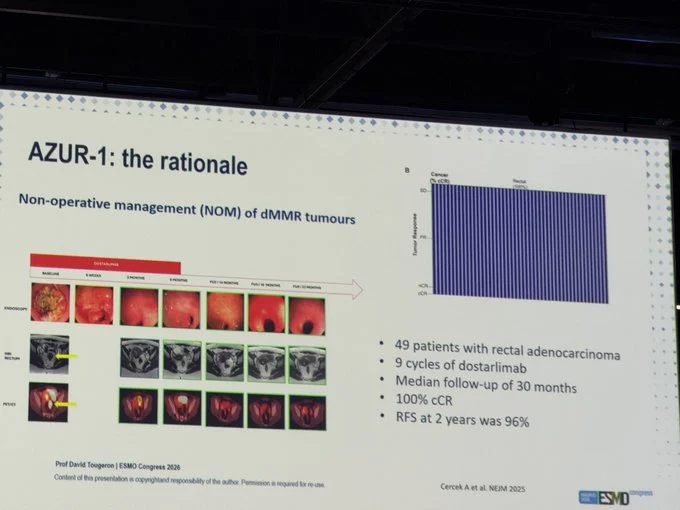
AZUR-1 delivers.
Phase 2, single arm. Dostarlimab x 9 cycles (6 months) in untreated stage II/III dMMR/MSI-H rectal cancer, 154 patients.
Cercek’s 49-patient NEJM cohort gone global.
No control arm, because randomizing these patients to TNT/TME isn’t equitable.
cCR12 (complete response held 12+ months, no further treatment): 68% by investigator.
- 26% needed additional treatment
- 10% went to surgery
68% is likely lower than reality since many patients probably just needed more time to radiographically respond. Using PET/Biopsy/ctDNA, especially ctDNA, is incredibly helpful in my practice to identify patients who can avoid TME even if a fibrotic tumor remains as they often do.
FDA already gave accelerated approval (way to steal the ESMO thunder) last week which leads me to my next point.
Obvious new standard of care. You should go to oncology jail if you don’t treat MSI-H with IO.
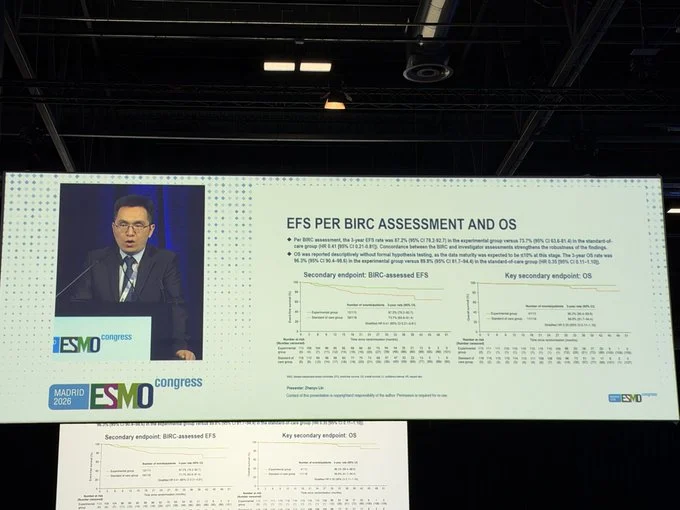
UNION: PIII neoadjuvant rectal cancer, presented at ESMO26. Basically PD1 + TNT vs TNT.
Positive on pCR and EFS. Does it change things? Very strong OS signal.
Design:
- Locally advanced rectal cancer, 231 randomized
- Short-course RT → camrelizumab + CAPOX vs long-course chemoRT → CAPOX, then TME
Efficacy:
- pCR (BIRC, primary) 39.8% vs 15.3%, OR 3.65, p<0.0001
- 3-yr EFS 91.3% vs 77.4%, HR 0.33 (investigator)
- 3-yr OS 96.3% vs 89.8%, HR 0.35 (95% CI 0.11–1.10). Descriptive only, 15 deaths total.
Toxicity:
- Grade ≥3 TRAEs 51.3% vs 48.2%, mostly heme
Is the backbone appropriate? Two things changed at once: the radiation schedule and the PD-1.
The control arm is long-course CRT with CAPEOX, not the TNT most of us give today, and a 15% pCR is a low bar to clear.
Everyone went to TME, so the question US practice actually cares about, organ preservation, wasn’t asked.
Still, an EFS HR of 0.33 at 3 years is considerable. I expect this’ll be standard in the future.
One thing I know, this study is done, and we’re still only ‘planning’ these PD1 studies in the US. Have to move faster.
HARMONi-GI1, presidential session at ESMO26.
Udhayvir Grewal guessed .7 HR. I guessed .8 HR. We were equally right (.75 HR).
Phase 3, 1L advanced biliary tract cancer: ivonescimab (PD-1 x VEGF) + GemCis vs durvalumab + GemCis. 682 patients, median follow-up 14.3 mo.
- OS 14.9 vs 12.1 mo, HR 0.75 (95% CI 0.61-0.92), p=0.0031
- PFS 8.4 vs 5.8 mo, HR 0.61 (95% CI 0.51-0.72)
- ORR 53.8% vs 32.5%
This was an appropriate comparator for 2026 and compelling data (although really did need every one of those patients to power).
Probable new first line once the full data comes out. The bispecifics era is in full force.
PRABITAS: PIII biweekly vs conventional TAS-102 + bev in refractory mCRC , presented at ESMO26.
Yay for confirmation. But everyone should have been doing this since the OG publications (and certainly after Dr. Cathy Eng published).
The SUNLIGHT schedule (TAS-102 days 1–5 and 8–12, bev days 1 and 15, every 28 days) works, but the neutropenia is savage at almost 50% G3-4 on SUNLIGHT.
PRABITAS has the same dose but spreads it out a litle more: TAS-102 days 1–5 + 15-19 and bev every 14 days. 970 patients, dosing at physician discretion. The primary endpoint was OS with an NI margin of 1.25.
OS 11.3 vs 10.3 mo, HR 0.93 (95% CI 0.80–1.08). Non-inferior, and the curves are the same.
Massive tox reduction, consistent with prior data.
This shouldn’t surprise anyone. Cathy Eng’s group published this schedule in 2025: 16% grade ≥3 neutropenia, no febrile neutropenia, no G-CSF. The Japanese phase 2 data go back to 2020.
Do we really always need randomized data to change practice? Do patients deserve to wait for 5+ years?
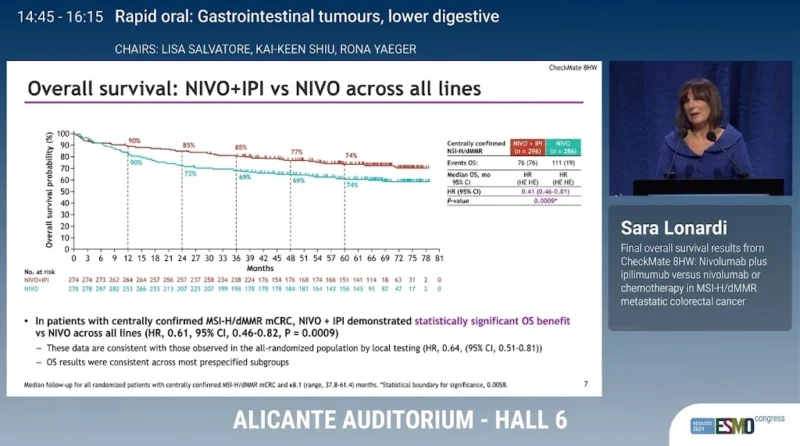
For the final act of CheckMate 8HW, we finally have the significant OS data the doubters have been asking for.
What happens when you have a great treatment and an even better one for a study (and almost everyone crosses over)? You have to wait a really, really long time for OS. Also, some thoughts on splitting the alpha I won’t get into here.
Nivo/ipi vs nivo alone vs chemo, MSI-H/dMMR mCRC. Final OS analysis.
Response rate 72% with nivo/ipi, 58% with nivo alone.
Median OS still not reached.
OS HR 0.66 for nivo/ipi over nivo, statistically significant.
77% of nivo/ipi patients alive at 5 years.
Three out of four patients alive at five years. In metastatic colorectal cancer.
Not even going to talk about the chemo arm. It’s clearly worse, and there is never a time to give chemo in MSI-H unless someone has extreme, active autoimmune disease. ‘Debulking’ is absolute nonsense.
Bottom line: the doubters got their OS. Nivo/ipi is the first-line standard for MSI-H mCRC.
Next steps: how do we decide length of therapy, and how do we manage oligometastatic progression?
I thought ESMO26 was the year of IO and this CART just came out of nowhere to smash expectations.
Is this real?
SL-28 (1002O): off-the-shelf allogeneic leukocytes from healthy donors.
No genetic modification, no HLA matching, no conditioning. 12 heavily pretreated patients.
- ORR 66.7% (4 CR, 4 PR)
- 4 SD, 0 PD
- mDoR not reached in responders
- mPFS 24.7 mo
- 4 of 12 patients died, all labeled non-cancer related. In a cell therapy dataset I need to know what killed them.
- The 12 mix a Phase 1/2 that started in 2026 with expanded-access patients. A 24.7 mo median PFS likely utilizes the compassionate-use cases.
- SL-28 runs on ‘TezR’ receptors, a system first described by the company’s founders (one of whom presented today).
I’d love to see someone else replicate it. Have we finally entered the era of solid tumor CAR-Ts?
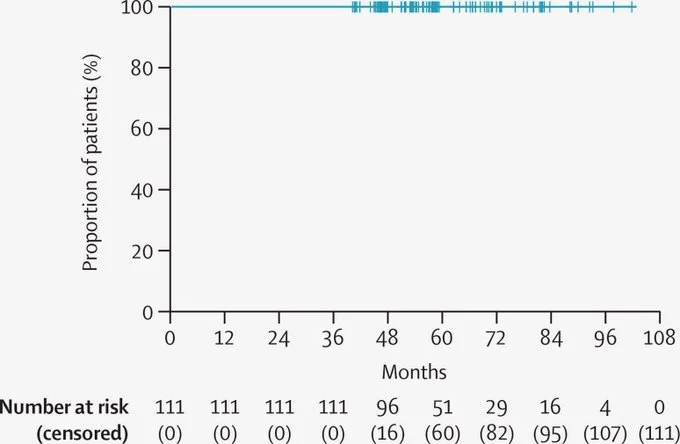
NICHE-2. Keeping it short because the plot speaks for itself.
- Rename it Chalabi’s disease
- Stop operating on patients first
For those who don’t know: 111 patients with locally advanced dMMR colon cancer got one dose of ipi and two of nivo, then surgery. Zero events. A flat line.
Next up? Avoid the surgery altogether.
ESMO26 Day 1 highlight for me: MASTERPLAN, now in Lancet Oncology.
Radiation and pancreatic cancer have a complicated history. ESPAC-1 suggested adjuvant chemoradiation hurt. LAP07 and CONKO-007 couldn’t show an OS benefit after chemo. A021501 closed its RT arm for futility. PREOPANC-2 was a draw. We walked through the adjuvant side of this story in Sem Rad Onc last year:
So why is MASTERPLAN different?
- Phase 2, 14 sites in Australia and NZ (can i just say I love the Aus-NZ studies). 74 patients with high-risk localized PDAC, randomized 2:1 to chemo ± SBRT 40 Gy/5 after induction.
12-mo locoregional recurrence 20.2% vs 52.0%, sHR 0.44, p=0.022
- PFS 11.9 vs 6.3 mo, HR 0.44
- OS 22.0 vs 14.0 mo, HR 0.45
- Grade ≥3 AEs 70% vs 64%.
Why did this one work when others didn’t? The rad oncs can explain the physics better than I can. I just read it as better tumor zap zap.
Does it change practice? Maybe. I think we need to have a deeper conversation at every tumor board, but the juice seems worth the squeeze.
Title: Adjuvant Radiation for Resected Pancreatic Cancer: Historical Review and Current State
Authors: John Starner, Yen-Ruh Wuu, Nicholas Hornstein, Karyn A. Goodman, Joseph M. Herman, Ross Abrams, Leila T. Tchelebi
HERIZON-GEA-01 second OS interim at ESMO26, and I’m a triplet believer.
In January I wondered if tislelizumab was necessary. With 35 months of follow-up, my answer is yes.
914 patients, 1L HER2+ GEA, randomized 1:1:1 to zani + chemo ± tislelizumab vs trastuzumab + chemo.
Median OS:
- Zani + chemo + tisle: 27.0 mo
- Zani + chemo: 22.9 mo
- Tras + chemo: 19.6 mo
- 3-year OS: 39.8% vs 31.5% vs 22.9%
The doublet now has its own OS win over trastuzumab (HR 0.76, 95% CI 0.62–0.93, p=0.0088). The triplet vs trastuzumab got better with time (HR 0.72 at IA1, now 0.65).
Triplet vs doublet: HR 0.81 (95% CI 0.65–1.00), p=0.0502. Yes, it technically misses. But 4 more months of median OS is clinically meaningful in metastatic gastric cancer.
Patients also stayed on the triplet longer (~47 vs ~30 weeks), with no new safety signal.
Takeaway: zani + chemo + tisle is my 1L default for HER2+ GEA. Bring on the bispecifics.
China keeps delivering new assets and studies, now in HER2+ gastric.
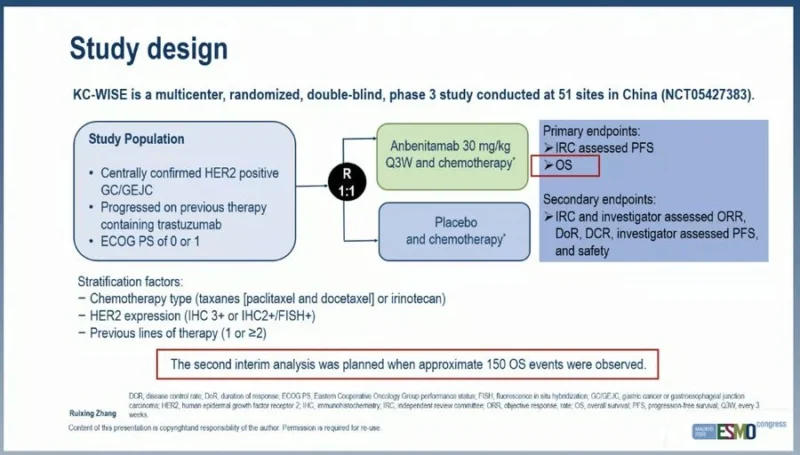
KC-WISE updated OS at ESMO26. Double-blind phase 3 in HER2+ GC/GEJC after progression on trastuzumab: anbenitamab (biparatopic HER2 bispecific) + chemo vs placebo + chemo.
- ORR 56 vs 14%
- mPFS 7.1 vs 2.7 mo
- mOS 19.6 vs 9.7 mo, HR
Almost 20 months median OS in second line. The control arm is single-agent chemo, so the bar wasn’t high. But the OS doubled, and that’s hard to argue with.
Takeaway: HER2 is still a target after trastuzumab. Sequential HER2 blockade works.
The question I can’t answer yet: HERIZON just moved zanidatamab to 1L. Once patients get a biparatopic up front, does a second one still work in 2L? Or does that spot go to T-DXd?
Also, Should point out 20 months is significantly lower than what we saw on HERIZON which hit 26 – 27 month.
3L gastric cancer means picking between drugs that minimally work (irinotecan, paclitaxel or TAS-102). Modest benefit, real tox.
G-HOPE-001 adds a fourth option.
Arcotatug tavatecan (CLDN18.2 ADC, TOPO-I payload) vs TPC n=408, CLDN18.2 ≥75% 2+, 2–4 prior lines, China and Japan.
- PFS 5.5 vs 2.9 mo, HR 0.47 (95% CI 0.34–0.65)
- OS 9.9 vs 7.4 mo, HR 0.63 (95% CI 0.45–0.89), interim
- ORR 23.6% vs 5.3%
- Grade ≥3 TEAEs 45.8% vs 57.9%
What changes in practice: CLDN18.2 IHC stops being a one-time 1L question. If this holds, the same result matters again two lines later.
OS at IA2 will tell us how much and the paper will tell us about prior CLDN exposure. Needs a western cohort as well.
SANO 5-year update, ESMO26 LBA78.
Some surprises.
Study Design:
Surveillance vs surgery after cCR to CRT in locally advanced esophageal cancer (n=309).
5-year OS ~50% vs 54% (NS), HR 1.17 (95% CI 0.77–1.77).
Distant mets 46% vs 29% (P<.01). This met rate is higher and now significant.
Reminder: only 41.4 Gy/23 fx. A pre-op, arguably non-definitive dose, especially with ~75% adenocarcinoma.
Does this apply in the DFLOT + post-CROSS era? Either way, upper GI harder to tackle non-op than hoped.
Topline ESMO data from INTerpath-001 (Moderna’s personalized cancer vaccine) reportedly leaked elsewhere: RFS HR 0.58.
(Honestly shame on people for breaking embargo’s). There is a huge divide here between physicians and non-physicians on the outcome.
To me, this was huge and clearly worked.
This hazard ratio puts it in the company of the most paradigm-changing adjuvant trials in oncology history.
Yes, the same outcome can be generated from giving pembro in the neoadjuvant space [SWOG S1801 neoadjuvant + adjuvant pembro vs adjuvant pembro alone: EFS HR 0.58.].
That isn’t the point. A peptide vaccine strategy yielded the same outcome as having a tumor in vivo. This demonstrates the tech worked, now it can be applied more broadly or potentially even supercharge the neoadjuvant space with less immunogenic tumors. Time to do better and apply to more things (like colon cancer pls).
You can also read:
25 Posts Not to Miss from ESMO Congress 2026: Day 3