






Mustafa Saleh, Genitourinary Oncology Research Fellow at Dana-Farber Cancer Institute, shared on X:
“Some patients on immunotherapy develop serious immune side effects. Others never do. What if a blood test before the first dose could tell them apart?
Hot off the press in Journal of ImmunoTherapy for Cancer: The answer may lie in the IL7 gene. Honored to have led this work with Eddy Saad and Jinhyeon.
This builds on our 2022 Nature Medicine that linked IL7 variants to immune-related adverse events (irAE).
We asked:
- Is it immunotherapy-specific in randomized trials?
- Does it hold across ancestries?
- What biology links genotype to toxicity?
We tested it in 2 randomized phase 3 trials and a prospective pan-cancer cohort:
- Kidney cancer: CheckMate-025, Nivolumab vs Everolimus
- Lung cancer: BTA-037, Pembrolizumab vs Bintrafusp alfa
- East Asian: K-ICI, 833 pts across cancers, 9 Korean centers
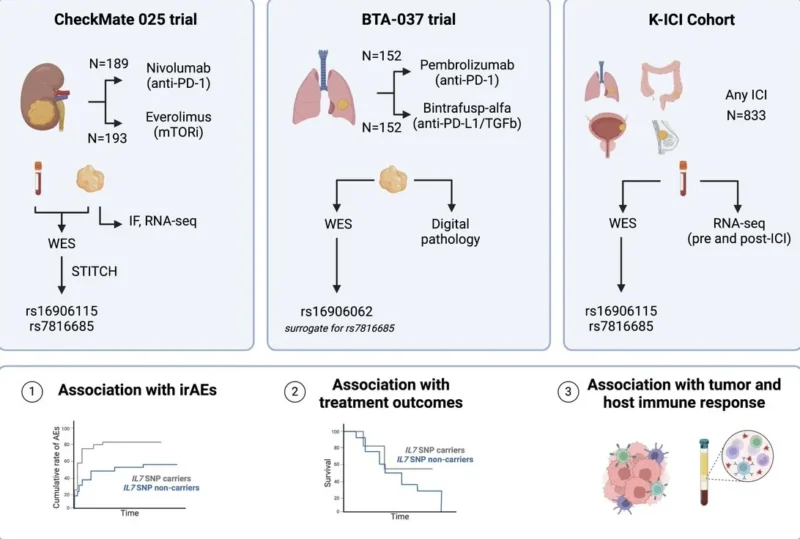
Q1: Is it immunotherapy-specific in randomized trials?
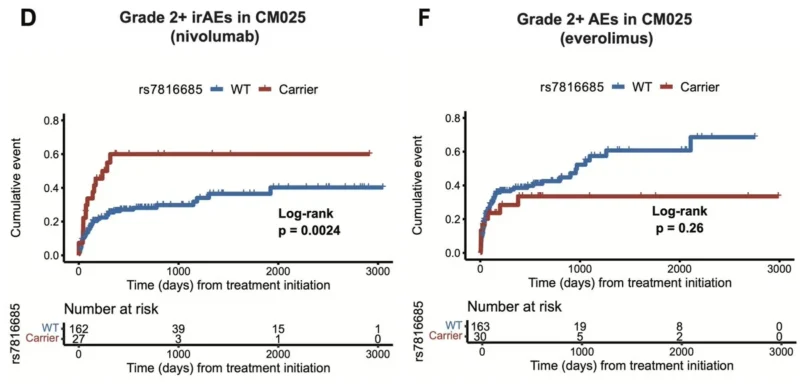
- On Nivolumab, carriers of the IL7 risk variant had 3x the risk of grade 2+ irAEs (HR 3.01, 95% CI 1.59 – 5.68)
- On Everolimus, the non-immunotherapy control, there was no effect (HR 0.65; interaction p=0.001)
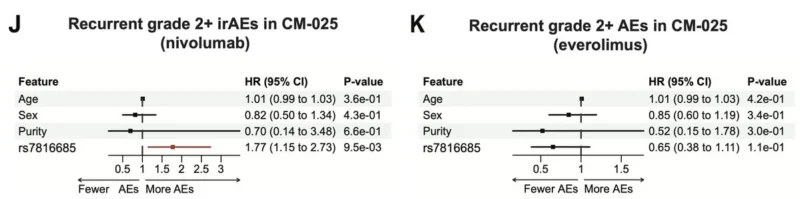
- Carriers aren’t just more likely to have a first side effect. They are more likely to have repeat episodes too.
- Recurrent grade 2+ irAEs on nivolumab: HR 1.77 (1.15 to 2.73). No signal on everolimus.
The same pattern held in lung cancer. In BTA-037, a closely linked variant (High LD R²≈1) raised irAE risk with Pembrolizumab (HR 2.30, 95% CI 1.16 – 4.60), but not with Bintrafusp alfa. irAEs tracked with better outcomes in the literature. Do IL7 carriers benefit more?
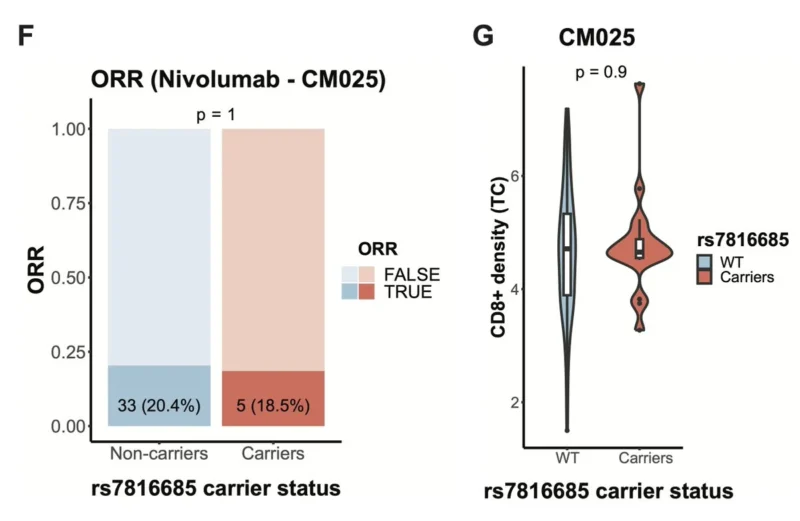
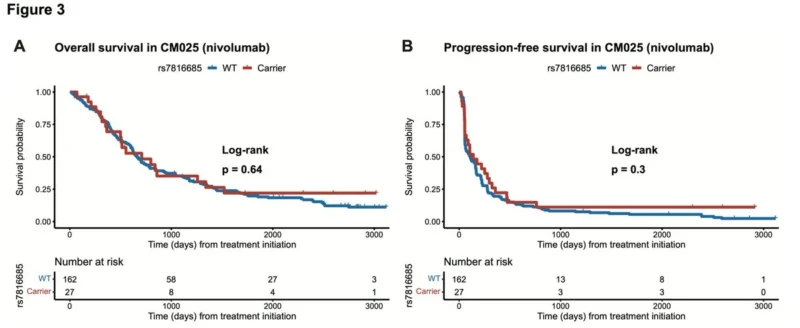
- Carriers had more irAEs but similar OS, PFS and response (18.5% vs 20.4% non-carriers)
- Similar tumor genomics and T cell infiltration – A marker of toxicity only
Q2: Does it hold beyond European ancestry?
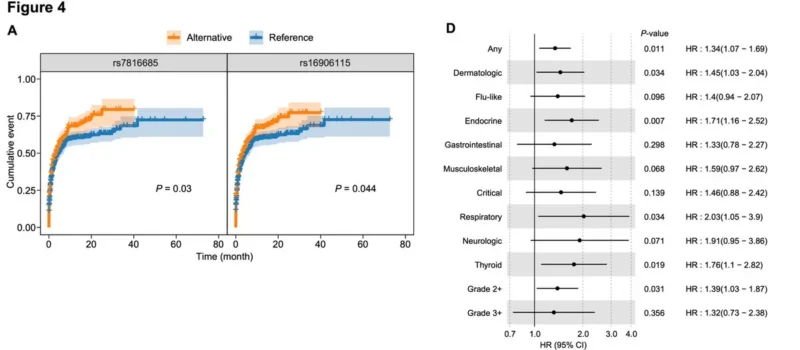
- The risk variant is far more common in East Asians (30% vs 6.6%).
- In our K-ICI Korean cohort, carriers again had more irAEs, with a smaller but consistent effect (HR 1.34, 1.07 – 1.69), across skin, thyroid, and lung.
Q3: Why?
- The risk variant is linked to the expression of a normally spliced-out piece of IL7: a ‘cryptic exon’.
- We first identified it in healthy donors (GTEx data) in 2022.
- Here we confirm it in blood from patients with cancer, highest in those carrying 2 copies.
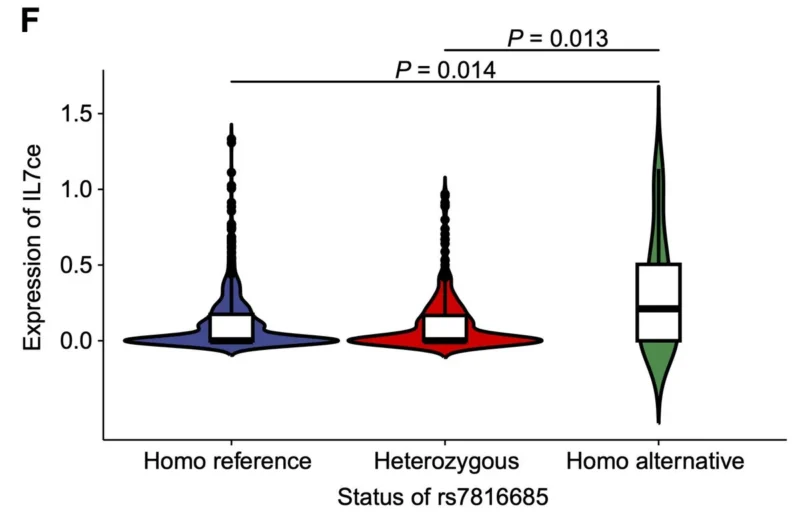
That cryptic exon tracks with killer (cytotoxic) T cells in blood.
- After ICI starts, these cells rise more in pts who develop irAEs, & higher post-ICI levels are linked to higher irAE risk (HR 1.21 per SD).
- Testable model: IL7 variant – cT-cell expansion – irAEs.
Why this matters?
- Germline DNA doesn’t change. A single test before treatment could flag patients who need closer monitoring, without withholding a therapy that works just as well for them
- Next step – prospective validation.
Immensely grateful to our mentors Toni Choueiri , Sasha Gusev, Eli Van Allen and Sook Ryun Park, our colleagues and collaborators KAISTPR, EMD Serono U.S Clinical Trials, Asan Medical Center, Bristol Myers Squibb, and every patient who made this possible
Title: Association of IL7 Germline Variants With Immune-Related Adverse Events in Patients With Cancer Treated With Immune Checkpoint Inhibitors
Authors: Eddy Saad, Jinhyeon An, Mustafa Saleh, Elnaz Mirzaei Mehrabad, Chris Labaki, Renée Maria Saliby, Marc Machaalani, Razane El Hajj Chehade, Stefan Groha, Karl Semaan, Marc Eid, Clara Steiner, Rashad Nawfal, Emre Yekedüz, Liliana Ascione, Tarek Baroud, Saurabh Gupta, Sai Vikram Vemula, Wassim Daoud Khatoun, Jad El Masri, Soohyeon Lee, Il-Hwan Kim, Ji-Young Han, Yeon Hee Park, Jee Hyun Kim, Eun Joo Kang, Min Hee Hong, Tae-Yong Kim, In Hae Park, Koung Jin Suh, Jung Kyoon Choi, Aarti Asnani, Elad Sharon, Gwo-Shu Mary Lee, Maxine Sun, David A. Braun, Parantu K. Shah, Sook Ryun Park, Eliezer M. Van Allen, Alexander Gusev, and Toni K. Choueiri.
Read more articles about Immune Oncology on OncoDaily.