





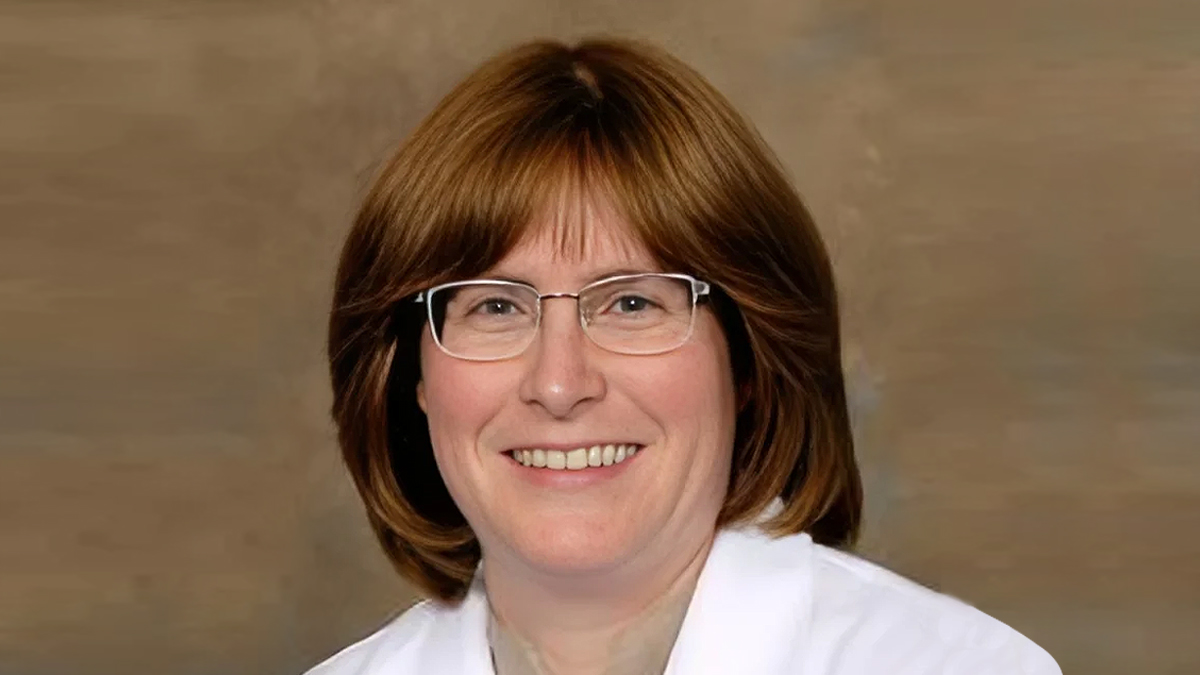
Michelle Kirschner, Managing Director of the International Cancer Rehabilitation Foundation, Clinical Lead and Medical Advisory Board Chairman at OneVillage, shared a post on LinkedIn:
” ‘Are we underestimating the true burden of thyroid cancer survivorship?’
Thyroid cancer is often called a ‘good cancer’ because survival rates are excellent.
But survival and survivorship are not the same thing.
Over the years, I have cared for many thyroid cancer survivors and repeatedly observed the same constellation of challenges: fatigue, sleep disruption, cognitive dysfunction, reduced stamina, and diminished quality of life. Yet these survivors are frequently managed outside traditional cancer survivorship programs and often remain invisible to the broader oncology community.
Emerging research is now validating what many clinicians and patients have known for years: a meaningful subset of thyroid cancer survivors experience persistent symptom burden long after treatment ends.
In my latest article, I explore:
- Why thyroid cancer survivorship remains underrecognized
- The growing evidence surrounding fatigue, sleep, and cognitive symptoms
- Challenges associated with lifelong thyroid hormone replacement and TSH suppression
- Gaps in current survivorship care models
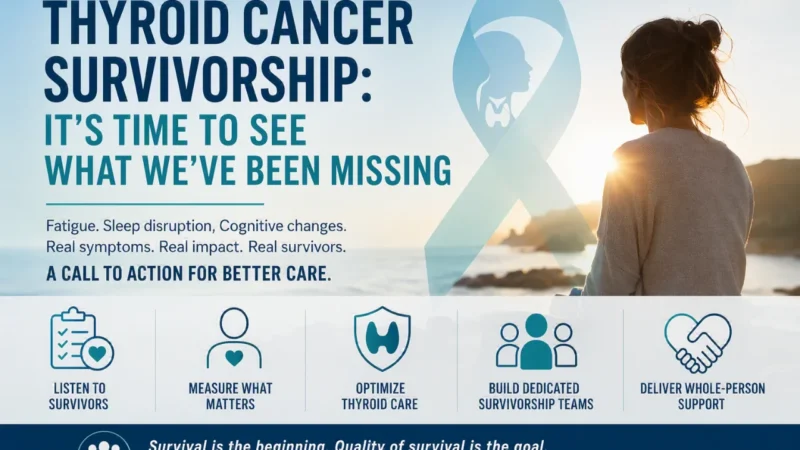
- A call to action for building comprehensive thyroid cancer survivorship programs
Most importantly, I outline practical recommendations to improve care through patient education, PROM-based symptom monitoring, multidisciplinary survivorship teams, and development of resources specifically designed for thyroid cancer survivors.
Survival is not the endpoint. Quality of survival is what matters most.
I would love to hear from:
- Thyroid cancer survivors
- Endocrinologists
- Surgeons
- Oncology professionals
- Survivorship researchers
What gaps do you see in thyroid cancer survivorship care?
Thyroid Cancer Survivorship: An Urgent Call to Action
The Blind Spot in Cancer Survivorship
By: Michelle Kirschner
One of the most persistent problems in oncology is not what we fail to cure, but what we fail to see.
The oncology community has made extraordinary progress in improving cancer survival. However, survivorship care has not evolved at the same pace for all cancers. In several malignancies with excellent survival rates, long-term treatment effects remain underrecognized, undermeasured, and under-treated. This creates a distorted perception that successful treatment automatically translates into successful survivorship.
Few populations illustrate this problem more clearly than thyroid cancer survivors.
For years, I had the opportunity to collaborate closely with endocrinologists and endocrine surgeons. Because of those relationships, thyroid cancer survivors routinely entered my clinic. On a weekly basis, I observed the same pattern repeatedly: profound fatigue, disrupted sleep, cognitive dysfunction, diminished productivity, and difficulty maintaining normal daily activities.
These symptoms rarely occurred in isolation.
Instead, they clustered together, creating a perfect storm that negatively impacted quality of life. Fatigue worsened sleep. Sleep disruption worsened cognition. Cognitive dysfunction impaired work performance, social functioning, and emotional well-being. The cumulative burden was often substantial.
Yet these experiences were largely invisible to much of the oncology survivorship community.
The Survivors Who Often Never Reach Survivorship Care
Unlike many other cancer populations, thyroid cancer survivors frequently disappear from the view of oncology survivorship programs shortly after treatment ends.
Many patients transition directly from surgery to endocrinology follow-up. As a result, survivorship providers often have little exposure to this population. Without integrated systems linking surgeons, endocrinologists, and survivorship services, there are few pathways that facilitate referral into comprehensive survivorship programs.
This has important consequences.
Research priorities, resource allocation, and supportive care programs naturally focus on the patient populations that survivorship clinicians see most often. The needs of thyroid cancer survivors become underrepresented not necessarily because their symptom burden is low, but because they are frequently managed outside traditional cancer survivorship settings.
This creates a dangerous cycle
- Limited visibility leads to limited awareness.
- Limited awareness leads to limited research.
- Limited research leads to limited survivorship resources.
- Limited resources reinforce the perception that the problem is small.
The result is a growing population of survivors whose needs frequently remain unrecognized.
The Evidence Is No Longer Anecdotal
The newest survivorship research strongly validates what many clinicians have observed for years.
In a recently published study from MD Anderson Cancer Center involving 864 thyroid cancer survivors followed in a dedicated survivorship clinic, fatigue and disrupted sleep emerged as the most common severe symptoms reported by survivors. Approximately 11.5% reported severe fatigue and 11.3% reported severe sleep disruption. Problems with memory, concentration, distress, and interference with daily functioning were also common. Importantly, symptom burden was highly variable, demonstrating that a significant subgroup of survivors experience meaningful and clinically important symptoms years after treatment.
The investigators concluded that while average symptom scores appeared relatively low, a meaningful subset of thyroid cancer survivors experienced substantial symptom burden and functional impairment requiring intervention. They specifically noted that survivorship care must extend beyond recurrence surveillance and address treatment-related symptoms and quality-of-life concerns.
These findings mirror earlier research. In a study of papillary thyroid cancer survivors without recurrent disease, 41.8% met criteria for clinically significant fatigue. Fatigue was strongly associated with poorer quality of life, and free T3 levels were significantly associated with symptom burden. Fatigue affected physical, emotional, and cognitive functioning and was strongly associated with impairments in vitality, mental health, and daily functioning.
The consistency across studies is striking. Regardless of geography, treatment setting, or methodology, the same themes keep emerging:
- Fatigue
- Sleep disruption
- Cognitive dysfunction
- Reduced vitality
- Emotional distress
- Impaired quality of life
These are not isolated complaints. They represent a recognizable survivorship syndrome.
We Should Not Be Surprised
The persistence of these symptoms should not be viewed as unexpected.
Patients who undergo partial or total thyroidectomy lose part or an entire endocrine organ and become dependent on lifelong hormone replacement. Many also undergo radioactive iodine therapy and remain on long-term TSH-suppressive therapy.
A growing body of literature suggests that accurately recreating normal thyroid physiology after thyroidectomy remains extraordinarily difficult.
A recent review described thyroid hormone replacement as an ongoing clinical ‘puzzle’, emphasizing that physicians continue to struggle with replicating endogenous thyroid hormone secretion and normal physiology through levothyroxine replacement alone. The authors argued that many patients may experience physiologic consequences despite appearing biochemically normal according to traditional laboratory measurements.
Research has demonstrated that patients receiving levothyroxine can exhibit altered T3:T4 ratios, lower T3 levels, reduced energy expenditure, metabolic abnormalities, and persistent symptoms despite achieving target TSH levels. Several studies have suggested that levothyroxine monotherapy may not ensure true euthyroidism in all tissues and organ systems.
When survivors report fatigue, sleep disruption, brain fog, diminished exercise tolerance, and poor quality of life despite ‘normal’ laboratory values, perhaps we should stop viewing these experiences as surprising and start viewing them as predictable.
The Thyroid Hormone Replacement Problem
The challenge extends beyond thyroid cancer.
A systematic review and meta-analysis involving more than 24,000 patients with hypothyroidism found that only 55% of patients achieved target euthyroidism. Approximately 20% were overtreated and 24% were undertreated. The authors concluded that significant numbers of patients are inadequately managed in real-world clinical settings, resulting in adverse health outcomes.
Importantly, these were not thyroid cancer patients. These were individuals with routine hypothyroidism.
If nearly half of hypothyroid patients experience over- or under-treatment in routine clinical practice, how much more complicated might management become among survivors who have undergone total thyroidectomy, radioactive iodine therapy, and intentional TSH suppression?
This reality should fundamentally influence how we think about thyroid cancer survivorship.
The Cost of TSH Suppression
Another important survivorship issue concerns TSH suppression therapy.
For decades, TSH suppression has been used to reduce recurrence risk in differentiated thyroid cancer. However, the long-term consequences of sustained suppression are increasingly being recognized.
A 2024 review concluded that while TSH suppression remains appropriate for selected higher-risk patients, substantial uncertainty remains regarding who truly benefits, for how long, and at what cost. The review also highlighted growing concerns regarding cardiovascular complications, atrial fibrillation, skeletal effects, and quality-of-life consequences associated with long-term suppression.
The author noted that after 30 years of practice, significant questions remain unanswered regarding symptoms, quality of life, and adverse effects experienced by survivors maintained on suppressive therapy.
For survivorship providers, this is particularly relevant because the outcomes most important to patients – energy, sleep, cognition, productivity, and well-being – often receive less attention than recurrence rates and laboratory values.
A Growing Recognition of Long-Term Health Risks
The conversation is beginning to change.
At the 2024 American Thyroid Association meeting, survivorship experts emphasized the growing need to recognize and manage long-term health risks among thyroid cancer survivors, reflecting increasing awareness that survivorship extends beyond surveillance for recurrence. Conference coverage highlighted concerns regarding cardiovascular health, bone health, endocrine management, and quality-of-life outcomes among long-term survivors.
This shift is encouraging, but awareness alone is not enough.
The field now needs action.
A Call to Action for Thyroid Cancer Survivorship
The time has come to build a comprehensive survivorship model for thyroid cancer survivors.
1. Educate Every Thyroid Cancer Survivor
Education should begin before treatment.
Patients deserve realistic discussions about:
- Short-term side effects
- Long-term side effects
- Persistent fatigue
- Sleep disruption
- Cognitive changes
- Metabolic consequences
- Fertility concerns
- Bone health risks
- Cardiovascular risks
- Uncertainty regarding symptom management
Patients should also be informed when TSH suppression is part of treatment planning and understand both the intended oncologic benefits and potential long-term consequences.
Most importantly, patients should know what resources will be available to them when symptoms emerge.
2. Implement Universal Symptom Screening
Every thyroid cancer survivor should routinely complete patient-reported outcome measures (PROMs).
Measurement must become standard practice rather than an afterthought.
PROMs should specifically evaluate:
- Fatigue
- Sleep quality
- Cognitive function
- Distress
- Physical functioning
- Work productivity
- Quality of life
If we do not systematically measure symptoms, we will continue to underestimate them.
3. Optimize Thyroid Hormone Management
Appropriate follow-up, monitoring, and titration of thyroid hormone replacement should be a survivorship priority.
The goal should not merely be laboratory normalization.
The goal should be optimizing function, quality of life, and patient-reported outcomes while balancing oncologic considerations.
4. Build Dedicated Thyroid Survivorship Teams
Comprehensive survivorship care requires multidisciplinary support.
Teams should include:
- Endocrinologists
- Oncology providers
- Advanced practice providers
- Rehabilitation professionals
- Mental health specialists
- Sleep specialists
- Exercise professionals
- Social workers
- Survivorship clinicians
Strong referral pathways must exist between surgeons, endocrinologists, and survivorship programs.
No survivor should have to navigate these challenges alone.
5. Conduct a National Gap Analysis of Services
Before building programs, healthcare systems must understand what services already exist and what services are missing.
Every survivorship program should assess its capacity to provide support for the specific needs of thyroid cancer survivors.
Critical services include:
Cancer Exercise Programs
Focused on:
- Fatigue reduction
- Cardiovascular fitness
- Bone health
- Functional recovery
Occupational Therapy
Focused on:
- Energy conservation
- Activity pacing
- Workplace accommodations
- Cognitive compensation strategies
Sleep Medicine Resources
Including:
- CBT-I (Cognitive Behavioral Therapy for Insomnia)
- Behavioral sleep specialists
- Sleep hygiene interventions
Peer-to-Peer Support Programs
Helping survivors connect with others facing similar challenges.
Metabolic Health Programs
Focused on:
- Weight management
- Nutrition
- Physical activity
- Cardiometabolic risk reduction
Fertility Services
Providing education and support for younger survivors.
Cardio-Oncology Programs
Supporting survivors at increased risk for:
- Atrial fibrillation
- Cardiovascular complications
- Long-term endocrine-related cardiac effects
Conclusion
The central issue is not whether thyroid cancer survivors survive.
Most do.
The issue is whether they thrive.
The newest survivorship research confirms what many clinicians have recognized for years: fatigue, sleep disruption, cognitive dysfunction, distress, and impaired quality of life are real concerns for a substantial subset of thyroid cancer survivors.
These patients have been hidden in plain sight – managed outside cancer centers, excluded from many survivorship conversations, and frequently overlooked because their prognosis is excellent.
Survival can no longer be the only measure of success.
The future of thyroid cancer care must include a commitment to thyroid cancer survivorship: systematic screening, proactive education, optimized endocrine management, interdisciplinary care, and development of services that address the realities survivors face every day.
The evidence now exists.
The question is whether the oncology and endocrine communities are willing to act on it.”
Other articles about Thyroid Cancer on OncoDaily.