Martin Ignacio Zapata Laguado, Medical oncologist and internal medicine physician at Instituto Nacional de Cancerologia, shared on LinkedIn:
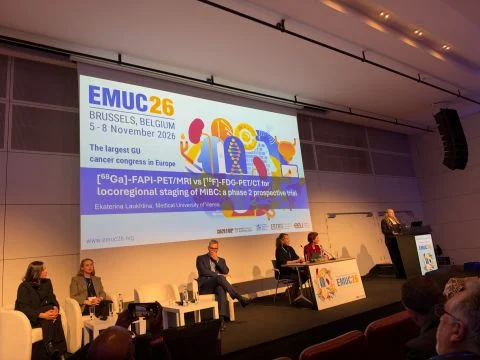
“Highlights from EMUC26 – Brussels
Europe’s largest GU cancer congress brought urologists, oncologists, radiologists and nuclear medicine physicians together.
My take-home messages on bladder cancer imaging:
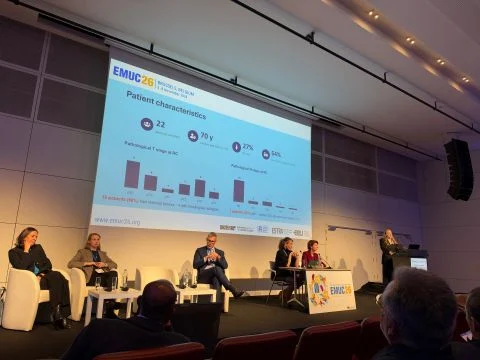
Nectin-4 PET – Prof. Lena Unterrainer (Augsburg)
- Nectin-4 is expressed in ~87% of urothelial carcinomas and linked to poor prognosis.
- EV + pembrolizumab brings toxicity (rash, neuropathy) and high cost (~US$560k/year vs ~US$3k for chemo, as presented): selection matters.
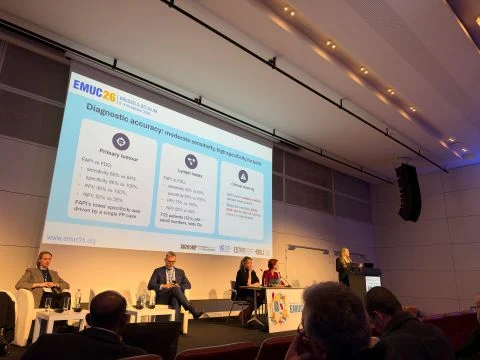
- CT remains the recommended staging modality; FDG PET/CT is an adjunct.
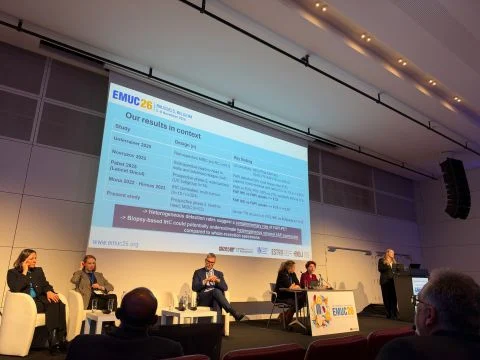
- Nectin-4 PET could map the target across all lesions, reveal heterogeneity a single biopsy misses and open the door to radioligand therapy.
- Still feasibility data. Withholding EV solely because of a negative PET is NOT evidence-based.
This can be interesting:
David Aggen: New Research Explores Nectin-4 Biomarkers and EV Plus Pembrolizumab
First-in-human ⁸⁹Zr-enfortumab vedotin PET (F. Grawe; ESMO 2026)
- Higher lesion detection than CT (84.1% vs 67.9%) and FDG PET (89.1% vs 78.5%).
- Early signal: high baseline uptake → PR on CT, CR on PET after 3 cycles of EV+P; low/heterogeneous uptake → progression. Hypothesis-generating.
Bladder preservation: how much tumour is too much? – Martina Pecoraro (Radiology)
- Validated predictors of OS after TMT (31 studies, 9,416 pts): ECOG ≥2 (HR 2.47), N+ (1.90), CIS (1.81), hydronephrosis (1.65), cT3 – 4 (1.47), GFR ≤60 (1.47); complete TURBT protective (0.77). Size was not among them.
- Diameter: no proven threshold (overlapping CIs). MRI volume never tested against TMT outcomes.
- MRI: VI-RADS validated; volume promising. MRI does not see CIS.
- AI segmentation is feasible but fails in residuals <0.5 cm³ – precisely our good responders.
- nacVI-RADS: AUC 0.93 for ypT0 after gem-cis; once in the model, size lost significance.
Real-world gap – Paramananthan Mariappan (Urology)
- NHS England 2013 – 2019: a substantial share of MIBC patients fell into ‘Other’, outside the defined treatment combinations.
The most beautiful lesson: none of this works in silos. The best opportunities for our patients will always come from multidisciplinary care: urology, medical and radiation oncology, radiology, nuclear medicine and pathology at the same table, with the patient at the centre.”
You can also read:
GDFATHER-NEO: Neoadjuvant Nivolumab + Visugromab in MIBC