Maria Babak, Associate Professor at City University of Hong Kong, shared an update from The Babak Lab, on LinkedIn, adding:
“Solid piece of work! Using in vivo click chemistry as a workaround for tumor heterogeneity and target downregulation is brilliant. If this translates to the clinic, it could literally resurrect ‘failed’ ADC pipelines and extend T-DXd usage without redesigning the antibody from scratch.”
Quoting The Babak Lab:
“Antibody-drug conjugates (ADCs) often face a hard limit: when cancer cells downregulate a target like HER2 or exhibit heterogeneous expression, the treatment stops working. A recent Nature study (Simó et al., 2026) introduces a modular in vivo click chemistry approach to bypass this hurdle.
Key Insights
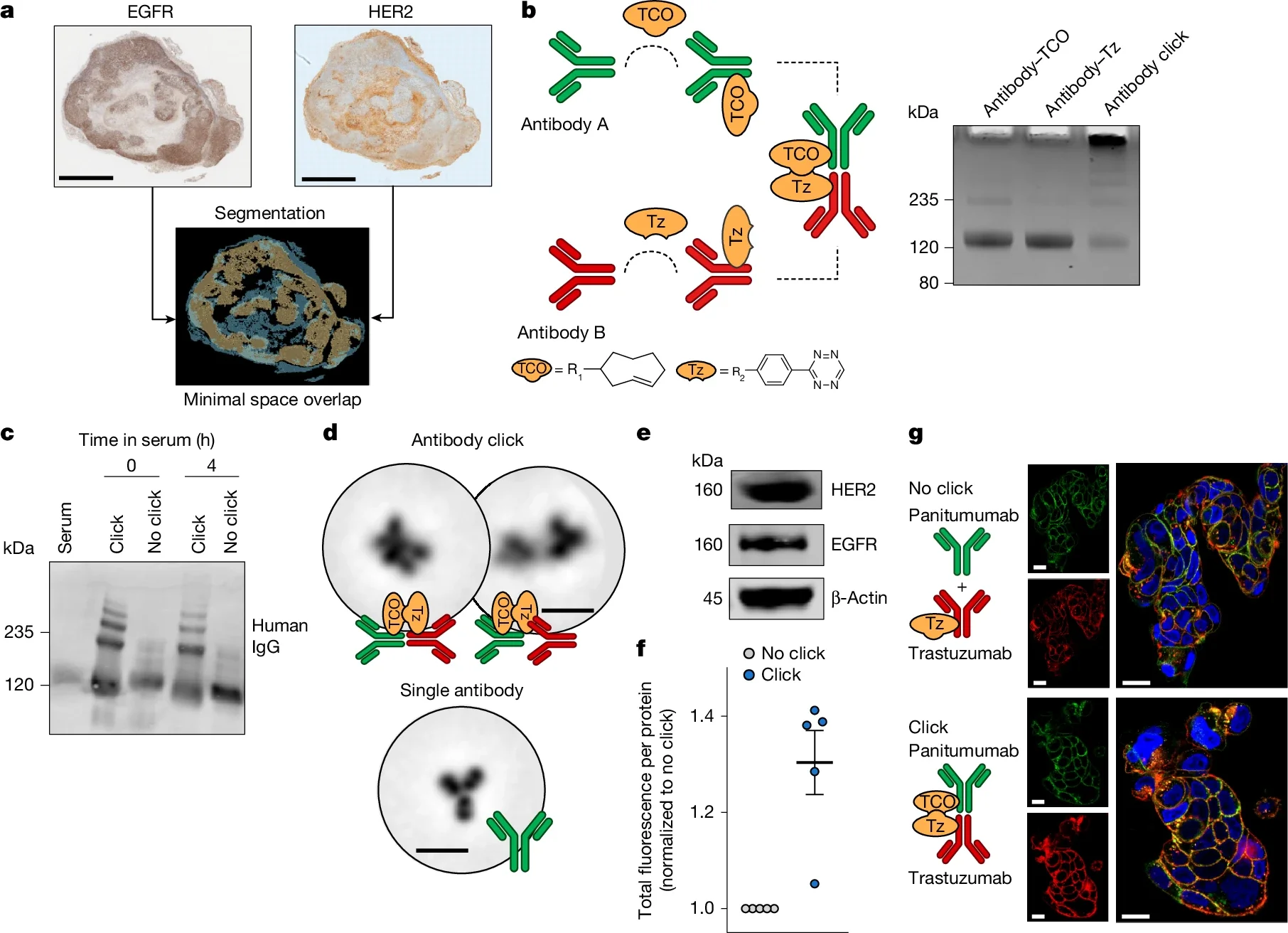
- The antibody-ADC click approach uses separately administered antibodies and ADCs carrying complementary chemical groups that rapidly ligate in vivo.
- The researchers used HER2 and EGFR as complementary targets, allowing HER2-directed ADCs to reach tumors with low, ultralow, heterogeneous, or even negative HER2 expression.
- Click formation enhanced ADC uptake, internalization, and payload delivery compared with conventional antibody + ADC combinations.
- In resistant breast and pancreatic cancer models, the approach improved tumor control and survival compared with T-DXd or T-DM1 alone.
- In mice that had stopped responding to T-DXd, switching to the click strategy suppressed tumor growth in 5 of 9 non-responders.
- The platform is modular and could potentially combine other antibodies, ADCs, and tumor targets without extensive antibody re-engineering.
Conclusion
One of the biggest headaches with therapies like T-DXd is that tumors learn to ‘hide’ the HER2 marker over time to survive. By using a more abundant receptor (like EGFR) as a docking station, this method basically tricks resistance mechanisms-delivering the heavy-hitting payload exactly where it needs to go without having to design a brand-new bispecific antibody from scratch.
Image generated using Sora by OpenAI.”
Title: Modular in vivo antibody–ADC click to reverse drug resistance in tumours
Authors: Cristina Simó, Alexander C. Vanover, Ricardo D’Oliveira Albanus, Sandeep Surendra Panikar, Shayla Shmuel, Alex Benton, Jader Giraldo-Guzman, José M. Luna, Yifei Xu, Na-Keysha Berry, Nai Keltee, Jingxia Liu, Farrokh Dehdashti,
Patrícia M. R. Pereira.
Read the full article.
This also can be interesting: Breast Cancer Highlights From ASCO 2026: ADCs, Biomarkers, and Earlier Treatment Strategies Take Center Stage