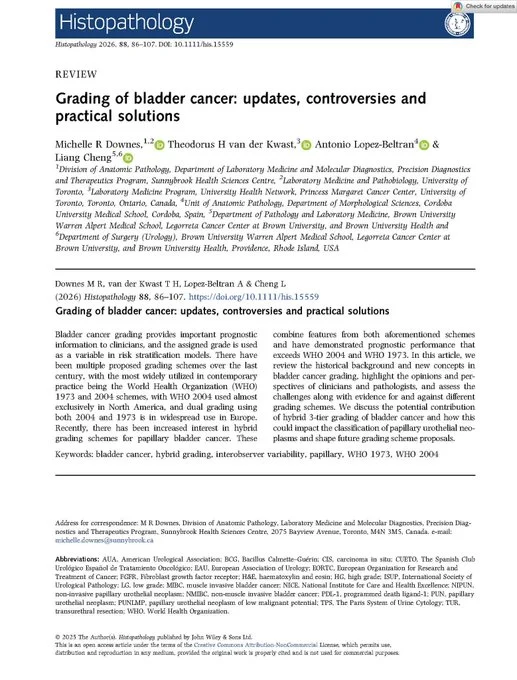
Liang Cheng, President of International Society of Urological Pathology, Vice Chair for Translational Research at the Warren Alpert Medical School of Brown University, shared on X:
“How should we grade bladder cancer in 2026? Is It Time to Move Beyond the VERY OLD 1998 ISUP/WHO Grading Systems? Do you opt for hybrid 3 or hybrid 4?
I am pleased to share this comprehensive review article by Professor Michelle Downes and colleagues, published in the 20th Anniversary Annual Review, January 2026 issue of Histopathology Histopathology, edited by Daniel Berney. I am also delighted to share that this article was recognized as one of the most viewed papers in the Wiley collection.
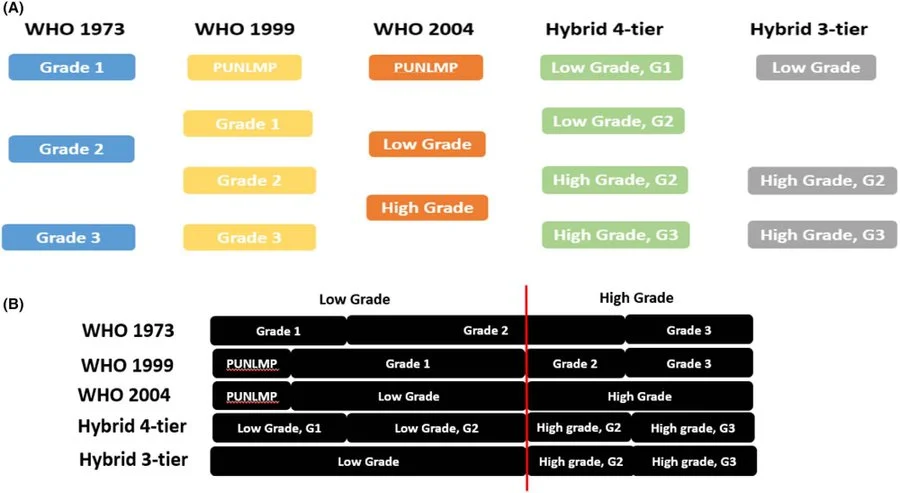
Tumor grade is a critical component of risk stratification algorithm for bladder cancer. The two systems most widely used today, WHO 1973 and ISUP/WHO 1998/2004, each have important limitations. WHO 1973 provides three grades but places many biologically diverse tumors into the intermediate G2 category. ISUP/WHO 1998/2004 simplifies grading into low- and high-grade carcinoma, but the high-grade category encompasses tumors with substantially different risks of progression. Interobserver reproducibility also remains imperfect, particularly for distinguishing low- from high-grade carcinoma and PUNLMP from low-grade papillary urothelial carcinoma.
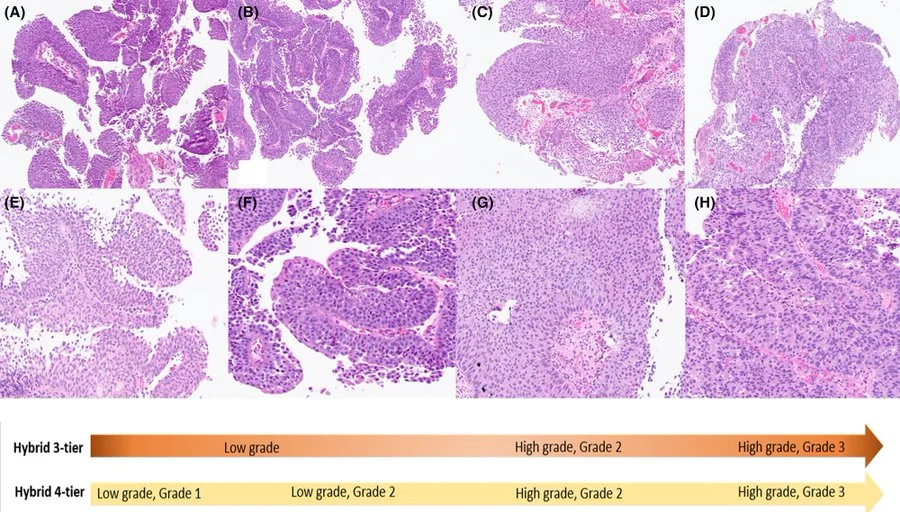
An increasingly attractive solution is hybrid grading, which integrates the strengths of both systems. The proposed hybrid 3-tier system retains the familiar WHO low-grade category while subdividing high-grade tumors into high grade, grade 2 (HG-G2) and high grade, grade 3 (HG-G3). This distinction is clinically meaningful. In a large study of 9,712 primary Ta and T1 tumors, 5-year progression rates were approximately 7–9% for HG-G2 compared with 18-20% for HG-G3, and hybrid 3-tier grading showed better prognostic accuracy than either WHO 1973 or ISUP/WHO 1998/2004 alone.
We also revisits PUNLMP, a diagnosis that has become increasingly uncommon. Molecular and outcome data demonstrate substantial overlap between PUNLMP and very low-grade papillary urothelial carcinoma, supporting the concept that PUNLMP may be best incorporated within the broader low-grade papillary urothelial carcinoma category. This new ISUP hybrid grading system combines the simplicity of ISUP/WHO 1998/2004 system with the additional prognostic information provided by separating the high-grade spectrum into G2 and G3. Recent studies also suggest that refined morphologic criteria can achieve good reproducibility.
Take-home message: bladder cancer grade exists along a biologic and morphologic continuum. A pragmatic 3-tier hybrid system -low grade, high grade G2, and high grade G3 -may provide more clinically meaningful risk stratification while remaining practical for routine pathology practice.
The full content (373-pages) of this special anniversary issue is freely available.”
Title: The Genitourinary Pathology Society and International Society of Urological Pathology Joint Expert Consultation Recommendations on intraductal carcinoma of the prostate
Authors: Rajal B Shah, Murali Varma, Ming Zhou, Gladell P Paner, Mahul B Amin, Daniel M Berney, Liang Cheng, Fang-Ming Deng, Michelle Downes, Scott Eggener, Behfar Ehdaie, Jonathan I Epstein, Andrew Evans, Samson W Fine, Nancy Greenland, Charles Guo, Bo Han, Michelle S Hirsch, Kenneth A Iczkowski, James G Kench, Tamara L Lotan, Cristina Magi-Galluzzi, Hiroshi Miyamoto, Jane K Nguyen, Toyonori Tsuzuki, Theodorus H van der Kwast, Geert J van Leenders, Sean R Williamson, Sara E Wobker, Chin-Lee Wu, Ximing Yang, Glen Kristiansen

You can also read: AI-Based Histopathology Analysis Predicts Checkpoint Inhibitor Response in Advanced Melanoma