
Kefah Mokbel, Professor of Medicine (Honorary) at Cardiff University School of Medicine, shared on LinkedIn:
“Partial-breast irradiation adds to our options for personalised breast cancer care – but its uptake remains limited.
The phase III IRMA trial adds to the existing body of evidence supporting partial-breast irradiation in appropriately selected patients with low-risk invasive breast cancer.
Across 35 centres, 3,309 patients were randomised to accelerated partial-breast irradiation (APBI) or whole-breast irradiation (WBI). With a median follow-up of 97.5 months, five-year recurrence in the treated breast was exceptionally low.
- APBI – 1.0%
- WBI – 0.8%
Formal statistical noninferiority was not demonstrated, as the upper confidence limit crossed the prespecified margin. Nevertheless, the small absolute difference is reassuring when considered alongside the wider randomised evidence.
Modern external-beam partial-breast techniques can reduce the volume of normal tissue irradiated. Trials such as Florence have demonstrated less toxicity, better cosmetic outcomes and improved patient-reported quality of life compared with the whole-breast schedules studied. These benefits depend on technique and fractionation. IRMA used twice-daily treatment, whereas current guidance favours daily or alternate-day schedules.
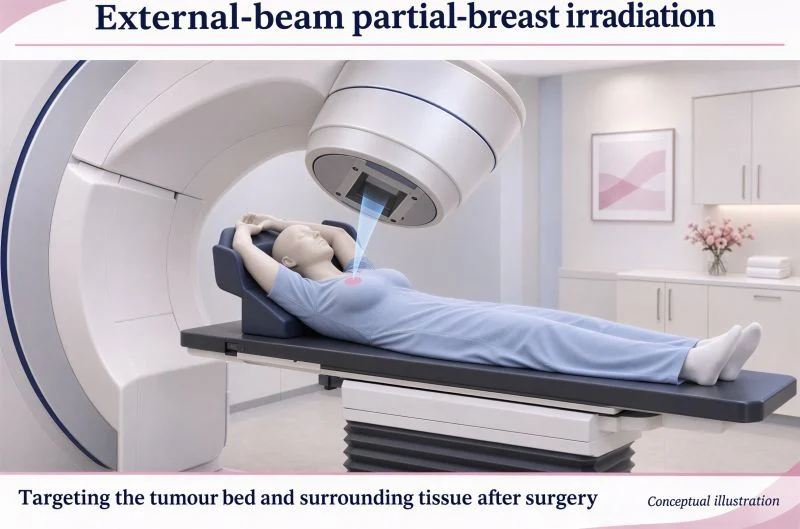
Postoperative external-beam treatment also has a practical advantage over intraoperative radiotherapy (IORT) – final pathology is available before treatment, allowing tumour characteristics, margin status and nodal findings to inform selection. Guideline support for external-beam PBI is stronger, with ASTRO restricting IORT alone to clinical trials or registries.
Suitability also requires individual assessment of breast anatomy and treatment dosimetry. Breast size and shape, the tumour-bed volume relative to breast volume, its location and proximity to the skin, chest wall, heart and lung all influence whether treatment can be delivered safely with an acceptable cosmetic outcome.
Despite substantial evidence and incorporation into guidelines, partial-breast irradiation appears underutilised. A US analysis published in 2026 found that only 23.3% of potentially eligible patients received it in 2022. Understanding barriers to implementation should help ensure that suitable patients are routinely offered an informed discussion of this option.
Title: Partial-Breast Irradiation Versus Whole-Breast Irradiation for Low-Risk Invasive Breast Carcinoma: 5-Year Results of the Multicenter, Randomized, Phase III IRMA Trial
Authors: Bruno Meduri, Antonella Baldissera, Cinzia Iotti, Luc J.E.E. Scheijmans, Marcel R. Stam, Salvatore Parisi, Liesbeth J. Boersma, Ilario Ammendolia, Eveline Koiter, Paola Canino, Dianne M. Busz, Marika Stenfert Kroese, Patrizia Giacobazzi, Maria P. Ruggieri, Antoine Engelen, Tindara Munafò, Karolien Verhoeven, Mariacarla Valli, Roberto Vicini, Riccardo Cuoghi Costantini, Elisa D’Angelo, Frank Lohr, Roberto D’Amico, Giovanni Frezza, Philip Poortmans
You can also read:
A Second Chance at Breast Conservation: Reirradiation Challenges Mastectomy After Local Recurrence