
For decades, women who developed a second breast tumor after lumpectomy and radiotherapy were commonly advised to undergo mastectomy. A new international review published as a journal pre-proof in The Breast challenges the assumption that removal of the breast is always necessary, examining growing evidence that repeat breast-conserving surgery followed by partial-breast reirradiation can provide durable local control in carefully selected patients.
The management of ipsilateral breast tumor recurrence following previous breast-conserving therapy remains one of the most difficult decisions in breast oncology.
Although modern surgery, radiotherapy, and systemic treatments have substantially improved local disease control, some women develop a recurrence or a new primary malignancy within a previously treated breast.
Historically, salvage mastectomy has been the preferred management strategy. The principal concern has been whether a second course of radiation could produce unacceptable damage to previously irradiated tissues.
However, advances in radiotherapy planning, image guidance, brachytherapy, and proton treatment are creating new opportunities for selected patients to preserve their breast without substantially compromising cancer control.
A new international narrative review, Reirradiation After Repeat Breast Conserving Treatment: Contemporary Evidence, Technical Approaches, and Expert Recommendations, brings together the evolving evidence supporting this approach.
Led by Dorota Gabryś, with contributions from Marianne Aznar, Arnaud Beddok, Reshma Jagsi, Philip Poortmans, Simona Shaitelman, Linda Hong, and other international experts, the review was developed through the Reirradiation Collaborative Group (ReCOG).
Accepted for publication in The Breast on November 6, 2026, the article summarizes clinical outcomes, modern radiation techniques, patient-selection criteria, toxicity concerns, and priorities for future research.
Its central message is increasingly relevant to multidisciplinary breast cancer care: a previous course of breast irradiation does not automatically exclude a second breast-conserving treatment.
Why Mastectomy Became the Historical Standard
Breast-conserving treatment generally combines surgical excision with adjuvant radiotherapy. For patients with early-stage breast cancer, this approach has provided excellent long-term disease control while preserving the breast.
However, when cancer subsequently develops in the same breast, treatment becomes considerably more complex. The new tumor may represent a true recurrence of the original malignancy or a biologically distinct second primary cancer.
Distinguishing between these events can influence prognosis and treatment selection. Important factors include the interval since initial treatment, tumor location, histological features, receptor status, molecular characteristics, and prior treatment history.
The challenge is particularly significant when the breast has already received whole-breast irradiation. Additional radiation may increase the cumulative exposure of skin, subcutaneous tissues, ribs, chest wall, heart, and lung.
Earlier studies of repeat lumpectomy without reirradiation reported second local recurrence rates approaching 30% in some populations. These findings reinforced the importance of delivering effective additional local treatment. Consequently, salvage mastectomy became the established approach for many patients.
The emergence of partial-breast reirradiation has now created an alternative strategy: instead of irradiating the entire breast again, clinicians can deliver a more localized dose to the new surgical cavity and surrounding tissue at risk.
Can Repeat Breast Conservation Match Mastectomy?
One of the strongest comparative datasets comes from the GEC-ESTRO Breast Cancer Working Group. The multicenter propensity score-matched analysis compared 377 women undergoing salvage mastectomy with 377 women treated using repeat lumpectomy followed by brachytherapy-based reirradiation.
Five-year overall survival was 88% following mastectomy and 87% following repeat breast-conserving treatment, with no statistically significant difference between groups. Similarly, the cumulative incidence of another ipsilateral breast tumor event was 2.3% following mastectomy and 2.8% following repeat conservative treatment.
These findings suggest that appropriately selected women may achieve favorable outcomes while preserving their breast. However, the study was observational. Propensity score matching reduced measured differences between treatment groups but could not eliminate unmeasured confounding or selection bias.
Therefore, the results should not be interpreted as definitive proof that the two approaches are oncologically equivalent. The new ReCOG review emphasizes this distinction. The available evidence supports repeat breast-conserving treatment as a reasonable option for selected patients, but prospective randomized comparisons remain lacking.
RTOG 1014: Prospective Evidence for a Second Lumpectomy
The NRG Oncology/RTOG 1014 phase II study provides important prospective evidence. The trial evaluated three-dimensional conformal partial-breast reirradiation following repeat lumpectomy in women with ipsilateral breast tumor recurrence after previous breast-conserving treatment and whole-breast irradiation.
A total of 58 patients were evaluable. Most participants had relatively small recurrent tumors, with 91% measuring 2 cm or less, and all were clinically node-negative. Patients received 45 Gy in 30 fractions of 1.5 Gy, administered twice daily over 15 treatment days.
At five years, the cumulative incidence of another in-breast recurrence was approximately 5%. The cumulative incidence of ipsilateral mastectomy for any reason was approximately 10%, indicating that breast preservation was maintained in approximately 90% of patients.
Both five-year overall survival and distant metastasis-free survival were approximately 95%. Importantly, late grade 3 treatment-related adverse events occurred in 7% of patients, with no grade 4 or grade 5 adverse events reported.
These results provide prospective support for the feasibility of a second breast-conserving approach. However, RTOG 1014 was a single-arm study and did not directly compare reirradiation with salvage mastectomy. Its favorable outcomes also reflect careful patient selection.
The trial therefore supports offering repeat conservation to eligible patients rather than replacing mastectomy as the preferred option for every recurrence.
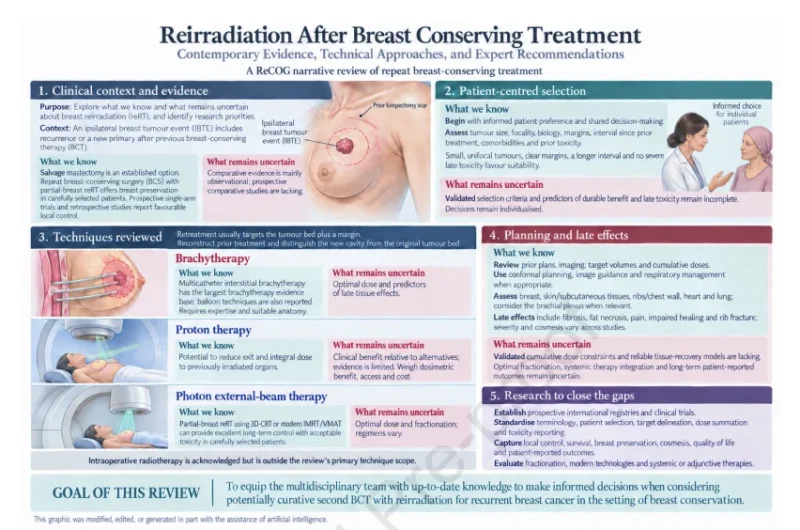
Brachytherapy: The Most Established Reirradiation Technique
Brachytherapy is among the best-studied approaches for delivering a second radiation course to the breast. Multicatheter interstitial brachytherapy allows radioactive sources to deliver high doses directly within or around the surgical cavity while reducing exposure to more distant normal tissues.
This localized dose distribution is particularly attractive in a previously irradiated breast. A GEC-ESTRO multicenter study involving 217 patients undergoing repeat lumpectomy followed by multicatheter brachytherapy reported a five-year ipsilateral breast tumor recurrence rate of approximately 5%.
Grade 3–4 complications occurred in approximately 11% of patients, while good cosmetic outcomes were reported in 85%. These findings support brachytherapy as an important option when suitable expertise and anatomy are available.
However, the technique requires specialized personnel, access to appropriate equipment, and careful assessment of the surgical cavity. The review emphasizes that lack of brachytherapy access should not automatically exclude a patient from a second breast-conserving approach. Other conformal external-beam techniques may also be appropriate.
Modern External-Beam Radiotherapy Expands Treatment Options
External-beam partial-breast reirradiation has become increasingly attractive because of its wider availability. Modern techniques include three-dimensional conformal radiotherapy, intensity-modulated radiotherapy (IMRT), and volumetric-modulated arc therapy (VMAT).
These approaches allow clinicians to deliver radiation to the treatment cavity while controlling dose distribution to nearby organs. The ReCOG review describes several fractionation strategies.
The RTOG 1014 regimen used 45 Gy in 1.5 Gy twice-daily fractions over three weeks. Other institutional series have investigated conventional once-daily treatment and moderately hypofractionated schedules.
One series using 37.05 Gy in 13 fractions reported an eight-year cumulative second local recurrence rate of approximately 4%. Grade 3 fibrosis occurred in 4% of evaluable patients, while good or excellent cosmetic outcomes were observed in slightly more than 60%.
Although these results are encouraging, differences in patient populations, treatment planning, fractionation, and follow-up prevent reliable comparisons between regimens. The authors emphasize that no single external-beam schedule has been established as optimal for breast reirradiation.
Proton Therapy: A Potential Advantage for Complex Anatomy
Proton therapy offers another approach to reducing radiation exposure in selected patients. Unlike conventional photons, protons deposit most of their energy within a defined range, potentially reducing unnecessary radiation beyond the treatment target.
This physical property may be particularly advantageous for centrally or medially located breast tumors, where minimizing cumulative heart and lung exposure is important. The review describes a cohort of 46 patients treated with proton reirradiation for recurrent or new primary breast cancer after previous breast or chest wall irradiation.
No local or regional recurrences were reported during the available follow-up, although 17% of patients experienced distant recurrence. One patient developed grade 3 breast pain requiring mastectomy, while no grade 4–5 toxicities were reported.
These observations suggest that proton therapy can be feasible in complex reirradiation settings. Nevertheless, the cohort was small and heterogeneous, and the treatment was not directly compared with photon-based approaches.
Moreover, proton facilities remain relatively scarce. The potential dosimetric advantages of proton therapy must therefore be balanced against accessibility, treatment complexity, cost, and the availability of alternative techniques.
Which Patients Are Suitable for a Second Breast-Conserving Treatment?
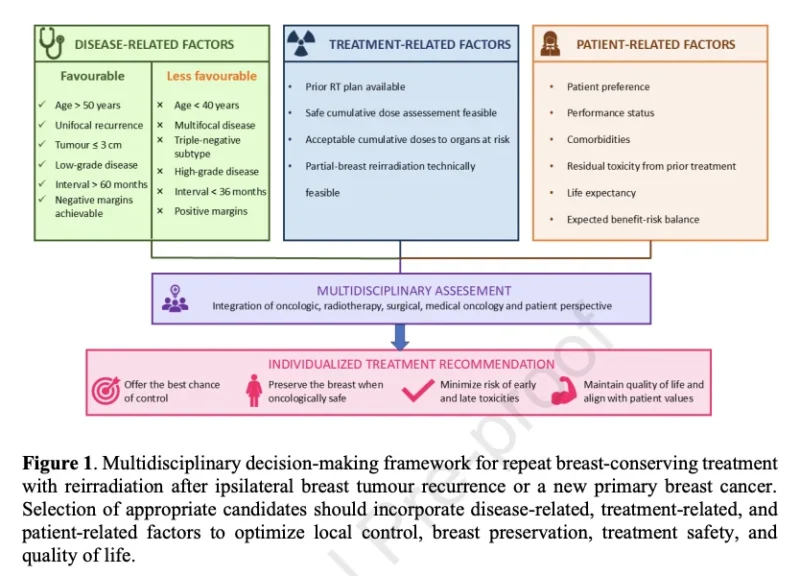
Patient selection represents one of the most important themes of the review. The authors emphasize that the suitability of repeat breast-conserving treatment cannot be determined by tumor size alone.
A longer disease-free interval, smaller tumor burden, unifocal disease, favorable biology, adequate surgical margins, and limited toxicity from previous treatment generally support consideration of a second conservative approach.
Patients older than 50 years, with tumors measuring 3 cm or less, lower-grade disease, and an interval of at least five years since initial radiotherapy may be particularly suitable.
Conversely, multifocal or multicentric disease, positive surgical margins, an early recurrence, substantial previous radiation-related toxicity, and extensive skin involvement may reduce the suitability of repeat conservation.
Aggressive tumor biology also requires careful consideration. However, an international Delphi consensus referenced in the review did not consider HER2-positive or triple-negative subtype to be an absolute contraindication to repeat breast-conserving treatment.
This distinction is important because clinical decisions should integrate multiple factors rather than applying a single exclusion criterion. The review also advises caution in patients carrying pathogenic BRCA1 or BRCA2 variants, for whom the risk of additional primary breast cancers may influence the choice of surgery.
Patient preference remains central. Some women may strongly prioritize preserving their breast, while others may prefer mastectomy because of recurrence concerns or uncertainty about the long-term consequences of another radiation course.
The appropriate decision requires multidisciplinary evaluation and a balanced discussion of both approaches.
The Central Safety Challenge: Cumulative Radiation Exposure
Despite improvements in treatment delivery, cumulative radiation toxicity remains the principal limitation of breast reirradiation. Previously irradiated tissues may have reduced tolerance to additional radiation exposure.
Potential late complications include fibrosis, telangiectasia, fat necrosis, breast deformation, chronic pain, wound-healing difficulties, rib fractures, and cardiopulmonary injury.
The review reports substantial variation in severe toxicity across published studies, with grade 3 or higher events ranging from none to approximately 35% in heterogeneous series. Such variation reflects differences in patient selection, previous radiation dose, reirradiation techniques, treatment volume, fractionation, and duration of follow-up.
Crucially, there are no universally validated cumulative dose constraints for breast reirradiation. The authors discuss expert-proposed objectives, including cumulative maximum doses of approximately 105 Gy for skin and 110 Gy for breast tissue.
However, there is considerable disagreement about appropriate limits for the ribs, chest wall, heart, and brachial plexus. These values are not validated safety thresholds and should not be applied as universal treatment-planning prescriptions.
Reconstruction of the first radiation course, cumulative dose assessment, organ-specific tolerance, and individual treatment history remain essential. An additional challenge is that older radiotherapy plans may be unavailable or incompatible with current planning systems.
Incomplete documentation can make accurate cumulative dose summation difficult. The ReCOG group therefore identifies standardized dosimetric reporting and reliable dose-accumulation methods as major priorities for future research.
Shorter Treatment Courses Could Improve Access
One of the most important unresolved questions concerns the optimal number of fractions. Traditional hyperfractionated reirradiation schedules can be demanding because patients may require twice-daily hospital visits over several weeks.
Shorter courses could improve convenience, reduce travel burden, and potentially expand access to breast-preserving treatment. The ongoing international PRESERVE phase II trial is evaluating partial-breast reirradiation using 26 Gy in five fractions following repeat lumpectomy.
Its objective is to assess the safety and feasibility of ultra-hypofractionated reirradiation in selected patients. However, the effectiveness and long-term toxicity of this schedule cannot yet be considered established on the basis of the trial’s design alone.
Other ongoing studies are evaluating alternative fractionation strategies, surgical timing, and radiation techniques. Collectively, these trials may help determine whether contemporary shorter regimens can maintain local control while reducing treatment burden.
Systemic Therapy Remains an Unresolved Component
Another important knowledge gap concerns how breast reirradiation should be integrated with contemporary systemic therapies. The treatment landscape now includes endocrine therapy, chemotherapy, HER2-directed treatment, CDK4/6 inhibitors, antibody-drug conjugates, and other targeted agents.
However, most published reirradiation series do not provide sufficiently detailed information about systemic therapy timing, duration, and adherence. Consequently, it remains difficult to determine the independent contribution of systemic therapy to the favorable outcomes observed after repeat breast conservation.
Potential interactions between radiation and modern targeted therapies also require investigation. The review emphasizes that treatment sequencing should be individualized according to disease biology, recurrence risk, previous treatment, and anticipated toxicity. It does not establish a standard approach to combining reirradiation with newer systemic agents.
Why the Next Step Must Be Prospective Evidence
Although the evidence supporting repeat conservation has expanded, important uncertainties remain. Most studies are retrospective, relatively small, or restricted to highly selected patients.
Definitions of local recurrence and second primary cancer are inconsistent. Patient-reported outcomes, long-term cosmetic results, and late toxicity are often incompletely captured. Furthermore, comparisons between techniques are complicated by differences in dose, target volume, fractionation, and prior treatment.
The ReCOG authors therefore call for prospective international registries and well-designed clinical trials. Standardized data collection should include previous and current radiation exposure, cumulative organ doses, tumor characteristics, systemic treatments, toxicity, cosmetic outcomes, quality of life, and long-term disease control.
Such efforts could provide the evidence needed to move from individualized institutional practice toward more reliable treatment standards. The recommendations presented in this review represent expert interpretation and research priorities rather than a formal clinical practice guideline.
OncoDaily Takeaway
A second breast cancer event in a previously irradiated breast no longer necessarily means that mastectomy is the only reasonable local treatment option.
Evidence from RTOG 1014, GEC-ESTRO cohorts, and other contemporary studies suggests that repeat lumpectomy followed by partial-breast reirradiation can achieve favorable local control and preserve the breast in carefully selected women.
The five-year local recurrence rate of approximately 5% in RTOG 1014 and the comparable survival observed in propensity-matched comparisons with mastectomy provide meaningful support for this evolving approach.
However, the available evidence does not establish universal equivalence between repeat conservation and mastectomy. Patient selection, complete excision, previous radiation exposure, tumor biology, treatment interval, and patient preference remain critical.
The most important unresolved questions concern cumulative dose tolerance, long-term tissue recovery, optimal fractionation, toxicity prediction, and the integration of modern systemic therapies.
The future of breast reirradiation is therefore not simply about delivering a second radiation course. It is about identifying which women can safely receive a second opportunity for breast conservation without compromising durable cancer control or quality of life.
Sources
- Gabryś D, Aznar M, Beddok A, et al. Reirradiation After Repeat Breast Conserving Treatment: Contemporary Evidence, Technical Approaches, and Expert Recommendations. The Breast. 2026. Journal pre-proof, accepted November 6, 2026. DOI: 10.1016/j.breast.2026.104955
- Arthur DW, Winter KA, Kuerer HM, et al. Effectiveness of Breast-Conserving Surgery and 3-Dimensional Conformal Partial Breast Reirradiation for Recurrence of Breast Cancer in the Ipsilateral Breast: The NRG Oncology/RTOG 1014 Phase 2 Clinical Trial. JAMA Oncology. 2020;6:75–82. DOI: 10.1001/jamaoncol.2019.4320
- Hannoun-Levi JM, Gal J, Van Limbergen E, et al. Salvage Mastectomy Versus Second Conservative Treatment for Second Ipsilateral Breast Tumor Event: A Propensity Score-Matched Cohort Analysis of the GEC-ESTRO Breast Cancer Working Group Database. International Journal of Radiation Oncology, Biology, Physics. 2021;110:452–461. DOI: 10.1016/j.ijrobp.2020.12.029
- Nano J, Shen Y, Allwohn L, et al. Beyond the First Dose: Systematic Review on External Beam Radiotherapy for Locoregional Breast Cancer Recurrence. The Breast. 2026;88:104847. DOI: 10.1016/j.breast.2026.104847