
Kefah Mokbel, Professor of Medicine at Cardiff University School of Medicine, shared on LinkedIn:
“ESMO 2026: Could ctDNA and MRI-guided response assessment transform neoadjuvant treatment de-escalation in TNBC and HER2-positive breast cancer?
Are we approaching an era where the duration and intensity of neoadjuvant systemic therapy could be determined by individual tumour response rather than a fixed treatment schedule?
Ahead of ESMO 2026, preliminary findings from the B-STRONGER-I study in early-stage triple-negative breast cancer (TNBC) suggest that approximately 82% of patients achieved ctDNA clearance after just 2–3 cycles of neoadjuvant systemic therapy.
Although these findings relate specifically to TNBC, the broader implications may extend to HER2-positive breast cancer, where response-adapted treatment de-escalation is also an important area of research.
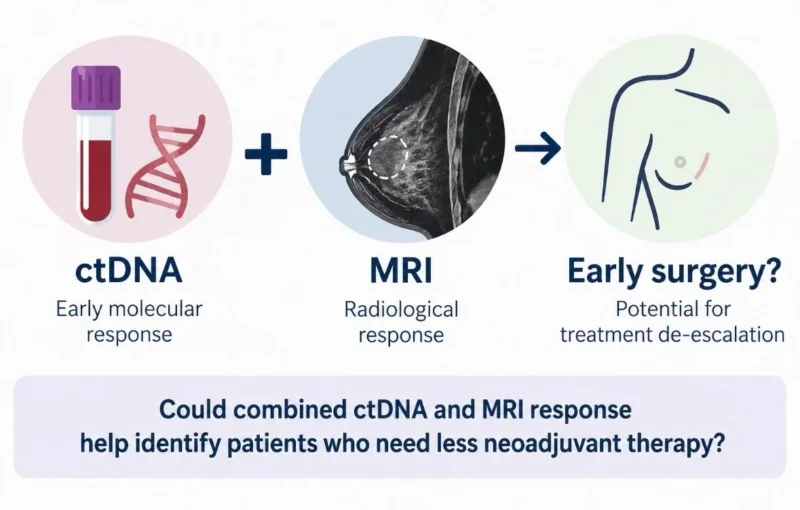
Could combining ctDNA clearance with complete or near-complete MRI response help identify patients who may safely receive less neoadjuvant systemic therapy?
Imagine a patient with TNBC or HER2-positive breast cancer who demonstrates:
- Early and sustained ctDNA clearance
- Complete or near-complete radiological response on breast MRI
Could we proceed directly to surgery rather than completing all planned neoadjuvant treatment?
In TNBC, this might mean avoiding additional chemotherapy, including anthracyclines, in carefully selected patients. In HER2-positive disease, it might mean reducing chemotherapy exposure while maintaining appropriate HER2-directed therapy.
The potential benefits are compelling: less toxicity, improved quality of life and genuinely personalised treatment.
However, several questions remain:
- Can combined ctDNA negativity and MRI response reliably predict pathological complete response (pCR)?
- What is the risk of residual microscopic disease despite concordant molecular and radiological responses?
- Would shortening neoadjuvant treatment compromise event-free or overall survival?
- Could a multimodal strategy incorporating ctDNA, MRI and possibly image-guided biopsy provide sufficient confidence for treatment de-escalation?
My perspective:
Neither ctDNA clearance nor MRI response alone is currently sufficient to justify early discontinuation of standard neoadjuvant treatment.
But their combination may represent a promising direction for prospective response-adapted clinical trials. Perhaps the next frontier is not simply achieving pCR, but identifying how much treatment each patient actually needs to achieve durable cure.
I look forward to the B-STRONGER-I presentation at ESMO 2026 and to further discussion about integrating molecular and imaging biomarkers into treatment decisions.
What do colleagues think? Could combined ctDNA–MRI-guided early surgery become a realistic de-escalation strategy in TNBC and HER2-positive breast cancer?
This should the focus of the next trial.”
You can also read:
ESMO 2026: 10 Breast Cancer ADCs to Watch in Madrid