
Kefah Mokbel, Professor of Medicine (Honorary) at Cardiff University School of Medicine, shared on LinkedIn:
“NRG-BR002: Is It Time to Rethink Metastasis-Directed Ablation in Breast Cancer?
Treating every visible metastasis makes intuitive sense. But does it actually improve survival?
The long-awaited results of NRG-BR002, now published in the Journal of Clinical Oncology, challenge one of the central assumptions behind metastasis-directed therapy in oligometastatic breast cancer.
This randomized phase II/III trial evaluated the addition of metastasis-directed ablation, predominantly SABR/SBRT, to first-line systemic therapy.
The results:
- 125 eligible patients, with ≤4 metastases and no progression on first-line systemic therapy.
- 60% had a single metastasis; 37% had bone-only disease.
- 93% of ablation treatments used SBRT.
Progression-free survival:
- Systemic therapy alone: 23.0 months
- Systemic therapy + ablation: 19.5 months
- HR 0.92 (95% CI 0.57–1.47); P = .36
Overall survival:
- No significant benefit (HR 1.07; 95% CI 0.60–1.89).
The trial did not meet its prespecified efficacy threshold and therefore did not proceed to phase III.
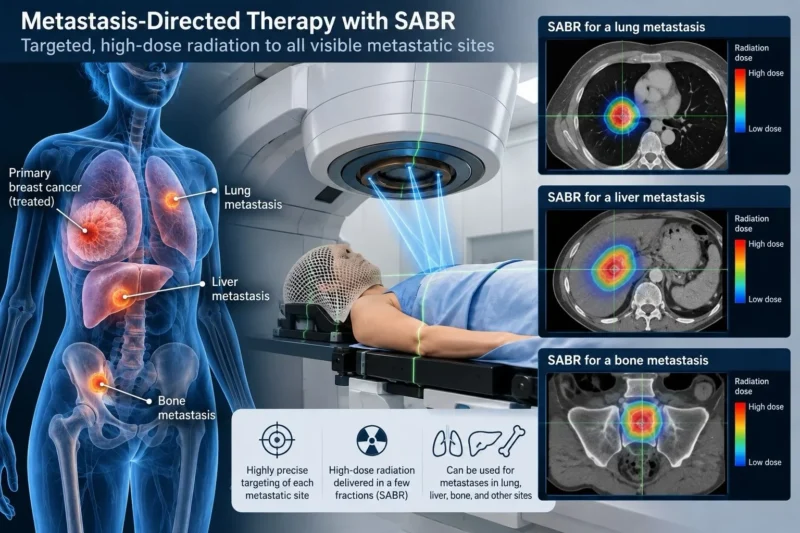
My take
NRG-BR002 should mark a turning point in how we approach oligometastatic breast cancer.
The oligometastatic concept is biologically compelling, and SABR can achieve excellent local control. But the assumption that ablating all visible disease translates into longer survival needs to be tested, not simply accepted.
What makes these findings particularly important is the highly selected population: most patients had very limited metastatic burden, many had bone-only disease, and all had disease controlled on systemic therapy at enrollment.
If a survival benefit cannot be demonstrated in this favourable population, the justification for routine ablation becomes difficult to defend.
Of course, this was a relatively small phase II trial, and the confidence intervals do not exclude a clinically meaningful benefit in selected patients. The exploratory circulating tumour cell findings also deserve further investigation.
Nevertheless, the evidence is insufficient to support routine metastasis-directed ablation with the expectation of improving PFS or OS in this setting.
These findings do not diminish the role of radiotherapy for symptom relief or the prevention of clinically significant skeletal complications, including pathological fractures and spinal cord compression. However, such indications must be distinguished from routine ablation of all visible metastases with the expectation of prolonging survival.
For now, the message is clear: oligometastatic disease is not, by itself, an indication for metastasis-directed ablation.
The ability to eradicate visible metastases is a technical achievement. Demonstrating that this improves patients’ lives or survival is a different matter entirely.
We should be guided by the latter, not the former.”
Title: NRG-BR002: A Randomized Phase II/III Trial of Metastasis-Directed Ablation With First-Line Systemic Therapy for Oligometastatic Breast Cancer
Authors: Steven J. Chmura, Kathryn A. Winter, Wendy A. Woodward, Virginia F. Borges, Joseph K. Salama, Hania A. Al-Hallaq, Martha M. Matuszak, Michael T. Milano, Nora T. Jaskowiak, Reshma Jagsi, Peter Kuhn, Anthony Lucci, Salyna Meas,Stephanie N. Shishido, Jeremy Mason, Jose G. Bazan, Robert A. Nordal, David Y. Lee, Benjamin D. Smith, Zsolt Gabos, Jason C. Ye, Shannon T. Kahn, Laura A. Vallow, Imran Zoberi, Wajeeha Razaq, Mark V. Mishra, Kristin M. Lupinacci, Jennifer Moughan, Eleftherios P. Mamounas, Julia R. White.
Read the full article.
You might be interested in:
FDA Approves Tucatinib as Front-Line Maintenance in HER2-Positive Metastatic Breast Cancer