
Kefah Mokbel, Professor of Medicine at Cardiff University School of Medicine, shared on LinkedIn:
“SLNB Omission in Real-World Practice: 28% Eligible, 13% Occult Nodal Disease
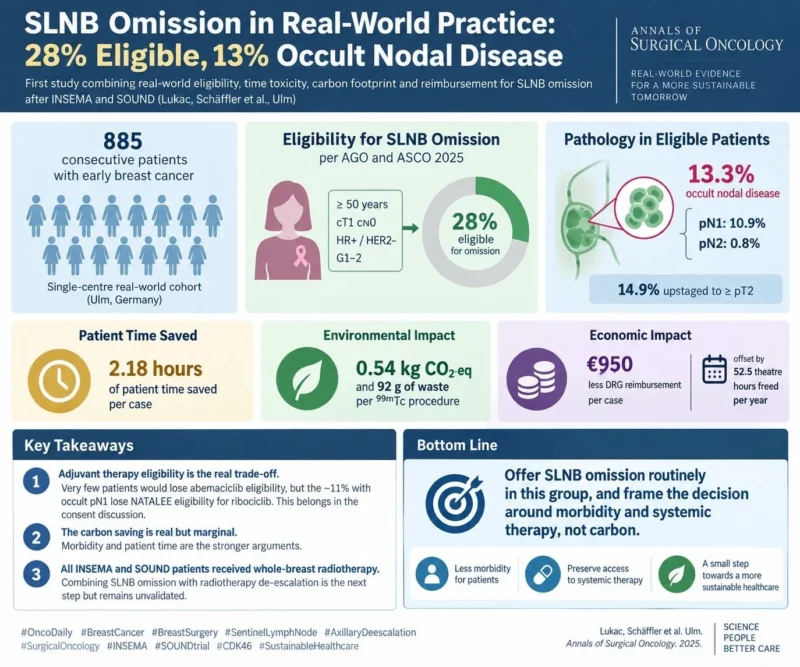
New in Annals of Surgical Oncology (Lukac, Schäffler et al., Ulm): the first study combining real-world eligibility, time toxicity, carbon footprint and reimbursement for SLNB omission after INSEMA and SOUND.
885 consecutive patients with early breast cancer: eligibility per AGO and ASCO 2025 (≥50, cT1 cN0, HR+/HER2−, G1–2).
- 28% eligible for omission
- 13.3% occult nodal disease (pN1 10.9%, pN2 0.8%)
- 14.9% upstaged to ≥pT2
- 2.18 h of patient time saved per case
- 0.54 kg CO2-eq and 92 g of waste per 99mTc procedure
- €950 less DRG reimbursement per case, offset by 52.5 theatre hours freed per year
My take
- The real trade-off is adjuvant therapy eligibility. Very few patients would lose abemaciclib eligibility, but the ~11% with occult pN1 lose NATALEE eligibility for ribociclib. This belongs in the consent discussion.
- The carbon saving is real but marginal. Morbidity and patient time are the stronger arguments.
- All INSEMA and SOUND patients received whole-breast radiotherapy. Combining SLNB omission with radiotherapy de-escalation is the next step but remains unvalidated.
Bottom line: offer SLNB omission routinely in this group, and frame the decision around morbidity and systemic therapy, not carbon.”
You might be interested in:
Premenopausal HR+/HER2− Early Breast Cancer: Moving Beyond One-Size-Fits-All Adjuvant Therapy