
Kefah Mokbel, Chair of Breast Cancer Surgery at London Breast Institute, shared on LinkedIn:
“Rethinking Chemotherapy for Small Node-Negative Triple-Negative Breast Cancer
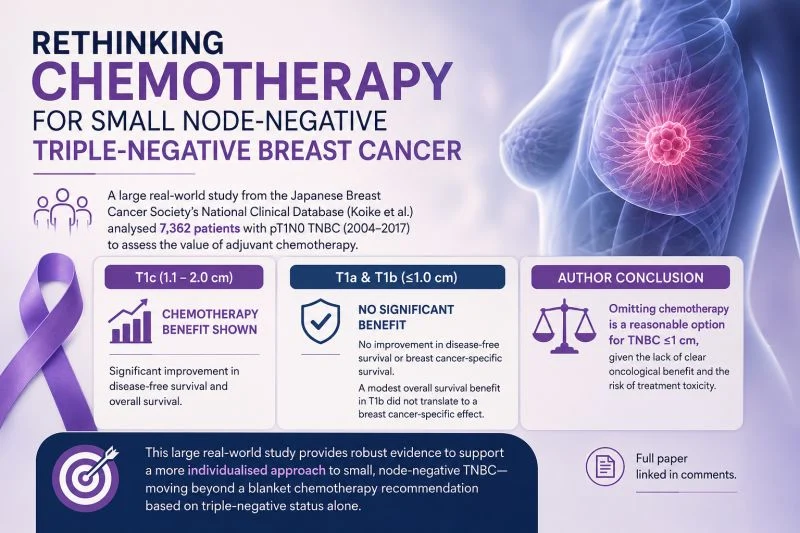
A large real-world study from the Japanese Breast Cancer Society’s National Clinical Database (Koike et al.) offers important clarity on a genuinely controversial question: does adjuvant chemotherapy benefit patients with pT1N0 triple-negative breast cancer when the tumour is 1 cm or smaller?
The study analysed 7362 patients with pT1N0 TNBC registered between 2004 and 2017, comparing outcomes with and without adjuvant chemotherapy across T1 subcategories.
For T1c tumours (1.1 to 2.0 cm), chemotherapy significantly improved disease-free survival and overall survival, confirming its established value in this group.
For T1a and T1b tumours (≤1.0 cm), no significant benefit was seen for disease-free survival or breast cancer-specific survival. A modest overall survival improvement in the T1b subgroup did not translate to a breast cancer-specific effect, suggesting it may reflect factors unrelated to the cancer itself.
The authors conclude that omitting chemotherapy is a reasonable option for TNBC ≤1 cm, given the absence of clear oncological benefit set against real treatment-related toxicity.
This adds meaningful, large-scale real-world evidence to a debate that has long relied on small subgroup analyses. It supports a more individualised approach to small, node-negative TNBC rather than a blanket chemotherapy recommendation based on triple-negative status alone.
My comments
A few limitations are worth flagging. This is a retrospective registry analysis spanning 2004 to 2017, a period during which chemotherapy regimens, staging accuracy, and pathological subtyping all evolved considerably, which likely contributes to heterogeneity within the T1a/b group itself. Registry data also cannot fully control for unmeasured selection bias in who received chemotherapy versus who did not, and the T1b subgroup in particular is underpowered for definitive conclusions given the wide confidence intervals.
This mirrors a broader pattern in the literature: NCCN treats T1b (0.6 to 1 cm) as a ‘consideration’ category rather than a clear recommendation, and SEER-based analyses in T1bN0M0 TNBC have similarly failed to show a breast cancer-specific survival benefit from chemotherapy in this band. The inconsistency in the literature largely stems from exactly this size range being treated differently across guidelines and datasets.
In our own practice, we offer adjuvant AC free chemotherapy to selected patients with T1bN0M0 TNBC. Studies like this one add useful real-world data, but the exact threshold for de-escalation remains a judgement call, not a settled figure.”
Title: Efficacy of adjuvant chemotherapy for triple-negative early breast cancer with tumor size ≤ 1 cm and node-negative from the National Clinical Database-Breast Cancer Registry in Japan
Authors: Yoshikazu Koike, Hiraku Kumamaru, Takayuki Iwamoto, Naoko Kinukawa, Takanori Ishida, Shigehira Saji, Naruto Taira
Read the full article.
You can also read:
The CDK4/6 Inhibitor Story Is Entering Its Next Chapter in Breast Cancer