Jason Mouabbi, Assistant Professor at MD Anderson Cancer Center, shared on LinkedIn:
“Is T-DM1 still useful after T-DXd in HER2+ MBC?
Two datasets seem to disagree, but they’re answering different questions.
UT MD Anderson ( Akshara R., Vicente Valero et al, Breast Cancer Research): 21 patients got T-DM1 after T-DXd. ORR was 0%, median PFS 2.2 months, and median OS 11.3 months. Only 10% had stable disease for 24 weeks or more.
ESMO – European Society for Medical Oncology 2025 (DB-02/03 exploratory analysis; Poster 322P Fasching et al.): 61 DB-03 patients got T-DM1 as their first HER2 therapy after T-DXd, with a median duration of treatment of 7.6 months. The conclusion was that HER2 therapies “remain effective.”
Why the gap? The ESMO analysis measured duration of treatment, not PFS or response. It included patients who stopped T-DXd for any reason, including ILD, and they were trial patients treated earlier. The MDA cohort was real-world and more heavily pretreated, with short prior T-DXd exposure (median 5.5 months).
The JNCI real-world data fit this (Paolo Tarantino). rwPFS on T-DM1 after T-DXd was 4.6 months overall but about 15 months when started before progression.
Takeaway: after progression on T-DXd, T-DM1 has little activity, which suggests cross-resistance between ADCs with the same target. After stopping T-DXd for toxicity, it’s a reasonable option.”
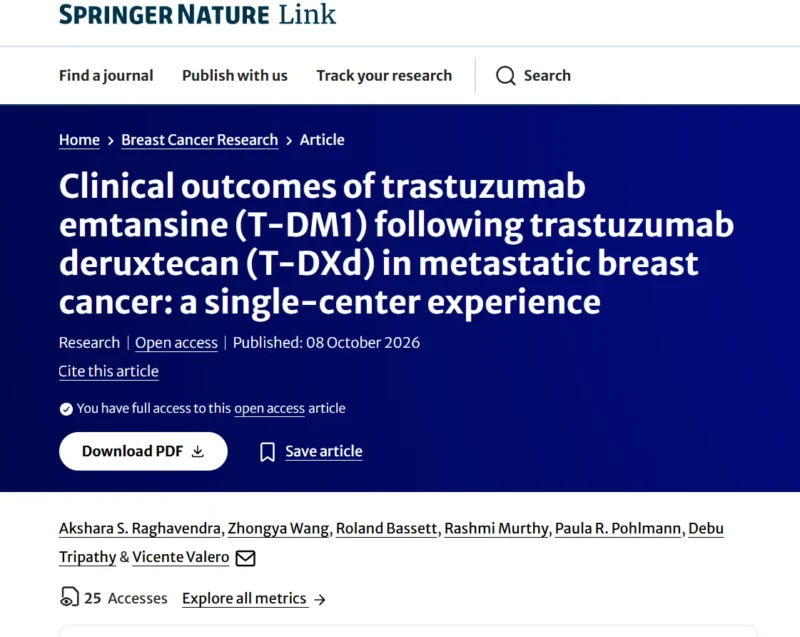
Title: Clinical outcomes of trastuzumab emtansine (T-DM1) following trastuzumab deruxtecan (T-DXd) in metastatic breast cancer: a single-center experience.
Authors: Akshara S. Raghavendra, Zhongya Wang, Roland Bassett, Rashmi Murthy, Paula R. Pohlmann, Debu Tripathy, Vicente Valero.
You can also read: Trastuzumab Deruxtecan Approved in China for HER2-Positive Early Breast Cancer With Residual Disease.