Jasmin Hundal, Chair of Hematology – Oncology Research Fellowship Working Group at Cleveland Clinic, shared on LinkedIn:
“A recent article I have been thinking about is how AI can help. Digital care has improved access, but it has also created a new category of clinical work that many health systems have not adequately designed for.
A new JCO Oncology Practice study of more than 83,000 hematology visits found that nearly 20% were virtual. Older and rural patients used virtual care at rates comparable with other groups, challenging assumptions about who can engage with telehealth.
But the more important finding may be what happened outside the visit.
Nearly 50,000 patient – initiated portal messages generated more than 343,000 additional EHR messages, a nearly 7-fold downstream cascade.
At the same time, 86.8% of clinicians reported spending more than 30 minutes per day managing the in – basket, while 94.3% were not routinely billing for that work!
The solution cannot simply be asking clinicians to answer messages faster.
We need to redesign the workflow.
AI could help create a more structured digital front door:
- classify incoming messages by urgency and complexity
- route protocol – based questions to the appropriate team member
- summarize the relevant clinical context
- draft responses for clinician review
- identify conversations that should be converted from asynchronous messaging into a virtual or in-person visit.
That could support a more intentional care model:
High-acuity or complex decisions – in-person care
Stable surveillance and selected follow-up – virtual care
Routine, protocol-driven needs – team-based asynchronous care
Complex digital conversations – converted into a scheduled encounter
Implementation will also require measurement. Health systems should track response time and message volume, but also downstream message proliferation, escalation rates, clinician touch time, conversion to visits, patient satisfaction, safety events, and whether AI meaningfully reduces rather than redistributes workload.
And there is an equity component – Digital systems should be designed for patients with different levels of digital literacy, language preference, and access to video technology rather than assuming one digital pathway will work for everyone. This study found substantially lower virtual and messaging engagement among patients who prefer non – English languages.
AI should not become another layer added onto an already fragmented system.
Its real value will be in helping us decide what needs a physician, what needs the broader care team, what needs a visit, and what can safely be handled digitally.
The goal is not a faster inbox. It is a better – designed model of care.”
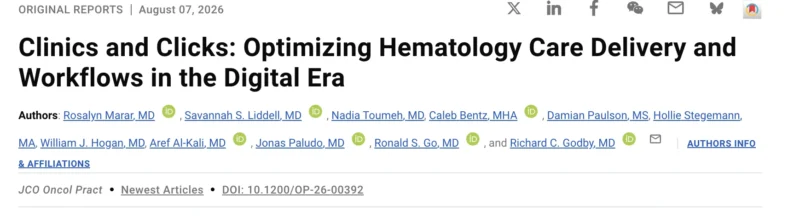
Title: Clinics and Clicks: Optimizing Hematology Care Delivery and Workflows in the Digital Era
Authors: Rosalyn Marar, Savannah S. Liddell, Nadia Toumeh, Caleb Bentz, Damian Paulson, Hollie Stegemann, William J. Hogan, Aref Al-Kali, Jonas Paludo, Ronald S. Go, Richard C. Godby
Read the Full Article
You can also read: Can you trust AI with your CANCER? Shaalan Beg