The FDA’s accelerated approval of Zenbexus (iberdomide) combined with subcutaneous daratumumab and dexamethasone marks a landmark shift in multiple myeloma treatment, offering a potent new option for patients with relapsed or refractory disease after just one prior line of therapy.
Here is what leading experts and industry leaders are saying about this breakthrough:
C. Ola Landgren, Professor of Medicine, Chief of Myeloma Division at University of Miami, shared on LinkedIn:
“Today marks a defining moment for the future of multiple myeloma drug development!
The FDA has granted accelerated approval to Zenbexus (iberdomide), in combination with subcutaneous daratumumab and dexamethasone, for patients with relapsed or refractory multiple myeloma who have received at least one prior line of therapy including a proteasome inhibitor and an immunomodulatory agent.
This is the first FDA accelerated approval in multiple myeloma based on minimal residual disease (MRD) as an early endpoint.
The phase 3 EXCALIBER-RRMM trial randomized 939 patients with relapsed or refractory multiple myeloma after one or two prior lines of therapy. In the primary efficacy population of 420 patients, iberdomide plus daratumumab and dexamethasone nearly doubled the rate of MRD-negative complete response compared with daratumumab, bortezomib, and dexamethasone: 41% versus 21% (p<0.0001). The safety profile was consistent with the expected effects of the regimen: neutropenia and infections were common and require careful monitoring and supportive care, although only 7.8% discontinued treatment because of adverse reactions. Follow-up for progression-free and overall survival continues.
For many years, we worked intensely on the EVIDENCE meta-analysis to establish the scientific foundation for MRD as an early endpoint capable of supporting accelerated approval. That effort required sustained collaboration among investigators, regulators, industry partners, statisticians, and, most importantly, patients participating in clinical trials. It is tremendously rewarding to see that work now translated into regulatory action.
This approval is about more than one new therapy. It establishes a path toward faster and more precise drug development, allowing highly active treatments to reach patients earlier while confirmatory clinical outcomes continue to mature.
The future of myeloma research will increasingly be shaped by deeper response assessment, MRD-guided clinical trials, and biologically informed treatment strategies. Today represents an important step toward that future.
Congratulations to everyone who helped make this possible, and especially to the patients whose participation and trust continue to move our field forward!”
Title: EVIDENCE meta-analysis: evaluating minimal residual disease as an intermediate clinical end point for multiple myeloma
Authors: Ola Landgren, Thomas J Prior, Tara Masterson, Christoph Heuck, Orlando F Bueno, Ajeeta B Dash, Hermann Einsele, Hartmut Goldschmidt, Stefan Knop, Cong Li, Ulf-Henrik Mellqvist, Ian McFadden, Corina Oprea, Jeremy A Ross, Mihaela Talpes, Jay R Hydren, Jennifer M Ahlstrom, Dickran Kazandjian, Niels Weinhold, Rick Zhang, Maryalice Stetler-Stevenson, Gerald Marti, Sean M Devlin.
Read the full article.
Michael Amatangelo, Scientific Director at Bristol Myers Squibb, also shared his perspective on LinkedIn:
“Iberdomide granted accelerated approval. It took a village. Feeling incredibly grateful to have played a part in the journey and to have worked alongside so many exceptional colleagues.
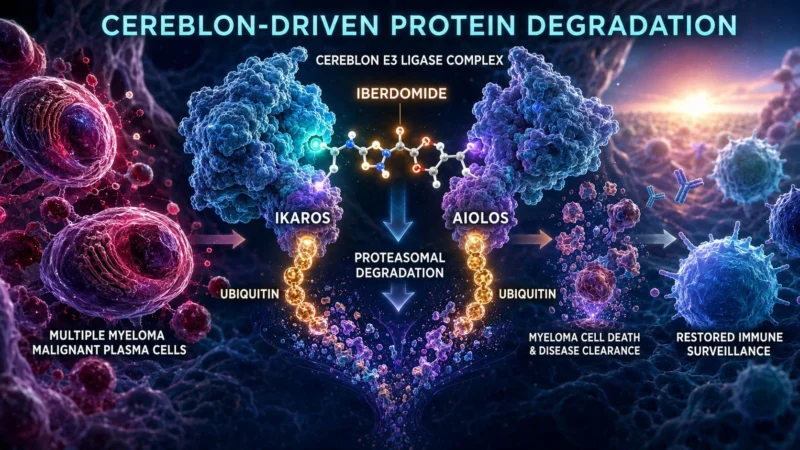
This is a meaningful milestone for patients and the field reflecting years of translational science: from preclinical work that supported prioritizing development in multiple myeloma and informed combination strategies, to PK/PD analysis that guided dose optimization and selection, to mechanistic studies that helped define cereblon-modulating protein degraders as a therapeutic class, and ultimately to the successful implementation of an MRD strategy, supported by a qualified assay and rigorous sample quality monitoring, enabling the endpoint that formed the basis of accelerated approval, a first for a myeloma therapy!”
Rahul Banerjee, Associate Professor at Fred Hutch, also reflected on the news on X, adding:
“And since patients (and doctors!) will be asking about iberdomide immediately in myeloma.
REMS program won’t go live until September 14th at the earliest, so not possible to prescribe commercial iberdomide still after then. There’s a Green Day song for this…
And I’ll add, reviewing FDA announcement:
- Iberdomide approved in myeloma after 1 prior line
- MRD-neg CR as basis for accel approval, woohoo!
- 41% MRD-neg CR with Iber-Dd in RRMM. Both DVd here and DKd in final CANDOR was ~20% MRD-neg CR, so essentially doubled.
VTE PPx still needed; I’ve moved to DOACs for most. REMS still needed… brand name ZENBEXUS so maybe I’ll start saying Dara-Zd ? No, I’ll still say Iber-Dd…
CELMoDs – from the subject of podcasts to the subject of clinic discussions! …. but we’ll still need podcasts.
- Be ready to give G-CSF during Cycle 1 and push through… neutropenia will often improve with time.
- VTE PPx still imperative from what we know.”
This also can be interesting: FDA Grants Accelerated Approval to Iberdomide Combination for Multiple Myeloma Based on MRD-Negative CR