Henry Fung, Chair and Professor of Department of Bone Marrow Transplant and Cellular Therapy at Fox Chase Cancer Center, shared on X:
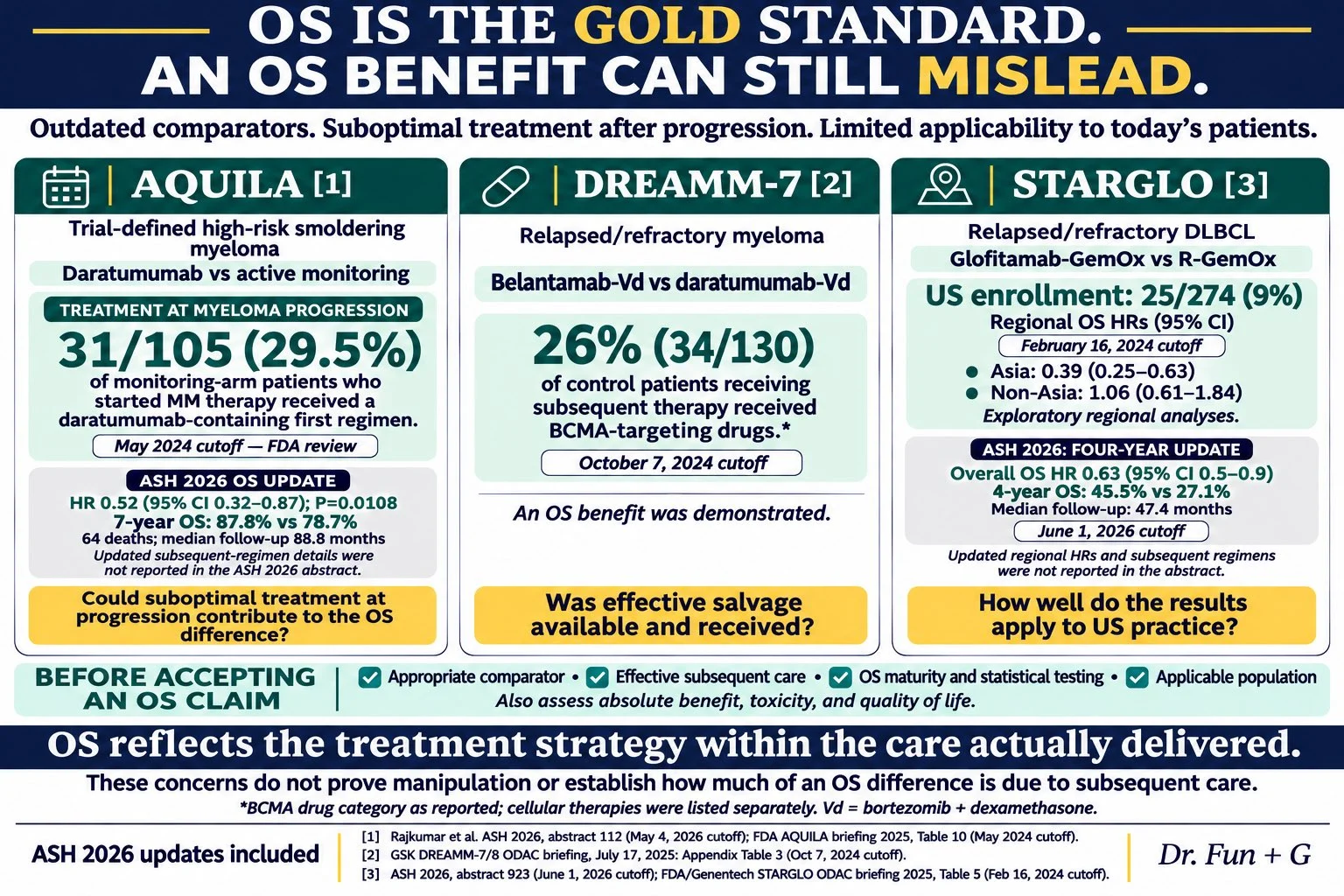
“Are the OS benefits reported in AQUILA, DREAMM-7 and STARGLO misleading?
OS is the gold standard. But beating a trial’s control arm does not necessarily mean beating today’s best care. Before calling these results ‘practice-changing,’ ask:
- Was the comparator adequate?
- Did patients have access to effective treatment after progression?
- Do the findings apply to our patients today?
Let’s critically review these trials – including the latest ASH26 updates – and examine what the survival headlines actually prove. ‘Improves survival‘ should start the discussion-not shut it down.
AQUILA
ASH 2026 strengthens the OS evidence:
- HR 0.52;
- 7-year OS 87.8% versus 78.7%.
But earlier FDA data showed that only 31/105 monitoring-arm patients who started myeloma treatment received a daratumumab-containing first regimen. The new abstract does not update that treatment breakdown.
DREAMM-7
An OS benefit was demonstrated. In the October 2024 dataset, 34/130 control patients receiving subsequent therapy received drugs in the reported BCMA-targeting category; cellular therapies were listed separately. Access to effective salvage remains relevant to interpretation.
STARGLO
ASH 2026 confirms a sustained overall survival advantage:
- HR 0.63;
- four-year OS 45.5% versus 27.1%.
Yet US enrollment was only 9%, and earlier exploratory regional estimates differed substantially. Updated regional and subsequent-treatment data would help assess applicability.
These observations do not establish how much subsequent care contributed to the survival differences. They identify questions that an OS headline alone cannot answer.
A real survival advantage within a trial does not automatically establish superiority over the best contemporary treatment sequence.
Read beyond the hazard ratio.”
Continue exploring: