Henry Fung, Chair and Professor, Department of Bone Marrow Transplant and Cellular Therapy at Fox Chase Cancer Center, shared on X:
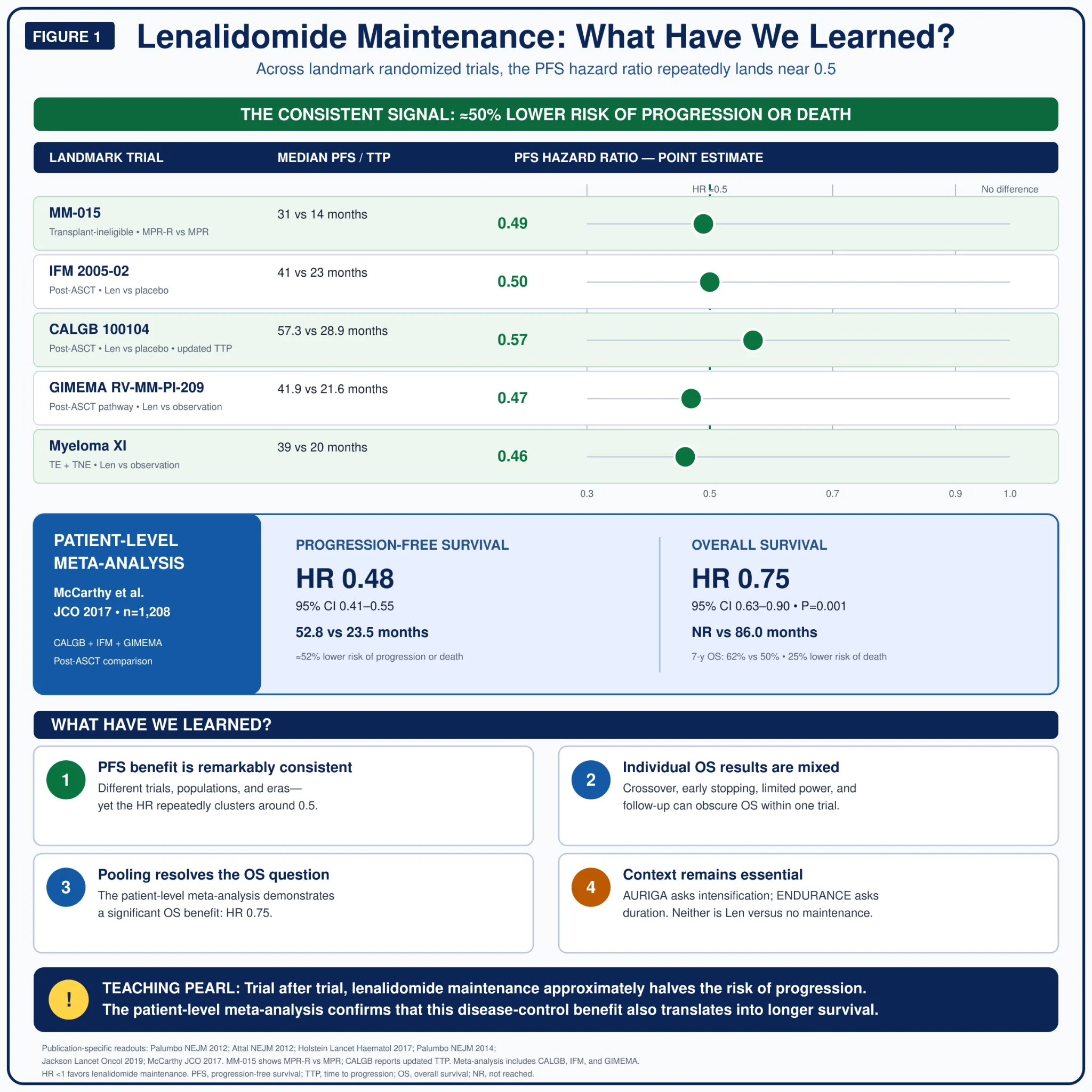
“Lenalidomide maintenance: what have two decades of trials actually taught us?
The PFS benefit is remarkably consistent-but population, duration, exposure, biology, and trial design all matter. A visual mini-series on what the evidence proves-and what it does not.
Lenalidomide exposure: planned duration matters.
Landmark trials did not all test the same strategy. Some planned 2 or 3 years; others continued until progression or unacceptable toxicity. ‘Lenalidomide maintenance’ is not one uniform intervention.
Lenalidomide maintenance: intention ≠ execution.
Yesterday: what duration did the protocols plan?
Today: how much lenalidomide exposure was actually delivered?
Even when treatment was assigned ‘until progression,’ reported exposure was often only approximately 1.5–3 years:
- IFM 2005-02: median 24 months
- CALGB 100104: median 31 months
- Myeloma XI: median 18 cycles
- SWOG S0777: median 17.1 months
- Patient-level post-ASCT meta-analysis: mean 28 months.
Progression, toxicity, withdrawal, crossover, administrative stopping, and protocol changes all shortened treatment. ‘Until progression’ describes the intended strategy-not indefinite treatment and not the exposure every patient received.
Tomorrow: truths versus myths about lenalidomide maintenance.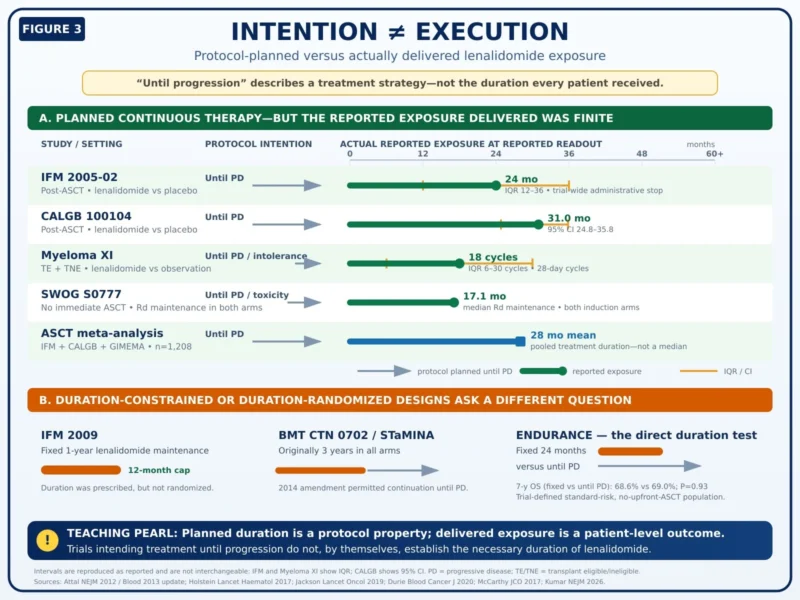
Lenalidomide maintenance: TRUTHS vs MYTHS
The evidence is strong-but its interpretation requires context. Lenalidomide consistently improves PFS and the post-ASCT meta-analysis demonstrated an OS benefit. But:
- ‘Until progression’ does not mean every patient remains on therapy indefinitely.
- Every trial did not test the same duration strategy.
- ‘Standard-risk’ has not meant the same thing across different eras.
- ENDURANCE should not be extrapolated beyond its selected, trial-defined population.
- Calendar time alone should not determine when maintenance stops.
Dose, biology, depth and durability of response, toxicity, patient preference, and actual treatment exposure all matter. Every randomized trial answers an important clinical question. The challenge is understanding exactly what it proves-and equally importantly, what it does not. Tomorrow: practical questions and answers about lenalidomide maintenance.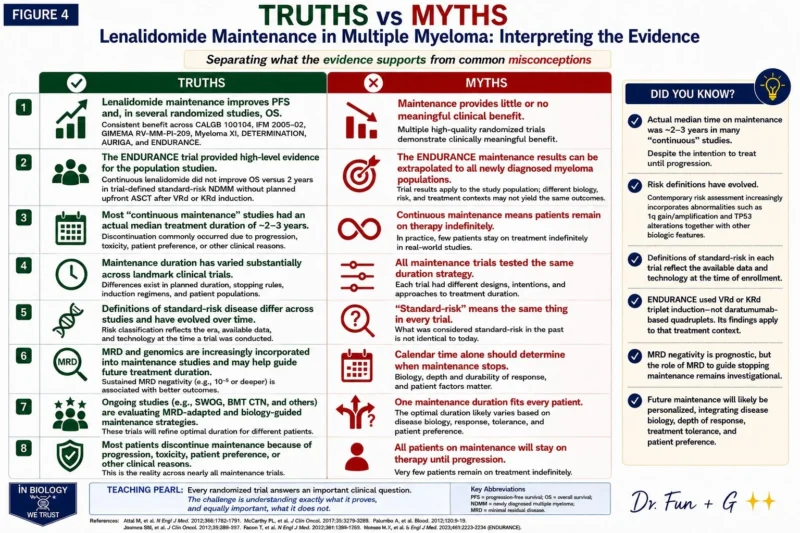
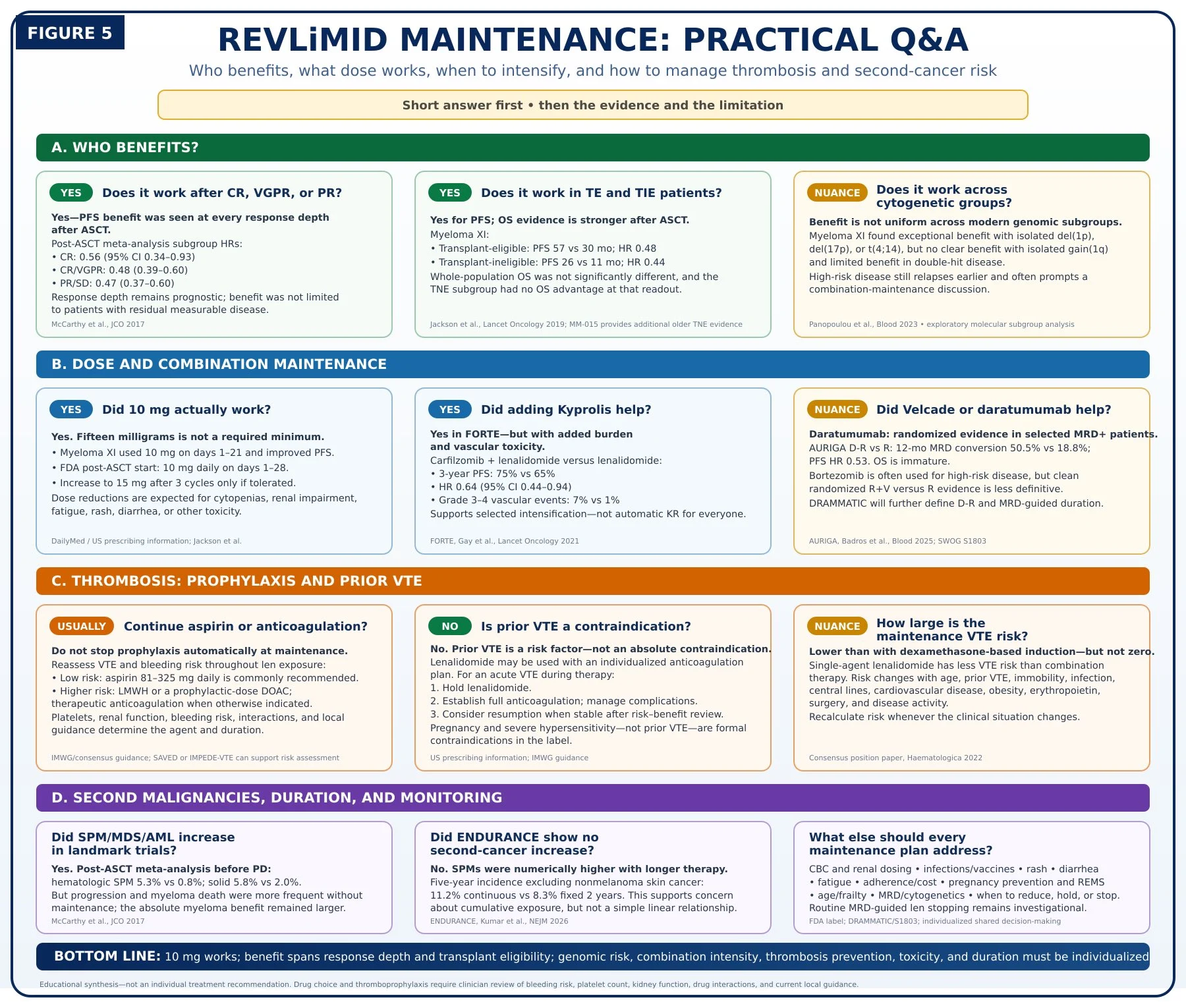
Lenalidomide maintenance: Practical QandA
- Does it work after CR, VGPR, or PR? In transplant-eligible and transplant-ineligible patients?
- Did 10 mg work-or is 15 mg required?
- Does adding carfilzomib, bortezomib, or daratumumab help?
- Should thromboprophylaxis continue?
- Is prior VTE a contraindication?
- Did second malignancies increase?
Short answers:
- PFS benefit spans response depth and transplant eligibility.
- Ten milligrams is an effective studied dose; 15 mg is not a required minimum.
- Combination maintenance can help selected patients-but is not automatically appropriate for everyone.
- Thromboprophylaxis should remain risk-adapted during lenalidomide exposure. Prior VTE is a risk factor-not an absolute contraindication.
- Second-primary malignancy risk is real, but the absolute reduction in myeloma progression remains larger.
The practical answer is rarely simply ‘continue’ or ‘stop.’ Biology, genomic risk, response depth, MRD durability, toxicity, thrombosis risk, renal function, and patient preference must all be considered. Tomorrow: what does progression during lenalidomide maintenance mean-and how should it change treatment?
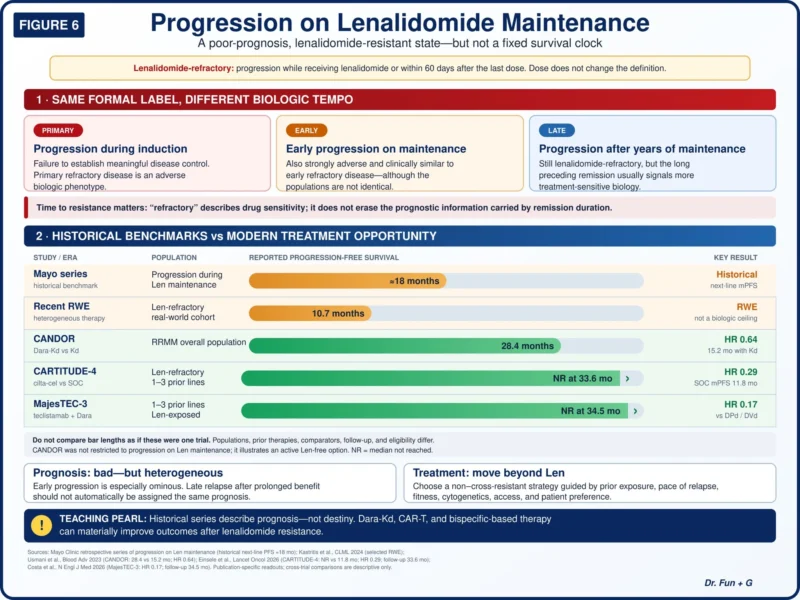
Lenalidomide maintenance: what happens when myeloma progresses?
Progression on Len-or within 60 days of the last dose-defines Len-refractory disease. But the label is not the whole prognosis: early progression and relapse after years of disease control are not biologically equivalent.
Historical next-line PFS was approximately 18 months; some recent RWE reported only 10.7 months. These are benchmarks-not destiny. Although cross-trial comparisons are imperfect, Dara-Kd, cilta-cel, and teclistamab-Dara demonstrate how modern therapy may substantially improve outcomes.
‘Refractory’ describes drug sensitivity-not a fixed survival clock.
Lenalidomide maintenance: We are done-let’s have dinner!
Fellow: ‘Maybe no more REvlimid today?’
Dr. Fun + G: ‘How about Chinatown for some REd meat-Hong Kong–style beef chow fun-and REd wine?’ Our complete visual series:
- What have we learned?
- Planned duration matters
- Intention ≠ execution
- Truths vs myths
- Practical QandA
- Progression on Len maintenance
- Time for beef chow fun!
The final lesson: Lenalidomide maintenance works-but population, disease biology, planned duration, actual exposure, tolerance, response depth, and patient preference all matter. Maintenance should be individualized through informed, shared decision-making-not reduced to one duration for every patient.
Thank you for following the entire series. In biology-and good food-we trust!”
Find out more: