The results of the randomized, prospective phase III ENDURANCE (E1A11) trial, designed and conducted by the ECOG-ACRIN Cancer Research Group (ECOG-ACRIN), were published on July 15, 2026, in the New England Journal of Medicine.
Clinical Context
Treatment outcomes for newly diagnosed multiple myeloma have improved considerably over the past two decades. As patients achieve deeper and more durable responses with modern induction therapy, maintenance treatment has become an integral part of care to sustain disease control, delay relapse, and prolong survival. Lenalidomide (Revlimid®) is the most commonly used maintenance therapy and is continued until disease progression despite longstanding uncertainty regarding its optimal duration.
Continuous maintenance exposes patients to cumulative toxicities, increases treatment burden, and raises healthcare costs. Many patients also discontinue lenalidomide before disease progression because of adverse effects or personal preference. Defining whether a fixed duration of maintenance can provide comparable long-term outcomes has therefore become one of the most important clinical questions in multiple myeloma, and the phase III ENDURANCE trial was undertaken to address it.
Methods
ENDURANCE was a randomized, open-label, phase III trial conducted by the ECOG-ACRIN Cancer Research Group. The maintenance phase evaluated whether continuous lenalidomide would improve overall survival compared with a predefined maintenance duration of two years.
Eligible patients had newly diagnosed standard-risk multiple myeloma and were considered ineligible for, or had chosen not to undergo, upfront autologous stem-cell transplantation. Patients with high-risk cytogenetic abnormalities, including del17p, t(14;16), and t(14;20), were excluded. Participants entered the maintenance phase after completing induction therapy without disease progression and after recovery from treatment-related toxicities.
The primary endpoint was overall survival. Secondary endpoints included progression-free survival, treatment response, safety, quality of life, treatment exposure, and second primary malignancies.
How the ENDURANCE Trial Was Designed
The ENDURANCE trial consisted of two sequential randomizations. The first compared KRd (carfilzomib, lenalidomide, and dexamethasone) with VRd (bortezomib, lenalidomide, and dexamethasone) as induction therapy, results from which have been reported previously.
The present analysis focuses on the second randomization, in which patients were assigned in a 1:1 ratio to one of two maintenance strategies:
- Continuous maintenance: lenalidomide 15 mg daily on days 1-21 of each 28-day cycle until disease progression or unacceptable toxicity.
- Fixed-duration maintenance: the same lenalidomide schedule for two years.
A total of 516 patients entered the maintenance phase: 260 assigned to continuous treatment and 256 assigned to fixed-duration therapy. Baseline demographic and disease characteristics were well balanced. The median follow-up exceeded seven years, providing one of the longest evaluations of maintenance duration available in multiple myeloma.
Results
At the time of analysis, only 35 patients receiving continuous maintenance remained on treatment. Patients assigned to continuous therapy received a mean of 38.5 maintenance cycles compared with 18.2 cycles in the fixed-duration group.
Dose reductions occurred more frequently with prolonged treatment. Approximately 62% of patients receiving continuous maintenance required dose modification because of adverse events compared with 44.5% of those assigned to two years of therapy. Autologous stem-cell transplantation performed after relapse occurred at similar frequencies in both groups.
No Survival Advantage With Continuous Maintenance
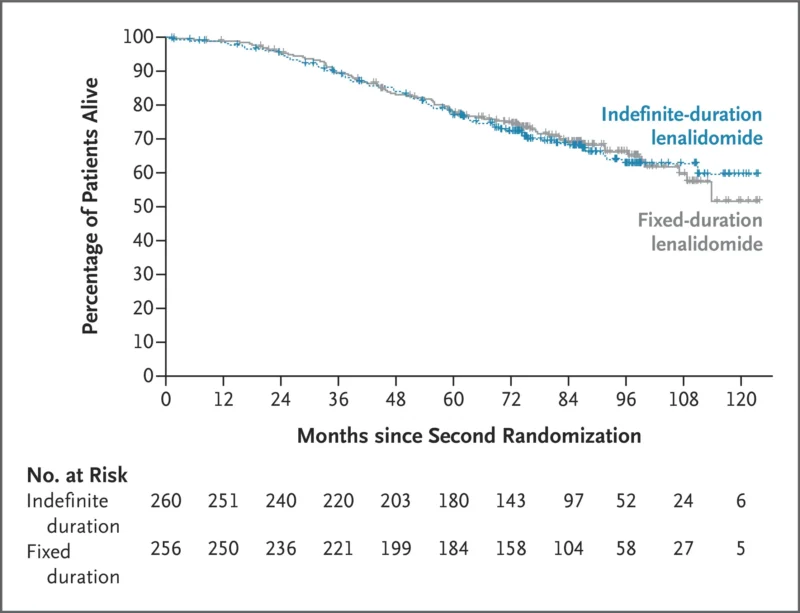
After a median follow-up of 86 months, 160 deaths had occurred, with 80 deaths reported in each treatment group. Seven-year OS was 68.6% with continuous maintenance and 69.0% with fixed-duration maintenance (P=0.93). Additional analyses censoring patients at the initiation of non protocol therapy produced similar findings. Landmark analyses performed after completion of two years of maintenance also confirmed the absence of an OS benefit with continued lenalidomide therapy.
Progression-Free Survival Showed Only Modest Numerical Differences
Disease progression or death occurred in 317 patients during follow-up. Median PFS measured 42.5 months in the continuous maintenance group and 38.9 months in the fixed-duration group. Seven-year PFS rates were 36.1% and 29.7%, respectively. Additional exploratory analyses accounting for nonprotocol therapy numerically favored continuous treatment, though the overall pattern remained consistent with the primary analysis.
Maintenance Therapy Preserved Deep Responses in Both Groups
Partial response or better was achieved in more than 92% of treated patients during maintenance. Very good partial response or better occurred in over 83% of patients in both groups. Complete response rates remained similar, reaching 46.7% with continuous maintenance and 49.2% with fixed-duration treatment. These findings indicate that extending lenalidomide maintenance did not produce a meaningful increase in response depth after induction therapy.
Longer Treatment Duration Increased Toxicity
Grade 3 or higher hematologic and nonhematologic adverse events occurred in 62.4% of patients receiving continuous maintenance compared with 46.9% in the fixed-duration group. Treatment-related grade 3 or higher adverse events were also more common with prolonged therapy.
Treatment discontinuation because of adverse events occurred in 15.3% of patients assigned to continuous maintenance and 9.8% of those assigned to two years of therapy. Fatigue, anemia, neutropenia, and diarrhea represented the most frequent reasons for discontinuation.
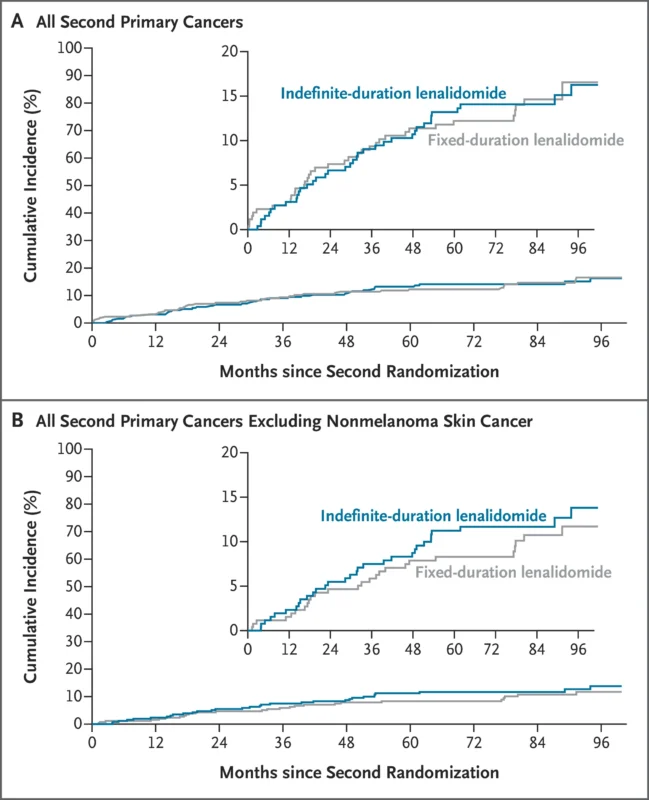
Second primary malignancies occurred in both groups. Excluding nonmelanoma skin cancers, the five-year cumulative incidence measured 11.2% with continuous maintenance and 8.3% with fixed-duration treatment. Quality-of-life assessments were collected throughout the study, though declining patient participation over time limited definitive conclusions.
Discussion
The ENDURANCE trial provides prospective randomized evidence addressing one of the most common questions in multiple myeloma management. The central finding is straightforward. Extending lenalidomide maintenance until disease progression did not improve overall survival compared with stopping treatment after two years in this population of patients with standard-risk disease. This observation is clinically important because maintenance therapy has frequently been continued indefinitely despite limited evidence for its optimal duration.
The results also emphasize that treatment duration should be evaluated independently from treatment efficacy. Maintenance therapy clearly remains beneficial compared with no maintenance. This study examined two accepted maintenance strategies, indicating that much of the benefit of lenalidomide maintenance may be achieved during the first two years of therapy.
Safety findings are equally relevant. Prolonged exposure increased cumulative toxicity, leading to more dose reductions and more treatment discontinuations. Many adverse effects associated with lenalidomide may persist for years and influence daily functioning even when disease remains controlled. These are increasingly important as patients experience longer survival and spend more time receiving maintenance therapy.
Economic considerations also deserve attention. Continuous maintenance substantially increases treatment costs for patients and healthcare systems. A fixed-duration strategy that maintains similar long-term survival could reduce financial burden without compromising clinical outcomes in appropriately selected patients. High-risk disease was excluded, and modern quadruplet induction regimens were not part of the treatment strategy.
Ongoing studies will determine whether maintenance duration should differ in patients with high-risk cytogenetics, measurable residual disease-guided treatment approaches, or transplant-based treatment pathways, and identify patients who can safely discontinue therapy earlier.
Expert Commentary
In an International Myeloma Foundation (IMF) news release accompanying the publication, lead author Dr. Shaji Kumar, Member of the IMF Scientific Advisory Board, co-chair of the ECOG-ACRIN Myeloma Committee, and Professor of Medicine at Mayo Clinic, stated:
For years, patients and clinicians have been hesitant to stop lenalidomide maintenance because we didn’t know how long was required for optimal benefit. Our trial results show that two years is sufficient and that continuing the drug longer adds toxicity without extending life.
Senior author Dr. S. Vincent Rajkumar, Chairperson of the IMF Board of Directors, Chair of the ECOG-ACRIN Myeloma Committee, and Professor of Medicine at Mayo Clinic, said:
Our findings suggest that a fixed-duration approach can become the new standard of care, at least for standard-risk patients, allowing us to pause treatment, monitor patients closely, with the option of potentially re-introducing lenalidomide or other new active treatments if the disease returns.
According to co-author Dr. Sagar Lonial, Vice Chairperson of the IMF Board of Directors and Chief Medical Officer of the Winship Cancer Institute at Emory University,
This is the first randomized trial to show that limited duration lenalidomide maintenance does not sacrifice overall survival in the context of no transplant and triplet induction.
Commenting on the study findings, Heather Cooper Ortner, President and Chief Executive Officer of the International Myeloma Foundation, said:
The impact of these study results on patients cannot be overstated from a quality-of-life perspective. For patients with standard-risk myeloma, knowing with confidence that they can safely discontinue treatment without compromising overall survival represents a remarkable advancement in personalized care. It means fewer side effects, less time on therapy, and greater freedom to focus on living their lives, not just managing their disease. This is exactly the kind of research that gives patients hope while bringing us closer to our ultimate goal: helping every patient live longer, better lives until we achieve a cure.
Watch more on OncoDaily TV