






Habib Nehmé, Chief Commercial Officer of Elekta, shared a post on LinkedIn:
“Future Technologies and Impact Matrix on Radiotherapy.
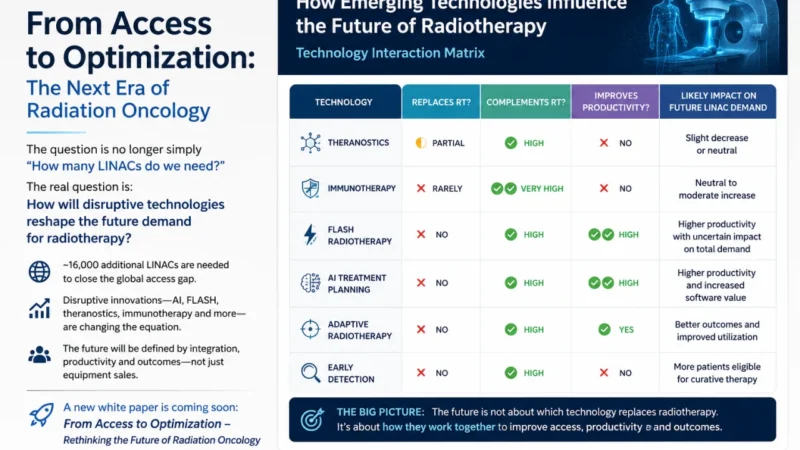
Do disruptive technologies replace radiotherapy or make it even more valuable? This was the question asked and even generated by my previous post. When we talk about the future of oncology among investors, ot policy makers, conversations often become polarized and confused:
Role of AI versus clinicians Roles? Future of Theranostics versus Radiotherapy. Targeted therapy, Immunotherapy versus radiation and surgery. Flash treatment versus conventianal and even adaptive radiotherapy etc.
Should we ask the question differently? it is not about which technology will win, perhaps it is rather How will these technologies converge to improve patient outcomes, expand access, and redefine the value of radiotherapy?
As I continue developing my upcoming thought leadership series to articulate the demand formula of Radiotherpay till 20245, one observation is becoming increasingly clear:
Most emerging technologies will not replace radiotherapy. Instead, they are likely to transform when, how, and why radiotherapy is delivered.
- AI is transforming treatment planning, workflow optimization, clinical decision support, and the ability to personalize care at scale.
- FLASH Radiotherapy has the potential to redefine treatment efficiency, patient experience, and the operational capacity of radiation oncology.
- Immunotherapy is strengthening the role of radiotherapy as an immune-modulating partner in multimodality cancer treatment.
- Theranostics is expanding precision oncology while creating new opportunities for integrated systemic and local therapies.
- Earlier diagnosis and improved screening may increase the number of patients eligible for curative-intent local treatments.
The future of oncology is unlikely to be defined by one disruptive technology replacing another. It will be defined by integration, convergence, and optimization.
This realization has led me to develop the Oncology Technology Impact Matrix™, a framework for understanding how emerging innovations influence four critical dimensions:
- – Clinical impact and complementarity
- – Productivity and operational efficiency
- – Patient access and capacity expansion
- – Future demand and strategic value of radiotherapy
(See illustration above.)
This framework is one of the concepts that will be explored in Oncology 2045 that will be about shifting the thinking from Access to Optimization, examining multiple scenarios for how cancer care may evolve over the next two decades.
Hence the central question is not whether technology will disrupt radiotherapy. The real question is: Will we successfully integrate these innovations to make radiotherapy more accessible, more precise, and more valuable for patients worldwide?”