Gustavo Viani, Professor at Faculty of Medicine of Botucatu, São Paulo State University (UNESP), shared on LinkedIn:
“Is it the biology or the nodes?
Our new study has just been published in Clinical Breast Cancer!
Following the landmark SUPREMO trial, an important question remains: Which women with intermediate-risk breast cancer may benefit most from postmastectomy radiotherapy?
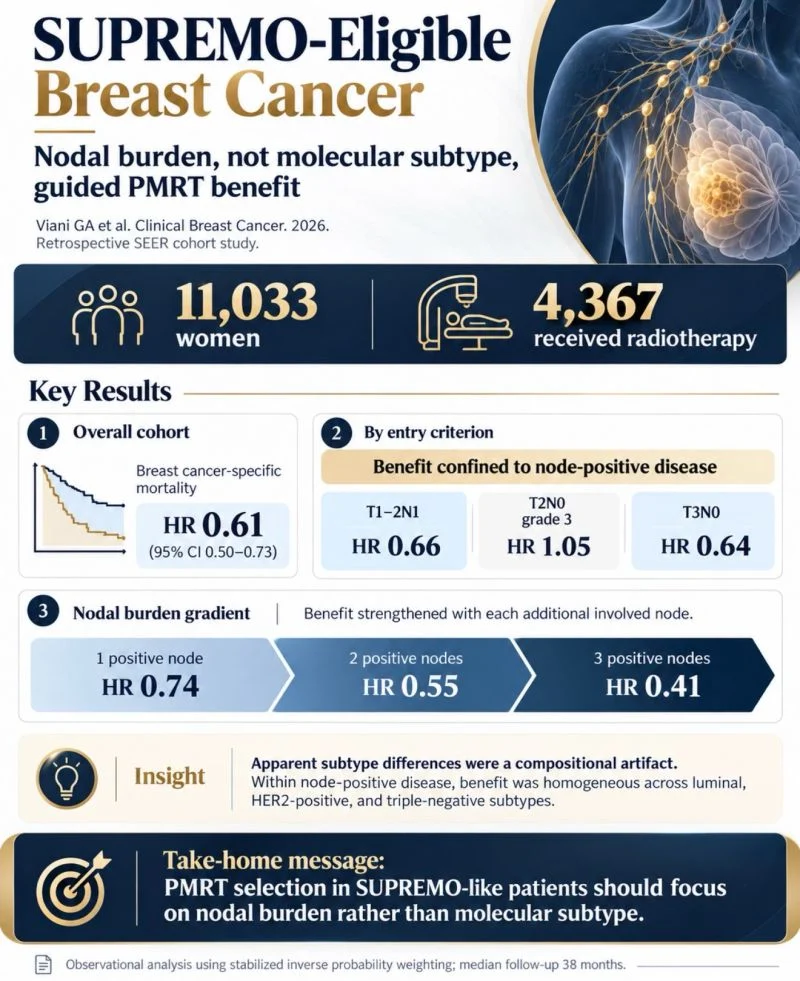
We analyzed 11,033 SUPREMO-eligible women from the SEER database.
Three findings stood out:
- In node-positive disease, radiotherapy was associated with lower breast cancer-specific mortality (HR 0.66).
- The association became stronger with increasing nodal burden: HR 0.74, 0.55, and 0.41 for one, two, and three positive nodes.
- Once nodal status was accounted for, the apparent differences between molecular subtypes disappeared (interaction p=0.86).
The key message: nodal burden may be more informative than molecular subtype alone when investigating who benefits from PMRT.
These findings are hypothesis-generating. Our retrospective study does not establish causality or overturn the randomized SUPREMO results.
The next step is to identify which patients truly benefit from additional radiotherapy.
Congratulations to all co-authors for this collaborative achievement!
Title: Is it the biology or the nodes? Molecular subtype is not associated with differential outcomes after post-mastectomy radiotherapy in SUPREMO-eligible breast cancer: a retrospective SEER cohort study
Authors: Gustavo A. Viani, Ana Carolina Hamamura, Caio Viani Arruda, Carlos E. Cardoso, Helio A. Salmon, Gustavo O. Amaral
You can also read: monarchE: Abemaciclib Benefit Persists Across Nodal Subgroups in High-Risk HR+/HER2− Early Breast Cancer