
George Kumar, Senior Director at AstraZeneca, shared on LinkedIn:
“Breast cancer taxonomy may be due for an upgrade.
For years, a major barrier to analyzing breast cancer transcriptomes at scale has been technical noise between studies. Pool data from different labs and platforms, and batch effects can drown out the biology.
A new study tackles this by borrowing a playbook from single-cell RNA-seq. The authors applied single-cell harmonization strategies to 7,612 bulk breast cancer transcriptomes from 22 datasets, building a high-resolution atlas of malignant transcriptional states.
What stood out
- It works on familiar ground. The atlas recapitulates the established intrinsic subtypes and tumor microenvironment programs, which is an important sanity check.
- It finds rare states we have been missing. New subtypes include stem-like, basal-luminal progenitor (BLP), mucinous and neuroendocrine-differentiated (NED) tumors, each with distinct clinical behavior.
- NED tumors look luminal but behave badly. They combine luminal features with neuroendocrine differentiation and carry poor prognosis after chemo-endocrine therapy, linked to early relapse. This is a group that could be hiding inside ‘standard’ HR+ disease.
- A HER2-enriched subset predicts kinase inhibitor response. The HER2E kinase inhibitor-sensitive (HER2EKIS) subtype identified patients who responded to neoadjuvant HER2-targeted kinase inhibition.
- BLP tumors point to cell of origin and new options. Their transcriptomic position suggests a bipotent or myoepithelial progenitor link, unfavorable outcomes after chemotherapy, and potential benefit from VEGF and receptor tyrosine kinase inhibitors.
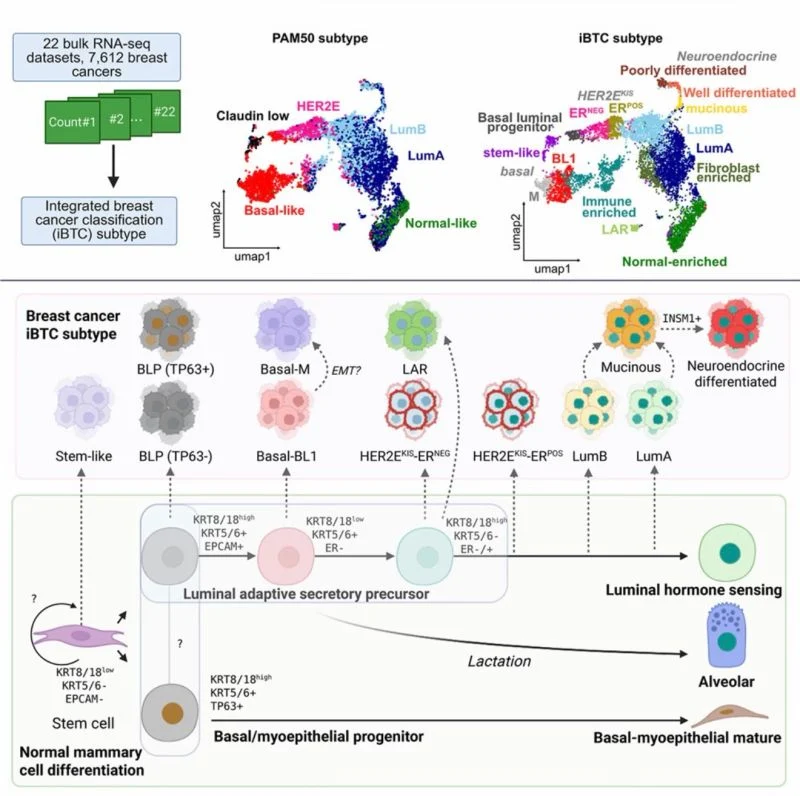
Figure Courtesy: Cell Reports Medicine. Brian D. Lehmann. Vanderbilt Health, Nashville, TN, 37232
Why it matters
Large, harmonized atlases like this do more than refine classification. They surface clinically meaningful minorities of patients who get averaged out in smaller cohorts, and they generate testable hypotheses for biomarker-driven stratification and drug development.
The next step will be translation: prospective validation, practical assays that can call these states in routine samples, and trials that test whether subtype-guided therapy improves outcomes.
Methods that cross the bulk and single-cell divide are quietly reshaping how we read tumors.”
Title: An integrated breast cancer transcriptomic atlas defines clinical subtypes and informs cellular origin
Authors: Xin Sun, Justin M. Balko, Hanbing An, Paula I. Gonzalez-Ericsson, Hailing Jin, Violeta Sanchez, Quanhu Sheng, Maksim S. Chapman, Thomas P. Stricker, Vandana G. Abramson, Ingrid M. Meszoely, Melinda E. Sanders, Jennifer A. Pietenpol, Brian D. Lehmann
You can also read:
- SABCS 2026: The Top 10 Breast Cancer Studies to Watch for Potential Practice-Changing Results
- Breast Cancer in 2026: Molecular Interception, MRD, ADC Sequencing and De-Escalation