Fagr Aboumadawy, Medical Oncology Specialist, Assistant Lecturer of Medical Oncology at Medical Research Institute – Alexandria University, shared on LinkedIn:
“ESMO 2026: It’s an ADC world and we are just living in it.
The next challenge for ADCs should be head-to-head trials.
The latest data in HER2-low metastatic breast cancer are impressive. But they also raise a fundamental question: are we demonstrating the superiority of new ADC designs, or simply confirming the efficacy of the ADC class?
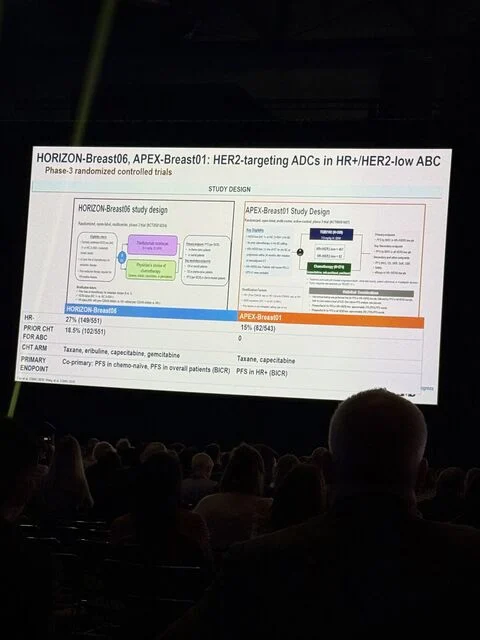
APEX-Breast01: TQB2102 versus chemotherapy
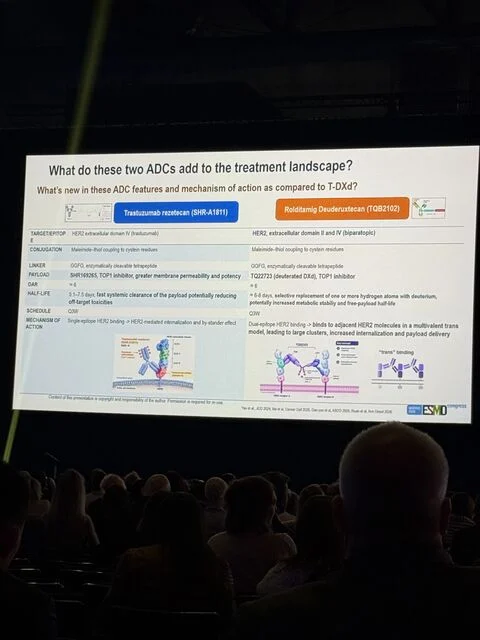
TQB2102 is an investigational biparatopic HER2-targeting ADC that binds ECD2 and ECD4 and delivers a topoisomerase I inhibitor payload (DAR ~6).
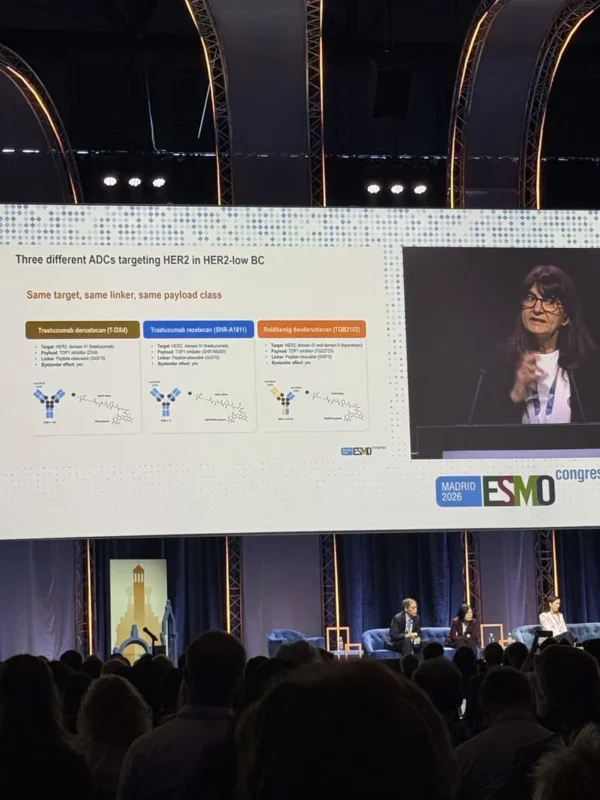
In HR+/HER2-low metastatic breast cancer, among patients with no prior chemotherapy for metastatic disease ( A DB06 Like Patient Population), the results were encouraging:
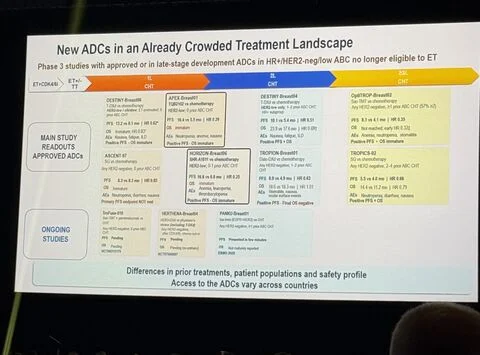
- Median PFS: 16.4 vs 5.5 months (BIRC; HR 0.29)
- ORR: 66.7% vs 31.3%
Overall survival: HR 0.44 in the reported analysis
Yet, there was no trastuzumab deruxtecan (T-DXd) arm. The biparatopic design is the scientific claim. Yet this trial cannot establish whether targeting two HER2 epitopes offers an advantage over an established HER2-directed ADC.
HORIZON-Breast06: Trastuzumab rezetecan versus chemotherapy
HORIZON-Breast06 adds to the growing evidence of ADC activity in HER2-low disease. In the chemotherapy-naïve subgroup, median PFS was 16.6 vs 6.8 months (HR 0.25), with benefit reported across HR-positive and HR-negative subgroups. Neutropenia was an important adverse event.
Again, these results demonstrate activity against chemotherapy, but they do not establish superiority over other ADCs. Cross-trial comparisons cannot reliably determine which ADC is better.
So, what have we actually learned?
HER2-low breast cancer can respond to a HER2-directed antibody carrying a topoisomerase I inhibitor payload, even at levels of HER2 expression below the traditional threshold for HER2-positive disease. That is important biology and a meaningful therapeutic advance.
But it is not proof that biparatopic targeting is clinically superior, nor does it tell us which ADC should be preferred.
As the ADC landscape becomes increasingly crowded, How do we determine the optimal sequencing of treatments when access, availability and approved indications vary considerably across countries?
It is time to challenge the field to conduct randomized, head-to-head trials comparing emerging ADCs with established ADCs in appropriate patient populations.
We need trials that assess not only efficacy, but also superiority, safety, quality of life and treatment burden.
Patients deserve to be randomized against a clinically relevant, recognized standard of care. And when an established ADC is the relevant standard, we should ask whether a new ADC offers a genuine improvement, not simply whether it outperforms chemotherapy.
The next phase of ADC development should be about more than demonstrating activity, It should be about demonstrating comparative value.”
You can also read: