






Enrique Soto Perez de Celis, Associate Professor at the University of Colorado Anschutz, shared on LinkedIn:
“Cancer is increasingly a disease of aging, but national cancer policies are not keeping pace.
In our new global analysis, we examined 156 national cancer control and non-communicable disease plans to understand how older adults are incorporated into cancer policy.
The findings were concerning:
- Only 18 plans, or 11.6%, included older adult-specific policies.
- Only 7 included a dedicated section focused on older adults.
- Only 6 included specific geriatric oncology implementation components.
- In most plans, older adults were mentioned only as a vulnerable population, without detailed strategies, implementation plans, or measurable indicators.
Perhaps most importantly, this was not simply a problem of one region or one income group. We found no significant differences according to region, national income level, or type of plan.
National cancer control plans do more than describe priorities. They influence where resources go, which populations are explicitly recognized, and how health systems are held accountable. If older adults are absent from these frameworks, their needs are much less likely to be systematically addressed.
As populations age worldwide, geriatric oncology needs to become an explicit part of cancer policy, with concrete strategies for assessment, workforce development, access, implementation, and measurement.
Very happy to see this work published in the Journal of Cancer Policy with Dominika Dulak, Mildred Medina-Palma, Dario Trapani, and Yannick Romero.”
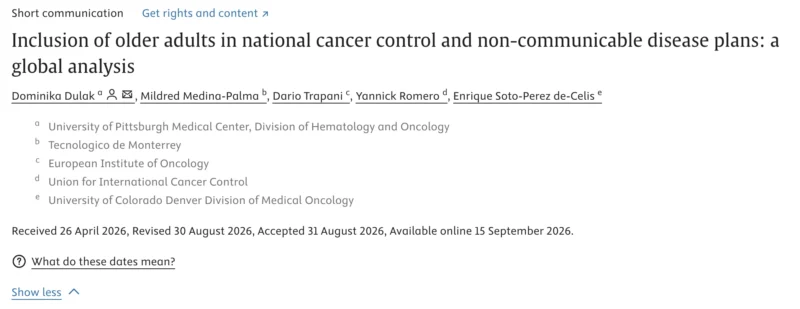
Title: Inclusion of older adults in national cancer control and non-communicable disease plans: a global analysis
Authors: Dominika Dulak, Mildred Medina-Palma, Dario Trapani, Yannick Romero, Enrique Soto-Perez de-Celis
Other posts featuring Enrique Soto Perez de Celis on OncoDaily.