
David Wazer, Director at Brown Health Cancer Institute, shared on LinkedIn:
“The Primary Tumor Still Matters: Why Clinical Judgment Should Guide Locoregional Therapy in De Novo Stage IV Breast Cancer
The randomized trials evaluating locoregional treatment of the intact breast primary in patients presenting with de novo stage IV breast cancer have largely answered the wrong question. They demonstrate that routine surgery or radiation for every patient does not improve overall survival or global quality of life. What they do not demonstrate is that locoregional therapy lacks value when applied thoughtfully to carefully selected patients.
Clinical judgment remains indispensable. Patients who experience an excellent response to contemporary systemic therapy yet are left with persistent or progressive locoregional disease represent a fundamentally different clinical scenario than those enrolled at diagnosis before the biology of their disease has declared itself. Likewise, patients with symptomatic breast or chest wall disease-pain, bleeding, ulceration, infection, malodor, or impending skin breakdown-may derive substantial benefit from local intervention, regardless of its effect on survival.”
Title: Locoregional treatment versus no treatment of the primary tumour in metastatic breast cancer: an open-label randomised controlled trial
Authors: Rajendra Badwe, Rohini Hawaldar, Nita Nair, Rucha Kaushik, Vani Parmar, Shabina Siddique, Ashwini Budrukkar, Indraneel Mittra, Sudeep Gupta.
Read the full article.
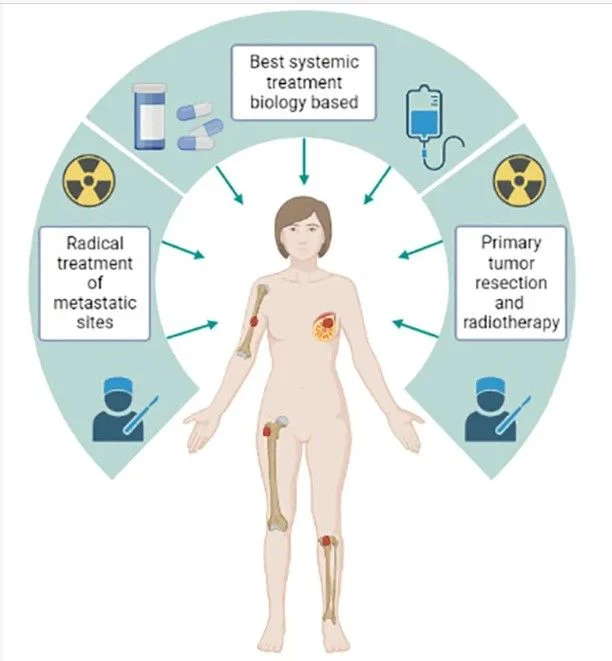
“The EA2108 trial elegantly demonstrated that locoregional therapy dramatically reduces locoregional progression, even in the absence of an overall survival advantage. For patients expected to live for years because of increasingly effective systemic therapies, preventing uncontrolled breast or chest wall progression is a meaningful endpoint in its own right. Indeed, preserving comfort, avoiding emergency interventions, maintaining body image, and minimizing chronic wound care are outcomes that matter deeply to patients, even if they are imperfectly captured by conventional quality-of-life instruments.
The modern management of metastatic breast cancer should therefore reject both extremes: neither routine treatment of every intact primary nor categorical abandonment of locoregional therapy. Instead, treatment decisions should integrate disease biology, response to systemic therapy, expected longevity, symptom burden, metastatic extent, and patient preferences. Precision oncology should extend beyond selecting systemic agents; it should also encompass precision in determining who stands to benefit from locoregional treatment. The art of oncology has always been knowing when evidence informs judgment-and when judgment must thoughtfully interpret the evidence.”
Title: Early Local Therapy for the Primary Site in De Novo Stage IV Breast Cancer: Results of a Randomized Clinical Trial (EA2108)
Authors: Seema A Khan, Fengmin Zhao, Lori J Goldstein, David Cella, Mark Basik, Mehra Golshan, Thomas B Julian, Barbara A Pockaj, Christine A Lee, Wajeeha Razaq, Joseph A Sparano, Gildy V Babiera, Irene A Dy, Sarika Jain, Paula Silverman, Carla S Fisher, Amye J Tevaarwerk, Lynne I Wagner, George W Sledge.
Read the full article.
You might be interested in:
RxPONDER Analysis: Ovarian Reserve May Refine Chemotherapy Decisions in HR-Positive Breast Cancer