Cristiane Bergerot, Former Postdoc Fellow and Research Consultant at City of Hope, shared on X:
“What happens when cancer care depends on electricity?
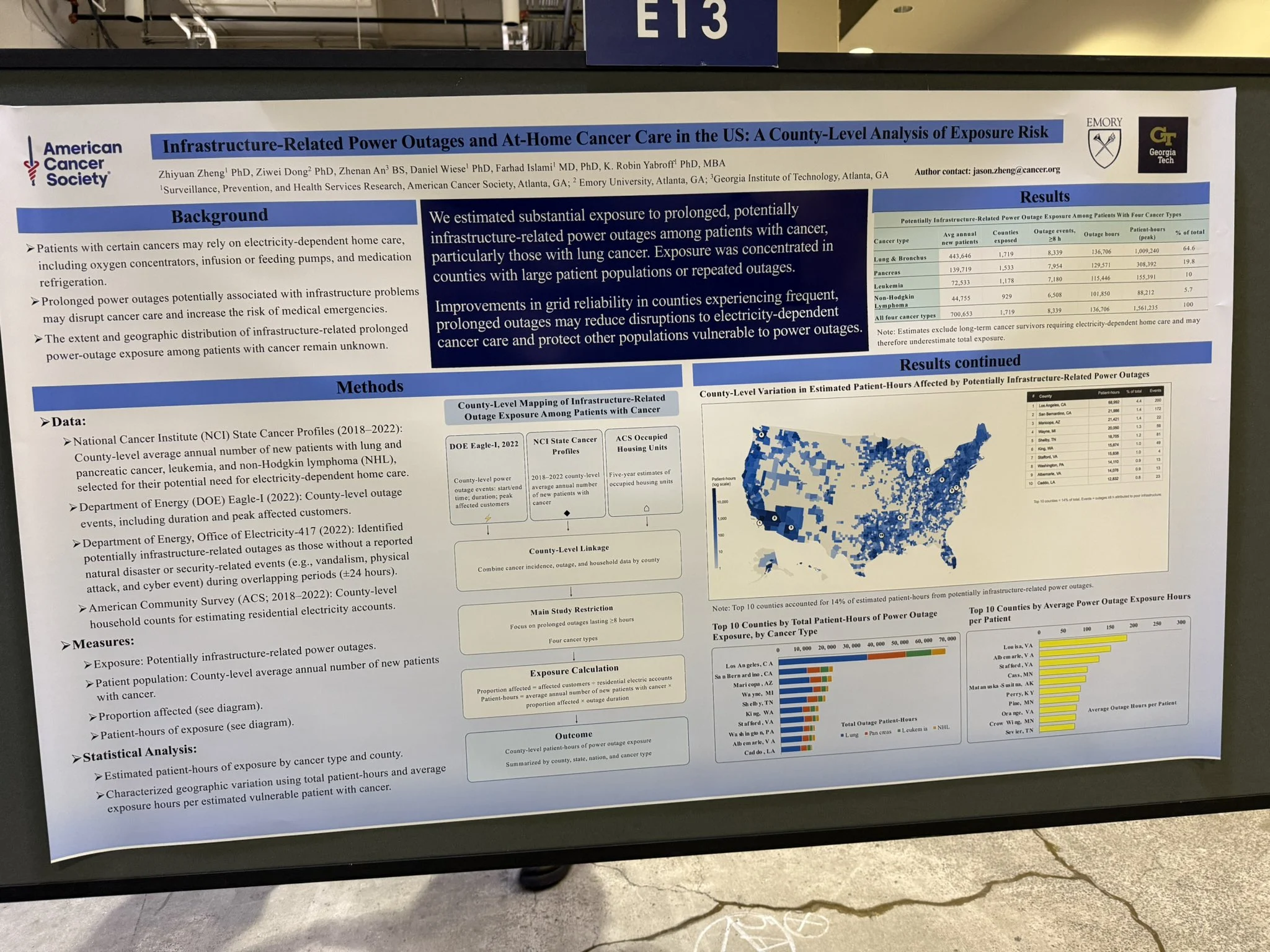
An important study at ASCOQLTY26 highlights substantial exposure to prolonged power outages among patients who may need electricity-dependent home care.
Infrastructure-Related Power Outages and At-Home Cancer Care in the US: A County-Level Analysis of Exposure Risk
Authors: Zhiyuan Zheng, Ziwei Dong, Zhenan An, Daniel Wiese, Farhad Islami, K. Robin Yabroff
Background
- Patients with certain cancers may rely on electricity-dependent home care, including oxygen concentrators, infusion or feeding pumps, and medication refrigeration.
- Prolonged power outages potentially associated with infrastructure problems may disrupt cancer care and increase the risk of medical emergencies.
- The extent and geographic distribution of infrastructure-related prolonged power-outage exposure among patients with cancer remain unknown.
Methods
Data:
- National Cancer Institute (NCI) State Cancer Profiles (2018-2022):
County-level average annual number of new patients with lung and pancreatic cancer, leukemia, and non-Hodgkin lymphoma (NHL), selected for their potential need for electricity-dependent home care. - Department of Energy (DOE) Eagle-1 (2022): County-level outage events, including duration and peak affected customers.
- Department of Energy, Office of Electricity-417 (2022): Identified potentially infrastructure-related outages as those without a reported natural disaster or security-related events (e.g., vandalism, physical attack, and eyber event) during overlapping periods (24 hours).
- American Community Survey (ACS; 2018-2022): County-level household counts for estimating residential electric
Measures
- Exposure: Potentially infrastructure-related power outages.
- Patient population: County-level average annual number of new patients with cancer.
- Proportion affected (see diagram).
- Patient-hours of exposure (see diagram).
Statistical Analysis
- Estimated patient-hours of exposure by cancer type and county.
- Characterized geographic variation using total patient-hours and average exposure hours per estimated vulnerable patient.”
You can also read: 20 Posts Not To Miss From ASCOQLTY26