


Ben Derman, Assistant Professor at the University of Chicago, shared on X:
“So many great abstracts to be presented at ASH 2026.
Here’s my top 10 in myeloma, with a focus on drugs with impending regulatory potential, novel agents/regimens, and updated data that’s relevant!
Let’s go!
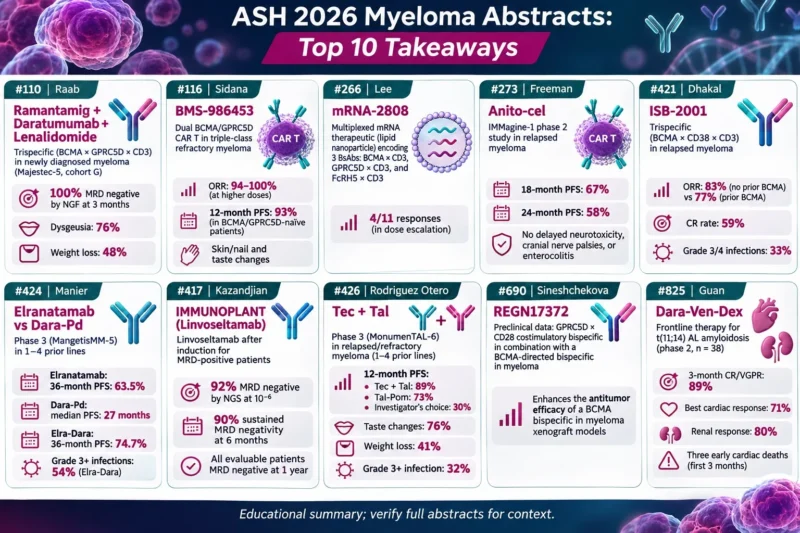
Abstract 110 (Raab): Ramantamig, Dara, Len in newly diagnosed myeloma (Majestec-5, cohort G).
This centers around ramantamig (BCMA x GPRC5D x CD3 trispecific) which can be given monthly. 100% of patients were MRD negative by NGF at 3 months!
The on-target, off-tumor tox is notable: 76% with dysgeusia and 48% with weight loss (5-20%).
My take: Early results look phenomenal.
Will we need to accept the GPRC5D-related toxicities or will BCMA bispecific in this space be sufficient to achieve deep and durable responses?
Title: Ramantamig, daratumumab (Dara), and lenalidomide (R) in patients with transplant-eligible (TE) newly diagnosed multiple myeloma (NDMM) in the phase 2 MajesTEC-5 trial: First results of a trispecific antibody in NDMM
Authors: Marc-Steffen Steffen Raab, Niels Weinhold, K. Martin Kortüm, Raphael Teipel, Johannes Waldschmidt, Stephan Bohl, Christine Riedhammer, Roland Fenk, Lilli Podola, Uta Bertsch, Lukas Scheller, Stefanie Huhn, Michael Hundemer, Carsten Mueller-Tidow, Cleo-Aron Weis, Elias K. Mai, Monika Engelhardt, Katja Weisel, Mathias Hänel, Florian Bassermann, Hans-Juergen Salwender, Elena Ershova, Bas D. Koster, Veronique Vreys, Christoph Heuck, Josephine Khan, Rachel Pearson, Hartmut Goldschmidt, Hermann Einsele, Leo Rasche Jr
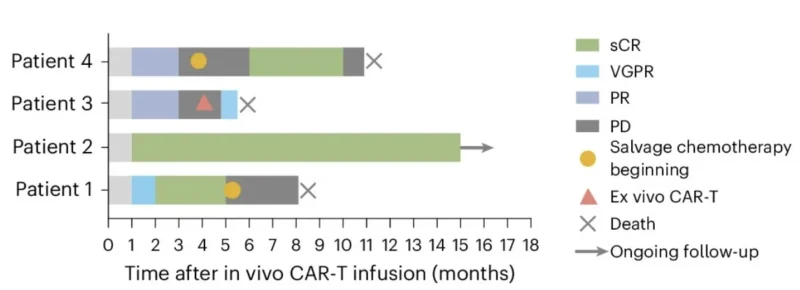
A disappointing development for ESO – T01 in vivo CAR T in myeloma.
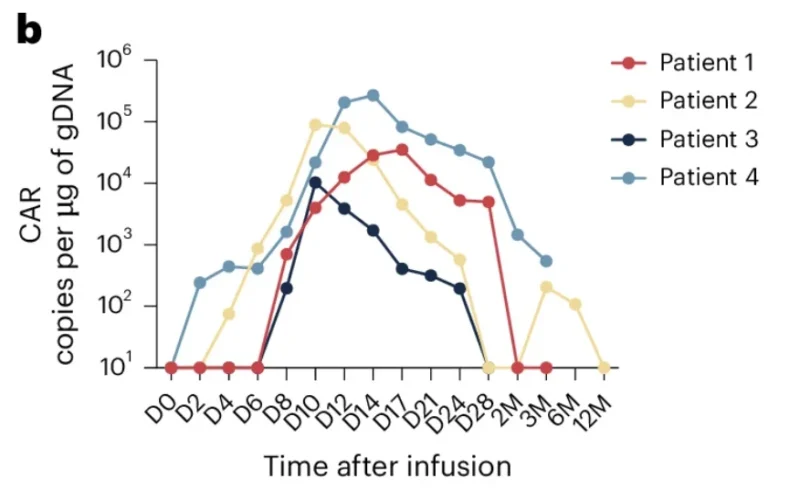
Despite early initial promise with all 4 patients having a response, 3 of these responses were short-lived (3-5 months). CAR persistence was generally short.
These responses seem much shorter than what’s already been seen with KLN-1010.
Is this a dose issue? A platform issue? So much to clarify over time.
Title: Extended follow-up of in vivo BCMA CAR-T therapy in relapsed/refractory multiple myeloma
Authors: Jia Xu, Lin Liu, Wei Xie, Liman Su, Weijiayi Wang, Chenggong Li, Qiaolin Liu, Yun Kang, Yinqiang Zhang, Wenjing Luo, Zhongpei Huang, Chun Zhang, Chunyan Sun, Yu Hu, Heng Mei
The latest version of the ASCO Multiple Myeloma Living Guideline is out!
All published phase 3 data is reviewed every 8 weeks and recommendations are updated in real-time.
We are continuing to refine algorithms for relapsed/refractory myeloma as time goes on.
Title: Treatment of Multiple Myeloma: ASCO Living Guideline
Authors: Benjamin Derman, Rahul Banerjee, Sita Bhella, Eloisa Riva, Tanya M. Wildes, Saad Z. Usmani, Ying Zhuo
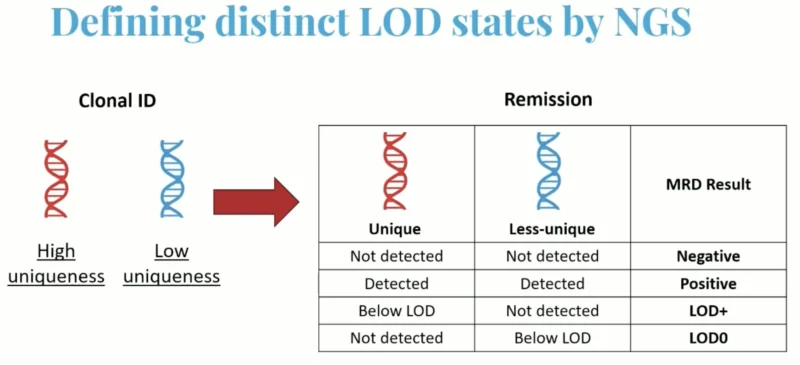
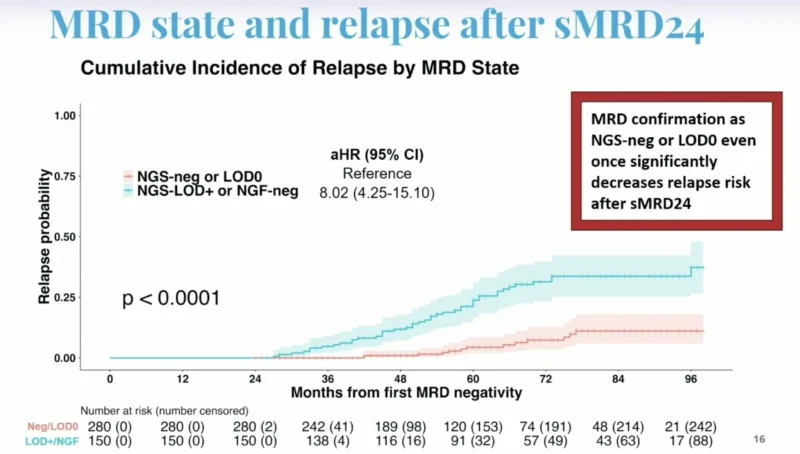
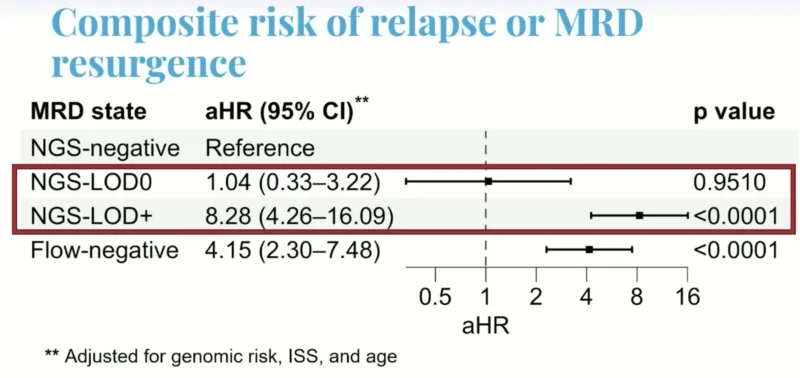
A great study idea from Zachary Avigan and the Mount Sinai group: What does it mean when deep responding patients have MRD ‘positivity’ below the limit of detection on clonoSEQ?
Not all results are the same! Unique sequences with disease detected below LOD (typically <1 cell/million I presume): high risk of relapse Less-unique sequences with disease detected below LOD: no difference from ‘true’ MRD negativity.
Longitudinal MRD analysis
430 patients with sustained MRD-negative, imaging-negative remission for $\ge 24$ months (sMRD24)
- Median follow-up 64 months
- 70% stopped therapy at varying timepoints
2,138 unique MRD timepoints
- 1,106 NGS (sensitivity $10^{-6}$) and 1,268 Flow (sensitivity $10^{-5}$)
- Includes 236 with simultaneous NGS and Flow
Evaluated risk of progression or MRD resurgence after each MRD result (NGS-neg, LOD0, LOD+, Flow-neg, MRD-positive)
It has been a real delight to have had UChicago Medicine Comprehensive Cancer Center be a part of the anito-cel journey.
Now we await the results of the phase 2 and the PDUFA date – December 23!
Title: Phase 1 Study of Anito-cel, a d-Domain BCMA CAR T Cell for Refractory or Recurrent Myeloma
Authors: Matthew J. Frigault, Binod Dhakal, Andrzej J. Jakubowiak, Noopur Raje, Kamalika Banerjee, C. Jenny Mu, Kevin C. Hart, Michael R. Bishop
Other articles about ASH 2026 on OncoDaily.