





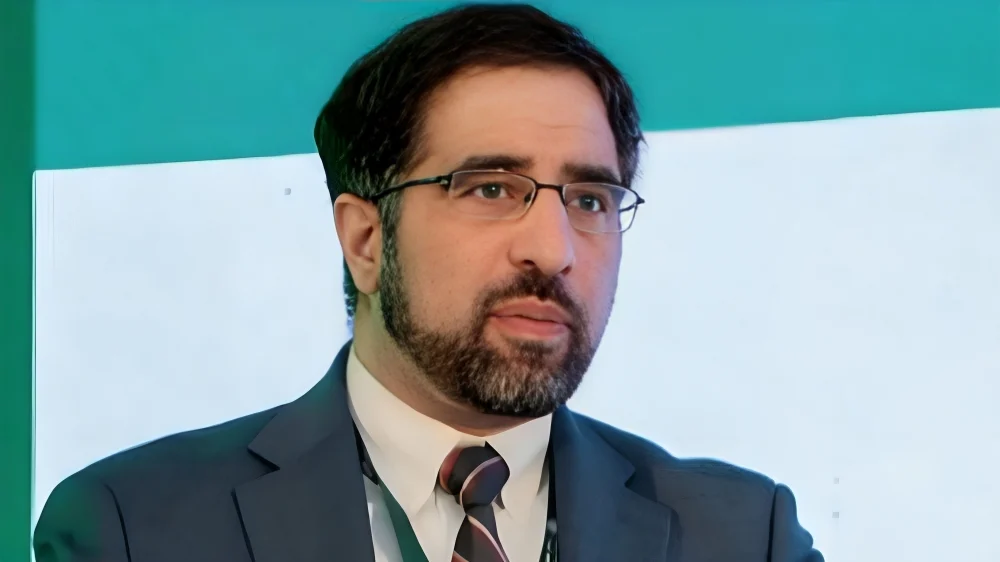
Al-Ola Abdallah, Associate Professor and Plasma Cell Disorder Program Director of the Division of HMCT at the University of Kansas Medical Center, shared on X:
“Cevostamab in Relapsed/Refractory Multiple Myeloma!
Challenging PFS A new phase 1 trial evaluates cevostamab, a first-in-class FcRH5×CD3 bispecific antibody, using a fixed-duration treatment strategy.
What should clinicians know?
Why FcRH5? FcRH5 is expressed across the B-cell lineage and is present on nearly all myeloma cells, independent of BCMA expression. This offers a novel target for patients progressing after BCMA- or GPRC5D-directed therapy.
Study design GO39775 was a phase 1 dose-escalation and expansion trial.
- 324 patients
- Median 6 prior lines
- 89.5% triple-class refractory
- 72.5% penta-drug refractory
- 47.5% had prior BCMA-targeted therapy
- 26.2% had extramedullary disease
Treatment was administered every 3 weeks for a fixed duration of approximately 12 months.
Recommended phase 2 regimen
The selected RP2D was:
- 0.3/1.2/3.6 mg triple step-up dosing
- Followed by cevostamab 160 mg IV every 3 weeks
- Maximum of 17 cycles
The maximum tolerated dose was not reached.
Efficacy in the overall 160-mg cohort Among 167 patients:
- ORR: 44.3%
- VGPR or better: 25.7%
- Median duration of response: 10.4 months
- Median DOR among patients achieving VGPR or better: 22.7 months
Responses occurred quickly, with a median time to first response of 1.4 months.
BCMA-naive patients performed substantially better In patients without prior BCMA therapy:
- ORR: 60.6%
- VGPR or better: 39.4%
- Median DOR: 19.7 months
- Median PFS: 5.2 months
This suggests cevostamab may be more effective when used before extensive exposure to other T-cell–redirecting therapies.
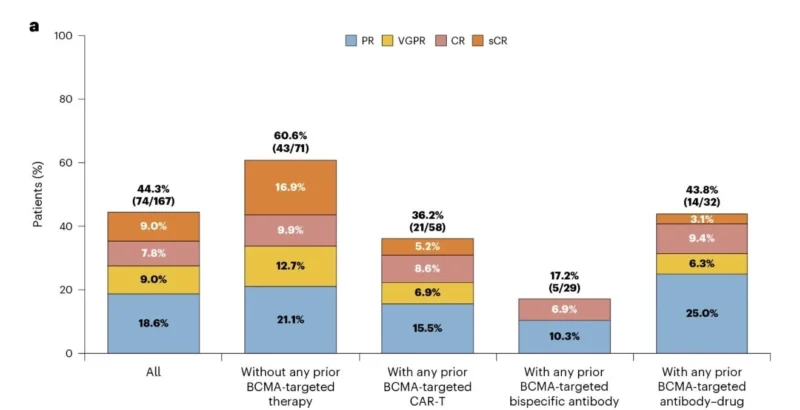
Activity after prior BCMA therapy ORR according to prior BCMA modality: CAR T-cell therapy: 36.2%, BCMA ADC: 43.8%, BCMA bispecific antibody: 17.2%.
Median DOR was also shortest after prior BCMA bispecific therapy. This may reflect treatment resistance, T-cell exhaustion or the short interval between sequential T-cell–engaging therapies.
Extramedullary disease remains challenging.
Among patients with EMD at baseline: ORR was 36.2%.
This demonstrates activity, but outcomes remain inferior to those seen in BCMA-naive patients overall. More detailed EMD-specific PFS and duration-of-response data are needed.
CRS was common but largely manageable.
With the recommended triple step-up schedule: CRS: 63.3% Grade 1: 46.7%, Grade 2: 16.7%, No grade 3 or 4 CRS. Median time to onset was approximately 13 hours, and all events resolved.
Neurotoxicity deserves attention.
Possible ICANS occurred in 13.8% at the 160-mg dose:
Grade 1: 6.6%, Grade 2: 5.4%, Grade 3: 1.8%.
Although usually low grade, this rate should not be overlooked when comparing cevostamab with other bispecific antibodies.
Hematologic toxicity.
At the 160-mg dose: Grade 3/4 neutropenia: 28.7%, Grade 3/4 anemia: 18.0%, Grade 3/4 thrombocytopenia: 10.8%, Febrile neutropenia: 4.8%.
Cytopenias were generally manageable and rarely resulted in treatment discontinuation.
Infection profile.
At the 160-mg dose: Any-grade infection: 54.5%, Grade 3/4 infection: 15.6%, Grade 5 infection: 3.6%.
IVIG was used in approximately one-third of patients, but antimicrobial prophylaxis and IVIG replacement were not protocol mandated. Cross-trial comparisons with BCMA bispecifics should therefore be made cautiously.
Important safety concerns.
Treatment-related deaths occurred from:
Hemophagocytic lymphohistiocytosis: 2 patients. Disseminated intravascular coagulation during pseudomonal sepsis: 1 patient HLH is uncommon but potentially fatal and requires increased clinician awareness, early recognition and clear management algorithms.
The most innovative feature: fixed-duration therapy.
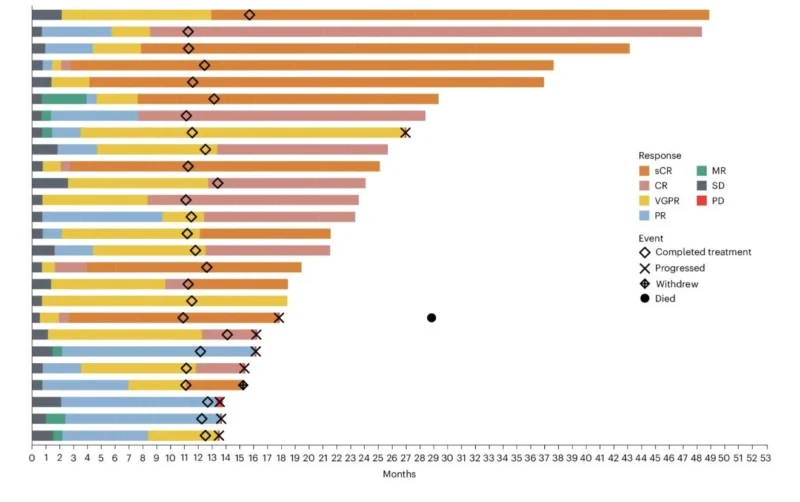
Unlike currently approved bispecific antibodies given until progression, cevostamab was stopped after approximately 12 months.
Among 26 responders who completed treatment:
17 remained in response off therapy. Several responses lasted more than 30 months from treatment initiation This supports the possibility of meaningful treatment-free intervals.
Why fixed duration matters.
A finite treatment course may reduce: Cumulative infection risk, Antigen escape, Progressive T-cell dysfunction, Treatment burden, Cost Impact on quality of life.
However, only a relatively small subset of enrolled patients completed all 17 cycles.
Major critique: the median PFS was short
Despite durable responses among responders:
Median PFS was only 2.8 months overall, 12-month PFS was 23.1%.
This reflects rapid progression among nonresponders and highlights the difference between a durable response in selected patients and overall disease control across the full cohort.
Additional limitations.
This was a phase 1, nonrandomized study with:
- Multiple dose levels and step-up schedules
- Changing supportive-care practices over time
- Heterogeneous prior BCMA exposure
- Limited numbers in the final triple step-up cohort
- No formal comparative hypothesis testing
- Post hoc PFS analysis
- Mandatory hospitalization during cycle 1 The results establish proof of concept, not superiority over other bispecific antibodies.
Another practical limitation.
Patients were hospitalized for at least 48 hours after every cycle 1 infusion. Therefore, the favorable CRS profile does not yet demonstrate that cevostamab can be routinely initiated in an outpatient or community setting.
Future studies must evaluate outpatient step-up dosing and resource utilization.
Clinical positioning.
Cevostamab may eventually offer: A non-BCMA therapeutic option. Activity after CAR T-cell therapy or BCMA ADC. Less dysgeusia, weight loss and skin/nail toxicity than GPRC5D-targeted therapy. A fixed-duration treatment strategy Its optimal sequencing remains uncertain.
Take-home messages:
- Cevostamab confirms FcRH5 as a promising myeloma target.
- Activity was strongest in BCMA-naive patients: ORR 60.6%, median DOR 19.7 months.
- Triple step-up dosing produced only grade 1–2 CRS.
- Infections, ICANS and rare HLH remain important risks.
- Fixed-duration therapy is promising, but sequencing and long-term benefit require further study.
Title: FcRH5×CD3 bispecific antibody cevostamab in relapsed or refractory multiple myeloma: a phase 1 trial
Authors: Adam D. Cohen, Joshua Richter, Suzanne Trudel, Alexander Lesokhin, Jacob P. Laubach, Sheeba K. Thomas, Simon J. Harrison, Luciano J. Costa, Andrew Spencer, Rafael Fonseca, Peter A. Forsberg, Jesus G. Berdeja, Rayan Kaedbey, Nizar J. Bahlis, Paula Rodriguez-Otero, Maria-Victoria Mateos, Tulika Tyagi, Divya Samineni, Wenyu Liu, Rin Nakamura, Voleak Choeurng, Chihunt Wong, James Cooper, Amrita Krishnan
Other articles about Multiple Myeloma on OncoDaily.