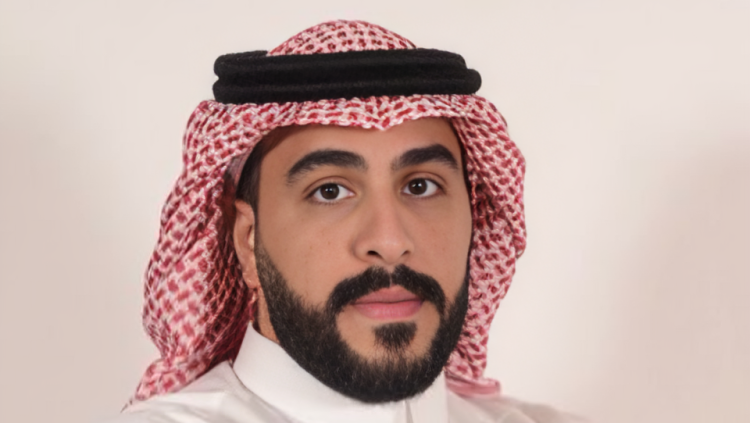
Ahmed S. Alanazi, Head of Hematology/Oncology Clinical Pharmacy Section at King Fahad Medical City – KFMC, shared a post on LinkedIn:
“Every publication marks the end of one project-but more importantly, the beginning of new questions that can improve patient care.
I’m delighted to share two of our latest publications in breast cancer, both reflecting our commitment to generating real-world evidence that addresses challenges encountered in everyday oncology practice.
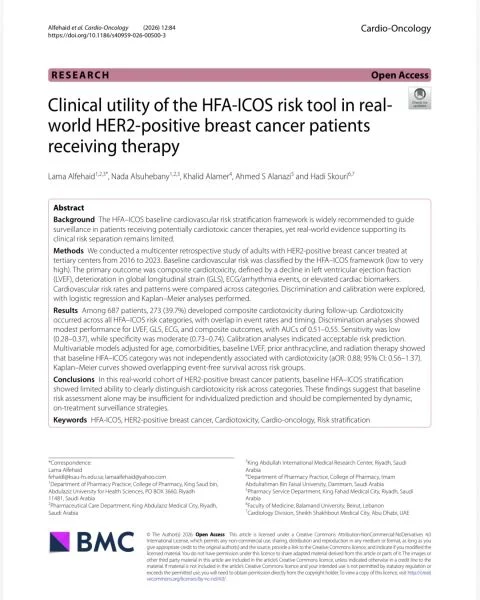
1. Title: Clinical utility of the HFA-ICOS risk tool in real-world HER2-positive breast cancer patients receiving therapy
Authors: Lama Alfehaid, Nada Alsuhebany, Khalid Alamer, Ahmed S. Alanazi, Hadi Skouri
Read the Full Article.
This study evaluated the performance of the HFA-ICOS cardiovascular risk tool in routine clinical practice. Our findings suggest that baseline risk assessment alone has limited ability to accurately distinguish patients at risk of cardiotoxicity, reinforcing the need for dynamic, longitudinal cardio-oncology surveillance throughout treatment.
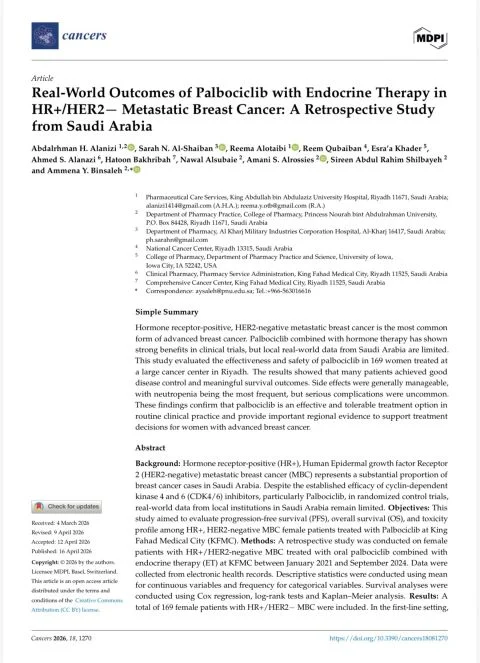
2. Title: Real-World Outcomes of Palbociclib with Endocrine Therapy in HR+/HER2− Metastatic Breast Cancer: A Retrospective Study from Saudi Arabia
Authors: Abdalrhman H. Alanizi, Sarah N. Al-Shaiban, Reema Alotaibi, Reem Qubaiban, Esra’a Khader, Ahmed S. Alanazi, Hatoon Bakhribah, Nawal Alsubaie, Amani S. Alrossies, Sireen Abdul Rahim Shilbayeh, Ammena Y. Binsaleh
Read the Full Article.
Our real-world experience showed that palbociclib combined with endocrine therapy delivers meaningful clinical benefit with a manageable safety profile, providing valuable evidence from the Middle East to complement data from pivotal clinical trials and support treatment decisions in routine practice.
What makes these publications particularly meaningful is that they answer questions arising from daily clinical practice-where patient populations are more diverse and treatment decisions are often more complex than those encountered in clinical trials.
I am sincerely grateful to my collegaues and co-authors, whose trust and participation make this research possible. Looking forward to continuing collaborative efforts that bridge research and clinical practice to improve outcomes for patients with cancer.”
You can also read: