
For years, first-line treatment for metastatic triple-negative breast cancer has been shaped by a difficult divide.
Patients whose tumors express PD-L1 and are eligible for immunotherapy may receive checkpoint blockade with chemotherapy. For patients who are not candidates for PD-1 or PD-L1 inhibitor-based therapy, chemotherapy has remained the principal first-line option.
Two recent FDA actions have changed that landscape.
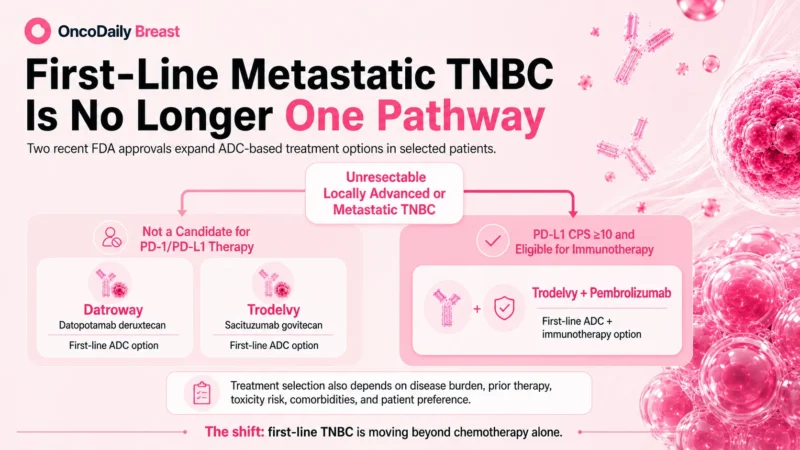
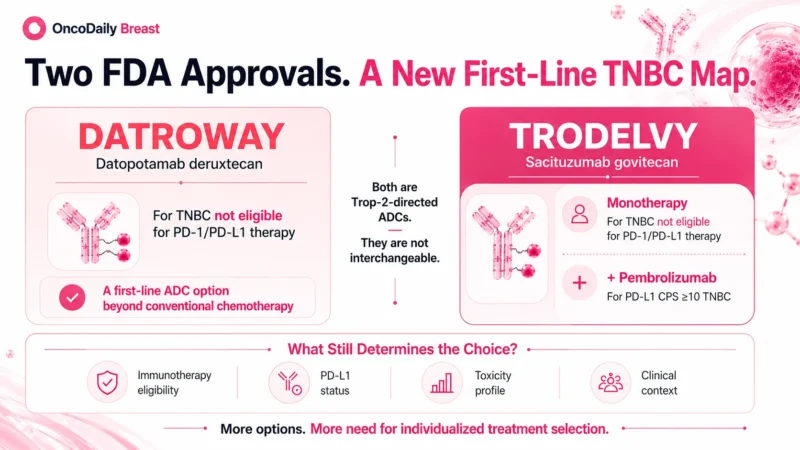
In May 2026, the FDA approved datopotamab deruxtecan-dlnk, known as Datroway, for adults with unresectable or metastatic TNBC who are not candidates for PD-1 or PD-L1 inhibitor therapy. One month later, the FDA approved sacituzumab govitecan-hziy, known as Trodelvy, both as monotherapy for the same immunotherapy-ineligible population and in combination with pembrolizumab for patients whose tumors have PD-L1 combined positive score of at least 10.
Together, these decisions bring antibody-drug conjugates into first-line metastatic TNBC across two clinically important settings: patients eligible for immunotherapy and those for whom immunotherapy is not appropriate.
They do not make treatment selection simple. They make it more biologically and clinically specific.
Why This Matters for Metastatic TNBC
Triple-negative breast cancer remains one of the most aggressive breast cancer subtypes. It lacks estrogen receptor, progesterone receptor, and HER2 targets, which has historically limited treatment to chemotherapy.
Immunotherapy improved outcomes for a biomarker-defined subgroup, particularly patients with PD-L1-positive disease. However, many patients are not candidates for PD-1 or PD-L1 inhibitor-based therapy because of tumor biomarker status, clinical contraindications, prior treatment considerations, or other individual factors.
Until now, these patients generally entered first-line treatment with single-agent or combination chemotherapy.
The recent FDA approvals introduce an important shift: in selected patients, treatment can begin with an antibody-drug conjugate rather than conventional chemotherapy alone.
Datroway Opens a New First-Line Option for Immunotherapy-Ineligible TNBC
On May 22, 2026, the FDA approved datopotamab deruxtecan-dlnk for adults with unresectable or metastatic TNBC who are not candidates for PD-1 or PD-L1 inhibitor therapy. [1]
The approval was based on TROPION-Breast02, a randomized phase 3 trial involving 644 patients with previously untreated unresectable or metastatic TNBC who were not candidates for PD-1 or PD-L1 inhibitor therapy.
Patients received either datopotamab deruxtecan or investigator’s choice of chemotherapy. The chemotherapy arm included paclitaxel, nab-paclitaxel, capecitabine, eribulin, or carboplatin.
Datopotamab deruxtecan improved progression-free survival:
Median PFS was 10.8 months with datopotamab deruxtecan versus 5.6 months with chemotherapy.
The hazard ratio for progression or death was 0.57.
Overall survival was also improved:
Median OS was 23.7 months with datopotamab deruxtecan versus 18.7 months with chemotherapy.
The hazard ratio for death was 0.79.
The confirmed objective response rate was 64% with datopotamab deruxtecan and 30% with investigator’s choice chemotherapy.
This approval is important because it provides a first-line non-immunotherapy option with both progression-free and overall survival benefit in a population that previously relied mainly on chemotherapy selection.
Trodelvy Creates Two New First-Line Pathways
On June 24, 2026, the FDA approved sacituzumab govitecan for two first-line indications in unresectable locally advanced or metastatic TNBC. [2]
The first indication is sacituzumab govitecan monotherapy for patients who are not candidates for PD-1 or PD-L1 inhibitor-based therapy.
The second is sacituzumab govitecan combined with pembrolizumab for patients whose tumors express PD-L1 with a combined positive score of at least 10, as determined by an FDA-authorized test.
This means that sacituzumab govitecan now has a role in both major first-line metastatic TNBC pathways.
Sacituzumab Govitecan Alone in Immunotherapy-Ineligible Disease
The monotherapy approval was supported by ASCENT-03, a randomized phase 3 study of 558 patients with unresectable locally advanced or metastatic TNBC who had not received prior systemic therapy for advanced disease and were not candidates for PD-1 or PD-L1 inhibitor therapy.
Patients received sacituzumab govitecan or treatment of physician’s choice, which included nab-paclitaxel, paclitaxel, or gemcitabine plus carboplatin.
Sacituzumab govitecan improved progression-free survival:
Median PFS was 9.7 months with sacituzumab govitecan versus 6.9 months with chemotherapy.
The hazard ratio for progression or death was 0.62.
The confirmed objective response rate was 50% with sacituzumab govitecan and 47% with chemotherapy.
Overall survival data were immature at the time of FDA approval.
The key point is that sacituzumab govitecan now joins datopotamab deruxtecan as a first-line option for patients who are not candidates for PD-1 or PD-L1 inhibitor therapy.
Sacituzumab Govitecan Plus Pembrolizumab in PD-L1-Positive TNBC
The second approval was supported by ASCENT-04/KEYNOTE-D19, which enrolled 443 patients with previously untreated locally advanced or metastatic TNBC and PD-L1 CPS of at least 10.
Patients received sacituzumab govitecan plus pembrolizumab or chemotherapy plus pembrolizumab.
The chemotherapy options were nab-paclitaxel, paclitaxel, or gemcitabine plus carboplatin.
The sacituzumab govitecan-pembrolizumab combination improved progression-free survival:
Median PFS was 11.2 months with sacituzumab govitecan plus pembrolizumab versus 7.8 months with chemotherapy plus pembrolizumab.
The hazard ratio for progression or death was 0.65.
The confirmed objective response rate was 61% with sacituzumab govitecan plus pembrolizumab and 55% with chemotherapy plus pembrolizumab.
Overall survival data were immature.
This approval matters because it moves an antibody-drug conjugate into an immunotherapy-eligible first-line population. It also challenges the assumption that pembrolizumab must be paired only with conventional chemotherapy in PD-L1-positive metastatic TNBC.

Read About FDA Approval on OncoDaily
Two ADCs, One Broad Clinical Question
Datopotamab deruxtecan and sacituzumab govitecan are both Trop-2-directed antibody-drug conjugates. Both are now approved in the first-line metastatic setting for patients who are not candidates for PD-1 or PD-L1 inhibitor therapy.
However, they should not be treated as interchangeable.
The studies differed in design, eligibility, chemotherapy comparators, and maturity of survival follow-up. Datopotamab deruxtecan demonstrated an overall survival advantage in TROPION-Breast02. In ASCENT-03, overall survival data for sacituzumab govitecan monotherapy were not yet mature.
The reported median PFS values cannot be used to compare the two drugs directly. There has been no head-to-head trial of datopotamab deruxtecan versus sacituzumab govitecan in first-line metastatic TNBC.
Treatment selection will therefore need to consider the strength and maturity of efficacy data, expected toxicity profile, prior treatment exposure, disease burden, comorbidities, patient preferences, and practical access.
Safety Will Matter in Treatment Selection
The two treatment approaches have different key safety considerations.
Datopotamab deruxtecan prescribing information includes warnings and precautions for interstitial lung disease and pneumonitis, ocular adverse reactions, stomatitis or oral mucositis, and embryo-fetal toxicity.
Sacituzumab govitecan includes a boxed warning for diarrhea and neutropenia. Its prescribing information also includes warnings related to hypersensitivity and infusion reactions, nausea and vomiting, reduced UGT1A1 activity, and embryo-fetal toxicity.
When sacituzumab govitecan is combined with pembrolizumab, immune-mediated adverse events from pembrolizumab must also be considered.
These differences are clinically relevant. The best first-line option may depend not only on tumor biology, but also on baseline pulmonary risk, gastrointestinal vulnerability, marrow reserve, history of autoimmune disease, treatment urgency, and the ability to monitor and manage treatment-related complications.
What Has Changed in the First-Line TNBC Treatment Map?
The recent approvals create a more defined first-line framework for unresectable locally advanced or metastatic TNBC.
For patients with PD-L1 CPS of at least 10 who are appropriate candidates for immunotherapy, sacituzumab govitecan plus pembrolizumab is now an FDA-approved option.
For patients who are not candidates for PD-1 or PD-L1 inhibitor therapy, both datopotamab deruxtecan and sacituzumab govitecan monotherapy are FDA-approved first-line options.
This represents a clear shift away from a chemotherapy-only pathway for immunotherapy-ineligible disease.
However, several questions remain unresolved.
There are no direct comparisons between datopotamab deruxtecan and sacituzumab govitecan. The optimal sequencing of these agents after prior exposure to another Trop-2-directed antibody-drug conjugate is not yet established. It is also unclear how best to select treatment after recurrence in patients previously treated with pembrolizumab-containing therapy for early-stage TNBC.
These questions will become more important as antibody-drug conjugates move earlier in the disease course.
The Bottom Line
The recent FDA approvals of datopotamab deruxtecan and sacituzumab govitecan mark a significant treatment advance in metastatic TNBC.
Datopotamab deruxtecan provides a new first-line option for patients who are not candidates for PD-1 or PD-L1 inhibitor therapy, with improvements in progression-free and overall survival versus chemotherapy.
Sacituzumab govitecan is now approved both as monotherapy for immunotherapy-ineligible patients and with pembrolizumab for PD-L1-positive disease.
The central change is not simply that TNBC has more drugs.
It is that first-line treatment is moving beyond a single chemotherapy-based approach toward a more individualized strategy shaped by PD-L1 status, immunotherapy eligibility, toxicity considerations, and the emerging role of antibody-drug conjugates.
References
- U.S. Food and Drug Administration. FDA approves datopotamab deruxtecan-dlnk for unresectable or metastatic triple-negative breast cancer. May 22,
- 2026.U.S. Food and Drug Administration. FDA approves sacituzumab govitecan-hziy as monotherapy and in combination with pembrolizumab for first-line treatment of triple-negative breast cancer. June 24, 2026.