Adrian Lee, Professor at University of Pittsburgh, shared on LinkedIn:
“Camizestrant: from ctDNA-guided hypothesis to accelerated approval
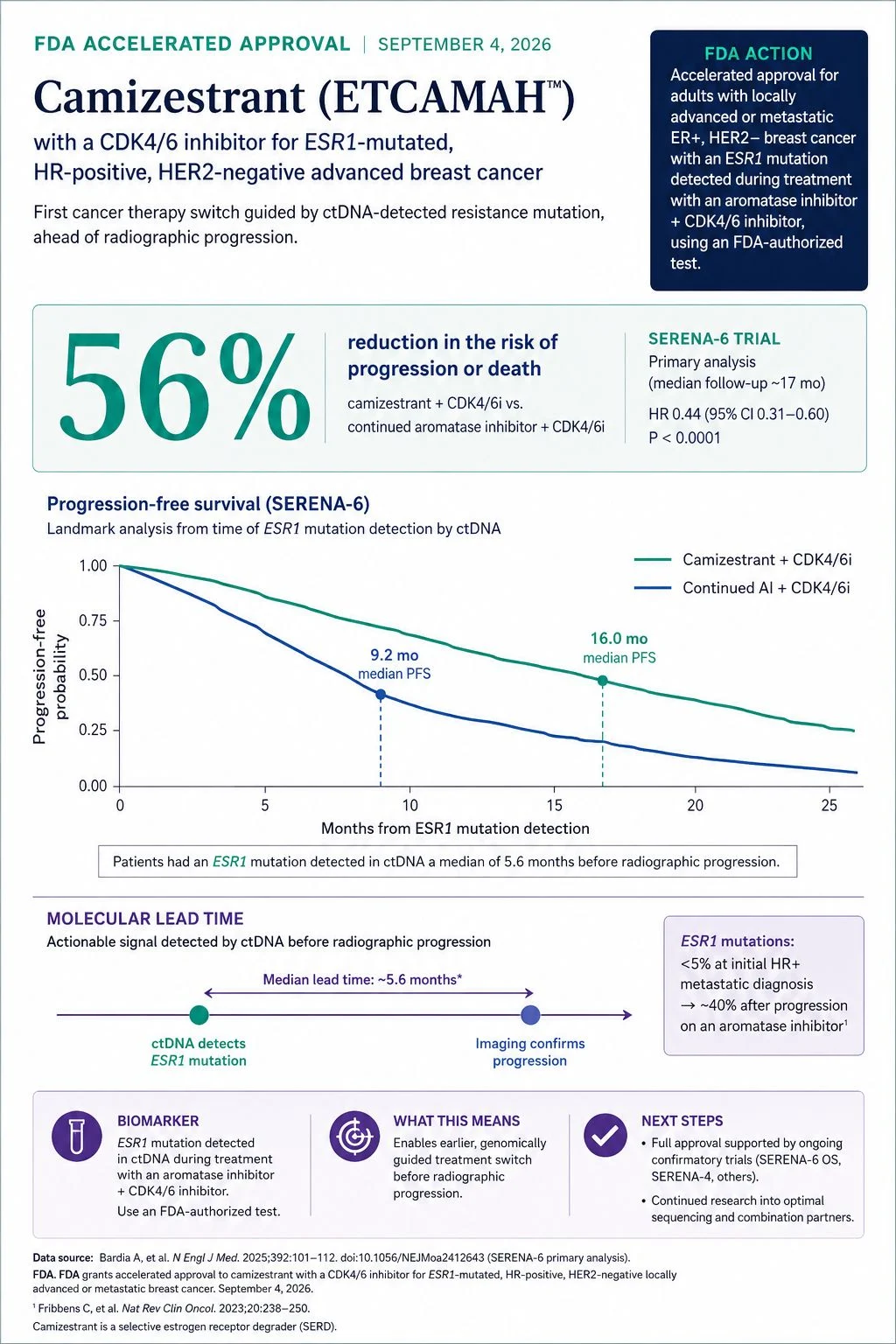
Regulatory science moved. Today, the FDA granted accelerated approval to camizestrant (Etcamah), in combination with a CDK4/6 inhibitor, for HR+/HER2− locally advanced or metastatic breast cancer upon ctDNA-detected emergence of an ESR1 mutation during aromatase inhibitor plus CDK4/6 inhibitor therapy. The Guardant360 CDx assay was authorized concurrently as the companion diagnostic. This is the first oncology approval built on switching therapy at the point of molecular resistance detection, rather than radiographic progression.
The efficacy basis is the same SERENA-6 dataset I highlighted in April: median PFS 16.0 months on the camizestrant switch versus 9.2 months on continued aromatase inhibitor, measured from the moment the resistance mutation was first identified in blood. ESR1 mutations are rare at initial diagnosis of HR+ metastatic disease (<5%) but emerge in nearly 40% of patients after progression on an aromatase inhibitor, a defined, actionable resistance signal that ctDNA surveillance can catch before imaging shows progression.
Worth noting explicitly, this is accelerated approval on a PFS surrogate, with confirmatory studies required. The clinical benefit of acting at molecular detection versus radiographic progression is not yet confirmed, that question remains open. But the regulatory framework is doing exactly what accelerated approval is designed to do: getting a validated, mechanistically grounded intervention to patients while the definitive evidence continues to accrue.
For a field that has spent a decade building ctDNA infrastructure, MRD detection, molecular residual disease, resistance surveillance, this is a structural marker: the first time acquired-resistance ctDNA monitoring has translated directly into a labeled treatment-switching indication. PADA-1 raised the hypothesis. SERENA-6 tested it. The Guardant360 CDx / camizestrant pairing operationalizes it into practice. But of course lots more to do.
Congratulations to the SERENA-6 investigators and to AstraZeneca. And genuine credit to FDA for the confirmatory-study framework that allows patients to benefit now while the evidentiary question is resolved properly.
Thanks to Claude for providing ideas for an image, ChatGPT for refining it, and Gemini for producing the final result.”
To which Svetlana Nikic, Founder of Precision Oncology Consulting, added:
“Excellent overview Adrian Lee – Camizestrant approval in metastatic breast cancer patients carrying ESR1 mutations associated with standard aromatase inhibitors and CDK4/6 inhibitors, is more than just another drug approval.
This is the first time where a CDx (in this case developed by Guardant Health) is an assay that measures the presence of ESR1 mutations in patients blood. The ctDNA enabled detection enables therapy switch.
Now let’s think about enabling access to ESR1 testing for all eligible patients.”
You can also read: