Aadil Najeed, Senior Resident at Government Medical College Srinagar, shared on LinkedIn:
“Response-adaptive stereotactic body radiotherapy (SBRT) boost following concurrent chemoradiotherapy (CCRT).
THE TREATMENT APPROACH
51 patients, Unresectable Stage III NSCLC
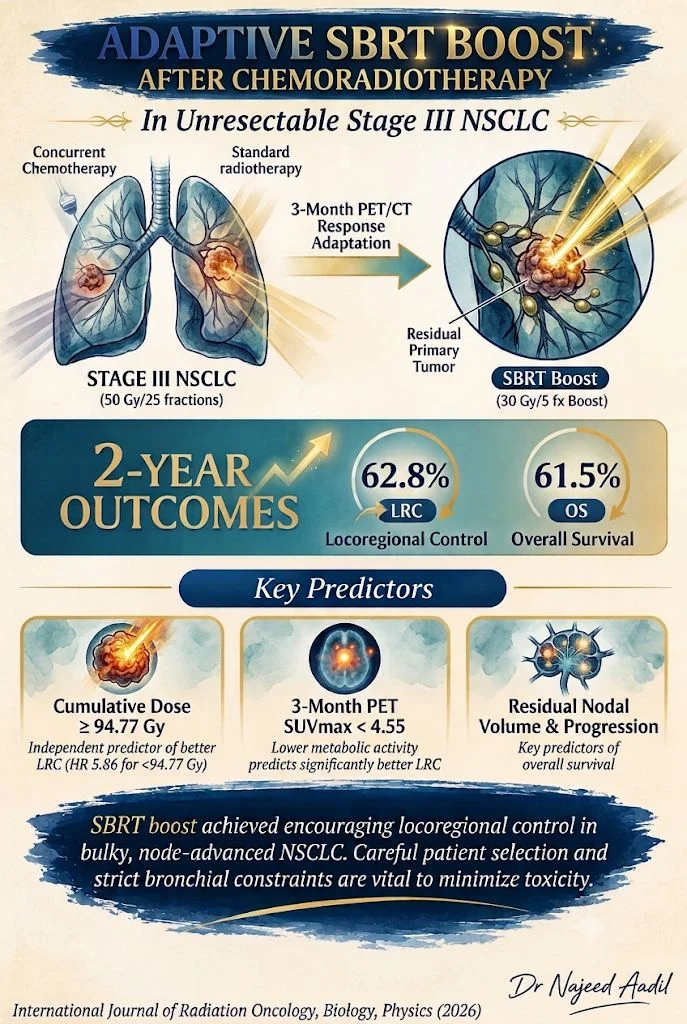
Concurrent CRT: 50 Gy / 25 fractions
- Weekly carboplatin + paclitaxel
- Adaptive SBRT boost after CRT:
- Primary tumour: 30 Gy / 5 fractions
- Residual nodes: 10 Gy / 5 fractions
- No consolidation durvalumab
THE MAIN RESULTS
- 61.5%
2-year overall survival - 62.8%
2-year locoregional control - 13 months
Median PFS - 16 months
Median DMFS
WHAT PREDICTED LOCoregional CONTROL?
Cumulative dose to residual primary tumour:
Below 94.77 Gy EQD2
- Associated with worse locoregional control
- HR 5.86
3-month post-treatment PET/CT:
Locoregional SUVmax ≥4.55
- Associated with worse locoregional control
- HR 5.04
TOXICITY PROFILE
- Grade 3–4 pneumonitis: 7.8%
- Grade 3 oesophagitis: 2% (1 patient)
- Haemoptysis: 9.8% (5 patients)
Haemoptysis was the main safety concern, occurring predominantly in patients with pre-existing haemoptysis.
Careful patient selection and strict bronchial constraints are essential.
THE MOST IMPORTANT TAKEAWAY
Although adaptive SBRT boost was associated with encouraging locoregional control, distant metastasis remained the dominant failure pattern (41.2%).
This highlights an important principle:
Better local control does not necessarily mean better overall survival.
Response-adaptive dose escalation may offer an opportunity to personalise radiotherapy for selected patients with residual disease after CRT.
However, this study does not establish SBRT boost as standard treatment.
IMPORTANT LIMITATIONS
- Small cohort (51 patients)
- Single-centre, prospective, single-arm study
- Median follow-up of 26 months
- No consolidation durvalumab
The findings are hypothesis-generating and require validation in larger comparative studies.
Reference:
Kiraz E, et al. Response-Adaptive Stereotactic Body Radiotherapy Boost After Concurrent Chemoradiotherapy in Unresectable Stage III NSCLC: A Prospective Single-Centre Cohort Study.
International Journal of Radiation Oncology, Biology, Physics. November 6, 2026.
When the right treatment exists, but the patient cannot afford it: The unseen barrier in cancer care
In oncology, we often discuss survival benefits, treatment advances and new standards of care. But there is another reality that deserves equal attention: financial toxicity.
The PACIFIC trial established consolidation durvalumab after concurrent chemoradiotherapy (CCRT) as a standard of care for unresectable Stage III NSCLC.
Yet, for many patients in low- and middle-income countries (LMICs), access to this treatment remains far beyond their financial reach.
THE GAP BETWEEN EVIDENCE AND ACCESS
For a patient and their family, a cancer diagnosis is already an enormous emotional, physical and financial burden.
The cost of immunotherapy can add another layer of distress.
Many patients cannot afford months of consolidation treatment, even when it is recommended by evidence-based guidelines.
Limited insurance coverage and out-of-pocket healthcare expenditure make this reality particularly difficult.
For some, treatment ends after definitive chemoradiotherapy – not because they have exhausted every possible option, but because they have exhausted their financial resources.
And that is a reality we, as oncologists, cannot afford to ignore.
CAN WE THINK DIFFERENTLY ABOUT RADIOTHERAPY?
This is where response-adaptive SBRT boost after CCRT becomes an interesting area for investigation.
Modern LINAC-based radiotherapy is available in many government cancer centres, where treatment is often provided free of charge or at highly subsidised rates.
- Could we use this existing infrastructure more effectively?
- Could carefully selected patients with residual disease benefit from adaptive SBRT boost to improve locoregional control?
- Could this approach help us develop more accessible treatment strategies for patients who cannot afford consolidation immunotherapy?
These are important questions, particularly in healthcare systems where the financial burden of cancer treatment can determine whether a patient receives further care.
SCIENTIFICALLY, WE MUST REMAIN CAUTIOUS
SBRT is a local treatment. It cannot replace the systemic benefit of immunotherapy or address distant micrometastatic disease.
The recent prospective cohort is encouraging, but it is small, single-centre and nonrandomised. It does not establish SBRT boost as an equivalent alternative to durvalumab.
Further comparative research is essential before changing clinical practice.
BEYOND TECHNOLOGY, THERE IS A HUMAN RESPONSIBILITY
As oncologists, our responsibility does not end with recommending the treatment that offers the best outcomes in clinical trials.
We must also recognise the circumstances in which our patients live, the resources they have access to, and the financial sacrifices their families make.
The future of radiation oncology should not only be about precision, dose escalation and technological innovation.
It should also be about accessibility, affordability and equity.
Because a treatment that a patient cannot afford remains, in practical terms, a treatment they cannot receive.
And no patient should feel that their financial circumstances have made them less deserving of the best possible cancer care.”
You can also read: Unresectable Stage III NSCLC: PACIFIC Remains the Backbone as Precision Strategies Reshape Care