The treatment landscape of unresectable stage III non-small-cell lung cancer (NSCLC) is evolving beyond a single standard pathway toward a more biologically defined, risk-adapted approach.
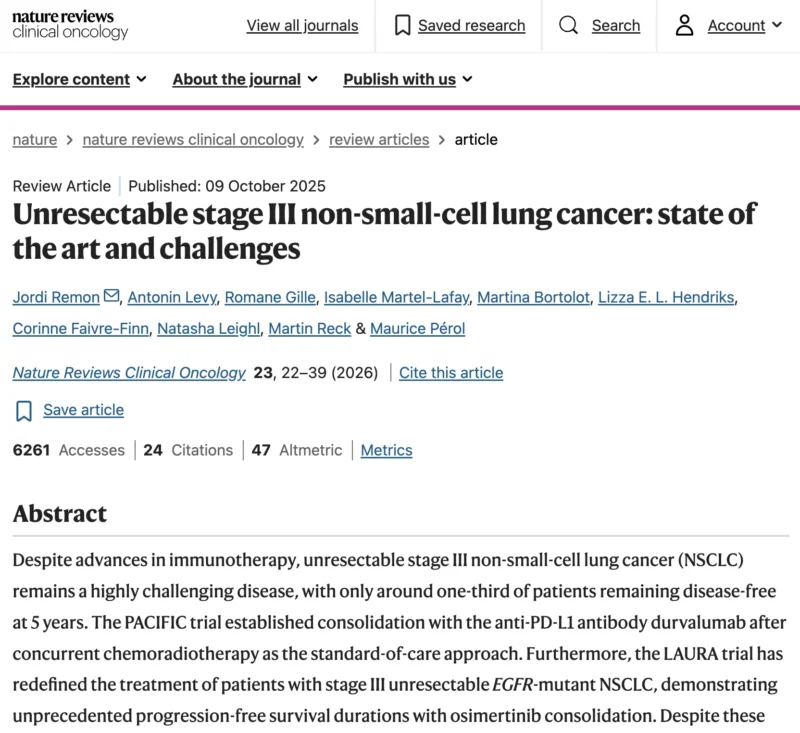
A new review in Nature Reviews Clinical Oncology by Jordi Remon and colleagues outlines the current standard of care while examining how EGFR-directed therapy, circulating tumor DNA (ctDNA), modern radiotherapy, and emerging chemoimmunotherapy strategies may further reshape management.
Despite major therapeutic advances, outcomes remain suboptimal. Only approximately one-third of patients remain disease-free at 5 years, underscoring the need for better patient selection, improved systemic control, and more individualized treatment strategies.
PACIFIC Remains the Standard for EGFR/ALK Wild-Type Disease
Concurrent chemoradiotherapy followed by consolidation with durvalumab remains the established standard for patients with unresectable stage III NSCLC without actionable EGFR or ALK alterations. The PACIFIC regimen fundamentally changed management by establishing consolidation immune checkpoint inhibition after definitive chemoradiotherapy.
The review reinforces that this approach remains the therapeutic backbone for appropriately selected patients with EGFR- and ALK-wild-type disease. Importantly, current evidence does not support routinely adding immune checkpoint inhibition directly to concurrent chemoradiotherapy. According to the authors, available data suggest greater toxicity without sufficiently convincing evidence of additional efficacy.
LAURA Redefines EGFR-Mutant Stage III Disease
The treatment paradigm is substantially different for patients with EGFR-mutant unresectable stage III NSCLC. The LAURA trial established consolidation treatment with a third-generation EGFR tyrosine kinase inhibitor after chemoradiotherapy as a major advance in this molecular subgroup.
The review highlights the unprecedented progression-free survival achieved with osimertinib consolidation, together with a reduction in the risk of central nervous system progression. This development further emphasizes the need for comprehensive molecular testing even in locally advanced disease.
Stage III NSCLC can no longer be approached solely according to anatomic stage; molecular biology increasingly determines the optimal post-chemoradiotherapy strategy.
ctDNA Could Enable Truly Personalized Consolidation Therapy
One of the most promising future approaches involves circulating tumor DNA-based minimal residual disease assessment. ctDNA monitoring may help distinguish patients who have achieved deep molecular responses after chemoradiotherapy from those who remain at high risk of recurrence.
In principle, this could allow consolidation treatment to become more individualized. Patients with persistent molecular disease could potentially undergo treatment escalation, whereas sustained ctDNA clearance might eventually support treatment de-escalation or individualized treatment duration.
However, these strategies remain investigational and require prospective validation before routine clinical implementation.
Radiotherapy Is Also Becoming More Precise
Radiotherapy remains central to curative-intent treatment of unresectable stage III NSCLC, but advances in radiation delivery may improve the therapeutic index. Modern techniques aim to maintain effective tumor control while limiting irradiation of surrounding normal tissues.
This is particularly relevant as radiotherapy becomes increasingly integrated with immunotherapy and targeted therapy, where pulmonary and other treatment-related toxicities can limit combined-modality treatment.
The review highlights the potential for new radiotherapy approaches to improve synergy with systemic therapy while reducing toxicity.
Induction Chemoimmunotherapy Could Challenge the Definition of “Unresectable”
Another developing strategy is the use of induction chemoimmunotherapy in patients initially considered unresectable. Experience from the neoadjuvant setting has generated interest in whether systemic treatment can produce sufficient tumor regression to permit subsequent surgical resection in selected patients.
Such an approach could eventually blur the traditional distinction between resectable and unresectable stage III disease. For now, however, evidence remains limited.
The authors emphasize that large prospective phase III trials are required before induction chemoimmunotherapy can be incorporated into routine treatment for unresectable disease.
What About Patients Unable to Receive Chemotherapy?
A clinically important unmet need remains the management of patients who are unable to tolerate concurrent chemotherapy. These patients are often older, frailer, or have substantial comorbidity and therefore may not be candidates for standard concurrent chemoradiotherapy.
Alternative treatment strategies are being evaluated in phase II studies, but a clearly established standard for this population remains lacking. This represents an important area for future research as treatment becomes increasingly personalized not only according to tumor biology but also according to patient fitness and competing health risks.
The Role of Immunotherapy Rechallenge Remains Uncertain
As more patients receive durvalumab in the curative-intent setting, clinicians increasingly face another question: what should be done when disease eventually recurs after prior immune checkpoint inhibition? The review identifies immunotherapy rechallenge as an emerging but unresolved issue.
Treatment decisions after recurrence will increasingly need to consider the timing of progression, prior duration of immunotherapy exposure, molecular status, pattern of relapse, and the availability of targeted therapies.
Prospective evidence remains limited, and this area is likely to become increasingly relevant as long-term survivorship after stage III treatment improves.
A More Molecularly Defined Stage III NSCLC Landscape
The evolving management of unresectable stage III NSCLC increasingly reflects the broader transformation of thoracic oncology. For patients without actionable oncogenic drivers, concurrent chemoradiotherapy followed by durvalumab remains the reference standard.
For patients with EGFR-mutant disease, the emergence of osimertinib consolidation demonstrates that targeted therapy can redefine treatment even in the locally advanced, potentially curable setting.
The next evolution may come from integrating molecular residual disease monitoring, modern radiation technologies, and response-adapted systemic treatment.
OncoDaily Takeaway
Unresectable stage III NSCLC should increasingly be considered a biologically heterogeneous disease rather than a single therapeutic category. The PACIFIC regimen remains the standard for EGFR/ALK wild-type disease, while the LAURA trial has established a distinct targeted approach for EGFR-mutant tumors.
At the same time, ctDNA-guided treatment, improved radiotherapy techniques, and induction chemoimmunotherapy could further personalize care and potentially redefine the boundaries between unresectable and surgically manageable disease.
The challenge now is not simply to intensify therapy, but to determine which treatment should be intensified, for which patient, and at what stage of the disease course.
Source
Remon J, Levy A, Gille R, et al. Unresectable stage III non-small-cell lung cancer: state of the art and challenges. Nature Reviews Clinical Oncology. 2026;23:22–39.