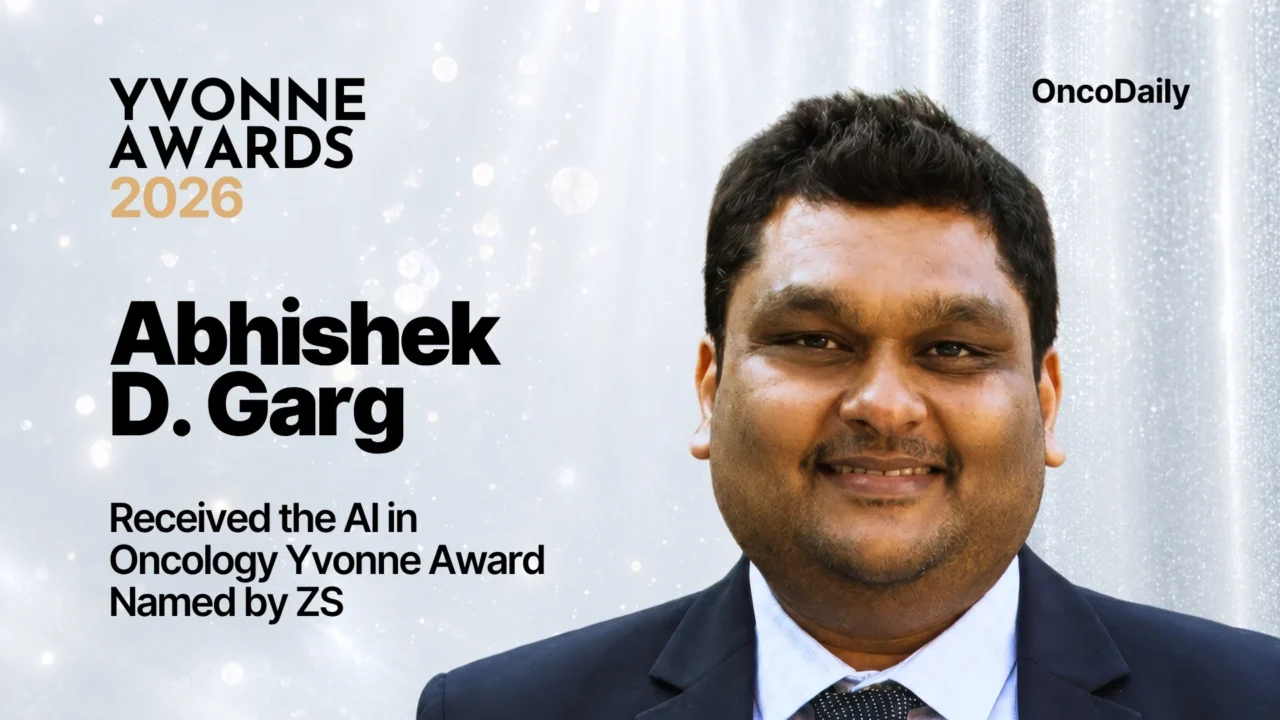
Prof. Abhishek D. Garg was honored with the AI in Oncology Yvonne Award Named by ZS during the Yvonne Awards Ceremony at OncoDaily Party 2026, held on May 29 at Park West in Chicago.
Natera was the exclusive partner of the Yvonne Awards Ceremony and OncoDaily Reception.
The recognition highlights Prof. Garg’s work in immuno-oncology, cell death immunology, molecular stress responses, anticancer vaccines, tumor microenvironment research, biomarker discovery, spatial biology, and AI-powered translational oncology. His scientific career has focused on understanding how cancer cell death, immune resistance, antigen presentation, myeloid and T-cell interactions, and tumor states shape response to cancer immunotherapy.
The AI in Oncology Yvonne Award Named by ZS recognizes leaders whose work is helping define how artificial intelligence and data-driven science can improve oncology research, biomarker development, and patient care. In Prof. Garg’s case, that work is deeply connected to immunotherapy biology, spatial multi-omics, antigen presentation, and clinically meaningful prediction of immune checkpoint blockade response.
A Scientific Career Built Around Cancer Immunity
Abhishek D. Garg has more than 17 years of high-impact experience in cancer immunology and immuno-oncology. His research has explored fundamental questions in cancer biology: how cancer cells die, why some forms of cell death stimulate immune responses while others do not, how danger signals and interferon pathways shape the immune environment, and how tumor-immune interactions influence sensitivity or resistance to immunotherapy.
His laboratory has studied both immunogenic and tolerogenic cancer cell death, CD8-positive T-cell death, molecular stress responses, wound-healing biology, myeloid-cell behavior, and the broader immune architecture of tumors.
This scientific focus has positioned his work at the center of one of oncology’s most important challenges: understanding why some tumors respond to immunotherapy while others remain resistant.
Leading the Laboratory of Cell Stress and Immunity
Abhishek D. Garg currently serves as Research Associate Professor in the Department of Cellular and Molecular Medicine, Faculty of Medicine, KU Leuven, Belgium, and as Group Leader of the Laboratory of Cell Stress and Immunity at KU Leuven.
Since 2020, his laboratory has developed a research program that connects fundamental immunology with translational oncology. The lab’s work uses reverse translational approaches, moving from clinical observations back into preclinical models to better understand mechanisms of response, resistance, and immune escape.
This approach reflects the strength of Prof. Garg’s scientific vision: meaningful cancer research must move in both directions, from the laboratory to the clinic and from the clinic back to the laboratory.
AI-Driven Biomarkers With Clinical Relevance
One of Prof. Garg’s most important contributions has been the development of an AI-driven signature of HLA antigen-presentation molecules with preference for cancer neoantigens. His laboratory was the first in the world to create this type of AI-based signature, which also captured a novel spatial immune architecture involving antigen-presenting cancer cells, pro-inflammatory macrophages, and pre-exhausted or exhausted CD8-positive T cells.
This work is especially important because antigen presentation is central to immune recognition. For immune checkpoint blockade to work, the immune system must be able to see tumor-associated antigens and mount an effective T-cell response. By using AI to identify patterns linked to antigen presentation and immune architecture, Prof. Garg’s laboratory has helped advance a more precise understanding of which tumors may respond to immunotherapy.
The AI signature demonstrated cohort-independent biomarker efficacy in predicting patient response to immune checkpoint blockade across more than 1,000 patients. This represents a major translational step, moving biomarker discovery closer to clinically useful patient stratification.
Bringing Spatial Biology Into Immunotherapy Prediction
Abhishek D. Garg ’s work is not limited to identifying molecular markers. His research also explores where immune cells and cancer cells are located inside tumors and how their spatial relationships affect treatment response.
This spatial perspective is essential in modern immuno-oncology. A tumor may contain immune cells, but their position, functional state, and interaction with cancer cells can determine whether they are active, suppressed, excluded, or exhausted. By combining spatial mapping, multi-omics, and AI, Prof. Garg’s laboratory has helped show that the organization of the tumor microenvironment can carry powerful information about immunotherapy response.
This approach brings oncology closer to a more integrated biomarker model, where prediction is based not only on single molecules, but on the full biological context of the tumor.
From Fundamental Discovery to Translational Immunotherapy
Abhishek D. Garg’s career has repeatedly connected basic discovery with therapeutic development. His work on immunogenic cell death, danger signaling, tumor microenvironment biology, and hypofunctional T-cell states has contributed to the broader understanding of how immune responses are activated, suppressed, or redirected in cancer.
His laboratory is also working with oncologists to translate AI-based and spatial biomarker discoveries toward early-stage clinical trials. These include dendritic cell vaccine strategies connected to spatial and AI biomarkers, with prospective trials in Germany and Belgium funded through EU Mission Cancer.
This direction reflects a key feature of Prof. Garg’s work: biomarker discovery is not an end point. It becomes most meaningful when it informs treatment selection, vaccine development, immunotherapy design, and clinical trial strategy.
A Global Voice in Immuno-Oncology
Prof. Garg has established himself as an international scientific leader in immuno-oncology. He has authored more than 130 peer-reviewed publications, with more than 32,000 citations in Scopus, an h-index above 60, and a strong record of publication in high-impact journals.
His work has placed him among the top 1–2% highly cited researchers in Stanford/Elsevier rankings and among highly cited researchers recognized by Clarivate. He has also been ranked among leading researchers in immunogenic cell death and in the broader field of biology and biochemistry.
Beyond publication metrics, his influence is reflected in the way his laboratory has shaped emerging concepts in tumor immunology, including diversity in hypofunctional T-cell states in cancer, immune resistance, antigen presentation, and the use of AI to interpret tumor-immune biology.
Recognition for Scientific Innovation
Prof. Garg’s awards reflect a career marked by scientific originality and international recognition. His honors include the India UK Achievers Honour 2026 in Education, Science and Innovation, the AstraZeneca Foundation Award 2025, the 41st Prix Galien Belgium in 2023, the Annual Award of KU Leuven Research Council, the European Society for Photobiology Young Investigator Award, the FWO-McKinsey & Company Scientific Prize, and earlier academic awards from the University of Leeds and institutions in India.
These recognitions reflect both the depth of his scientific work and the translational potential of his discoveries.
Editorial Leadership and Scientific Service
Prof. Garg also plays a major role in shaping scientific communication and peer review. He serves as Editor-in-Chief of Genes & Immunity, published by Springer Nature, and holds editorial roles across several international journals in immunology, oncology, and cell biology.
He has served as an evaluator or panel member for major grant agencies, including the European Research Council, and has contributed to scientific advisory boards, COST Action networks, and commissioned review series in cancer immunology.
This service reflects his broader contribution to the field: advancing not only his own research program, but also the scientific standards, editorial direction, and collaborative networks that support immuno-oncology globally.
Translating Discovery Through Partnerships
Prof. Garg’s work has also moved into research and development. He is a board member of PharmAbs, KU Leuven’s antibody platform, and his laboratory is involved in developing a potential spin-off focused on antibody gene transfer-based cancer immunotherapy.
His group has also worked through service and research agreements involving biomarker screening, multi-omics, AI immuno-oncology platforms, and collaborations with biotech and pharmaceutical partners. These activities reflect the translational pathway from laboratory discovery to therapeutic development and clinical application.
Honoring a Scientist at the Interface of Immunology and AI
The AI in Oncology Yvonne Award Named by ZS recognizes Prof. Abhishek D. Garg for his contribution to cancer research through immuno-oncology, AI-driven biomarker discovery, spatial biology, cell death immunology, antigen presentation research, and next-generation immunotherapy development.
At OncoDaily Party 2026, his recognition highlighted the growing importance of scientists who can connect deep biological insight with computational innovation. Prof. Garg’s work shows how AI can be used not as a replacement for biology, but as a tool to reveal patterns that help explain immune response, resistance, and therapeutic opportunity.
Through his work at KU Leuven, the Laboratory of Cell Stress and Immunity, PharmAbs, and international scientific collaborations, Prof. Garg continues to advance a research vision where immunology, spatial biology, and AI come together to shape more precise and effective cancer immunotherapy.
Written by Nare Hovhannisyan, MD