
SARC041 Trial of abemaciclib versus placebo in patients with advanced dedifferentiated liposarcoma, was presented during the ASCO 2026 Plenary Session by Mark A. Dickson, MD. The study evaluated whether abemaciclib, an oral CDK4/6 inhibitor, could improve progression-free survival in patients with recurrent or metastatic dedifferentiated liposarcoma.
Background
Liposarcoma accounts for approximately 3,000 cases per year in the United States. The presentation highlighted that most patients relapse after surgery and become candidates for systemic therapy when resection is no longer feasible.
Available systemic treatment options have historically provided limited disease control. The slides noted that no chemotherapy achieves progression-free survival beyond four months in this setting. Doxorubicin is FDA-approved in the first-line setting, with a median PFS of 2 to 4 months and median overall survival of 19 months. Eribulin and trabectedin are FDA-approved in the second-line and later setting, with median PFS of approximately 2 months.
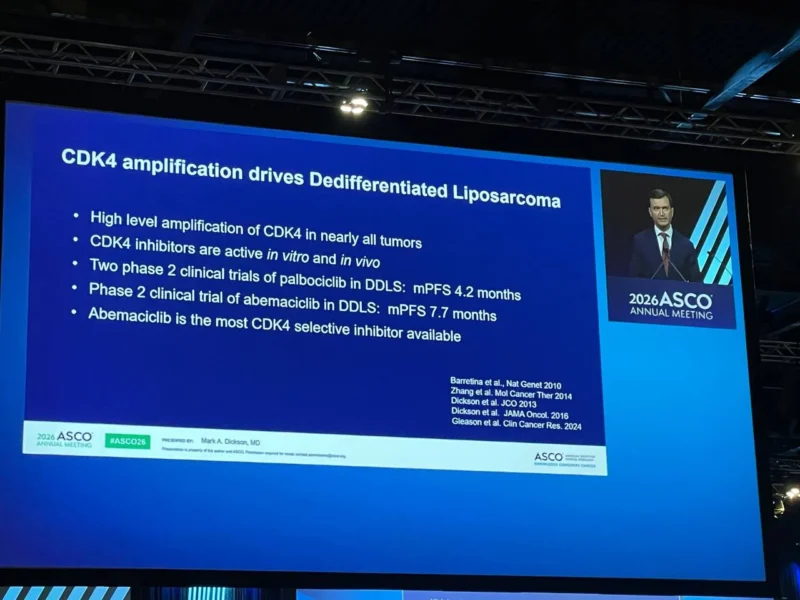
The biological rationale for SARC041 was based on CDK4 amplification, described in the presentation as a hallmark of dedifferentiated liposarcoma. High-level CDK4 amplification occurs in nearly all tumors, CDK4 inhibitors have shown activity in vitro and in vivo, and prior phase 2 studies showed median PFS of 4.2 months with palbociclib and 7.7 months with abemaciclib in dedifferentiated liposarcoma. The presentation also described abemaciclib as the most CDK4-selective inhibitor available.
Study Design
SARC041 was an investigator-initiated phase 3 clinical trial sponsored by the Sarcoma Alliance for Research through Collaboration. Patients with advanced or metastatic dedifferentiated liposarcoma were stratified by prior systemic treatment, defined as 0 versus ≥1 prior line, and randomized 1:1 to receive either abemaciclib 200 mg orally twice daily or placebo.
The study included a crossover design, allowing patients initially assigned to placebo to receive abemaciclib after progression. Imaging with CT was performed every six weeks for 36 weeks and then every 12 weeks.
Key eligibility criteria included age ≥18 years, ECOG performance status 0–1, and recurrent or metastatic dedifferentiated liposarcoma. Purely well-differentiated disease was excluded.
Patients were required to have disease progression by RECIST 1.1 within the six months before study entry. Any number of prior therapies was allowed, including none. Patients with extensive disease requiring immediate treatment were excluded.
The primary endpoint was progression-free survival. Secondary endpoints included objective response rate, PFS after crossover for patients initially randomized to placebo, overall survival, and toxicity assessed by CTCAE version 5.
The planned sample size was 108 evaluable patients, with 54 patients per arm. The study was designed with 80% power to detect a hazard ratio of 0.6 for PFS. The statistical assumptions included an estimated median PFS of 3.3 months in the placebo arm, with a hazard ratio of 0.6 corresponding to a median PFS of 5.4 months in the abemaciclib arm.
Baseline characteristics were generally balanced between the treatment arms, with 54 patients assigned to placebo and 54 patients assigned to abemaciclib.
The median age was 67 years in both groups. In the placebo arm, 25 patients were female and 29 were male. In the abemaciclib arm, 17 patients were female and 37 were male.
Most tumors were located in the abdomen or retroperitoneum, reported in 80% of patients in the placebo arm and 92% in the abemaciclib arm. Prior lines of therapy were also balanced: 52% of patients in the placebo arm and 50% in the abemaciclib arm had received no prior systemic therapy, while 48% and 50%, respectively, had received at least one prior line.
Results
SARC041 met its primary endpoint. Median progression-free survival was 9.7 months with abemaciclib compared with 1.5 months with placebo. This corresponded to a hazard ratio of 0.38, with a 90% confidence interval of 0.25–0.59 and p<0.001.
At six months, PFS was 60% with abemaciclib and 22% with placebo. At 12 months, PFS was 39% and 13%, respectively.
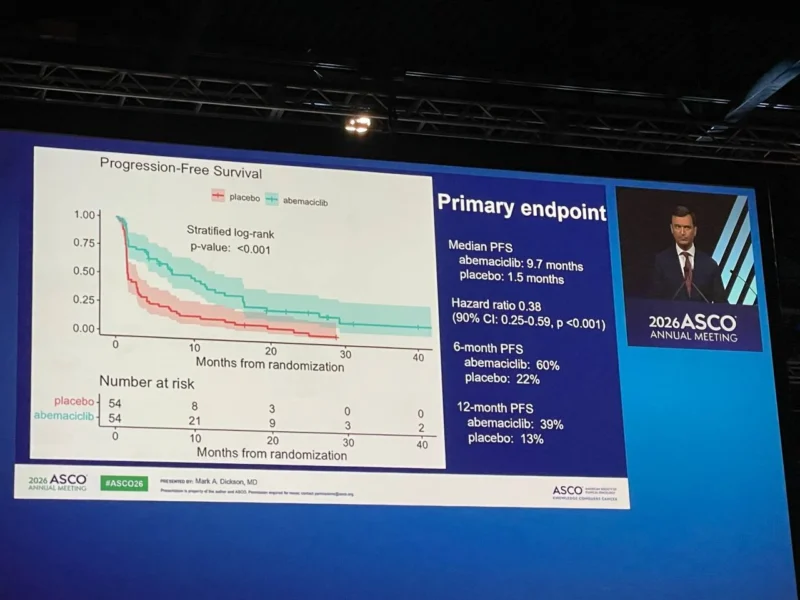
The presentation described this as a clinically meaningful and statistically significant improvement in progression-free survival for patients with dedifferentiated liposarcoma.
Objective response rate was higher with abemaciclib. The ORR was 9% in the abemaciclib arm and 0% in the placebo arm.
Among patients initially treated with placebo, 46 patients, representing 85%, received abemaciclib after progression on placebo.
After crossover to abemaciclib, median PFS was 3.4 months, and the response rate was 4%.
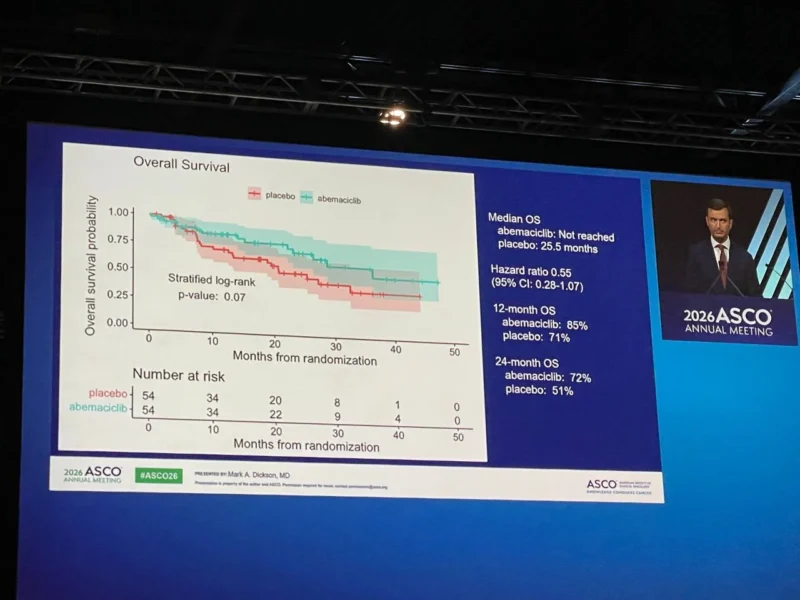
Overall survival showed a positive trend favoring abemaciclib. Median overall survival was not reached in the abemaciclib arm and was 25.5 months in the placebo arm. The hazard ratio was 0.55, with a 95% confidence interval of 0.28–1.07. The stratified log-rank p-value was 0.07.
The 12-month overall survival rate was 85% with abemaciclib and 71% with placebo. At 24 months, overall survival was 72% and 51%, respectively.
Safety
The key adverse events highlighted in the presentation were mainly hematologic and gastrointestinal. In the abemaciclib arm, grade 3 events included anemia in 4%, neutrophil count decreased in 11%, platelet count decreased in 4%, white blood cell count decreased in 7%, diarrhea in 7%, and increased creatinine in 6%. Grade 4 events included lymphocyte count decreased in 2% and neutrophil count decreased in 2%.
Diarrhea was more frequent with abemaciclib, with grade 2 diarrhea in 28% and grade 3 diarrhea in 7%, compared with grade 2 diarrhea in 2% and no grade 3 or 4 diarrhea in the placebo arm.
Dose reductions were more common with abemaciclib, occurring in 39% of patients compared with 2% in the placebo arm. The presentation described abemaciclib as well tolerated.
Limitations
The limitations noted in the presentation included enrollment only in the United States. Another limitation was the absence of central pathology review, although all sites were sarcoma centers with expert pathologists.
Conclusions
SARC041 was presented as the first positive clinical trial in dedifferentiated liposarcoma. Progression-free survival was significantly improved with abemaciclib compared with placebo. Although most patients in the placebo group crossed over to receive abemaciclib after progression, the overall survival trend still favored the abemaciclib group.
The key takeaway from the presentation was that abemaciclib, an oral CDK4/6 inhibitor, provided a clinically meaningful and statistically significant improvement in progression-free survival for patients with dedifferentiated liposarcoma.
Next Steps
The next steps presented included ongoing analysis of archival tumor tissue to evaluate biomarkers of response and mechanisms of resistance. The presenter also highlighted the need to advocate for inclusion of abemaciclib in practice guidelines to enable global access and to evaluate abemaciclib in the neoadjuvant and adjuvant setting.