The ReNeu trial, presented at the ESMO Sarcoma and Rare Cancers Congress 2026, evaluated the long-term efficacy and safety of Mirdametinib in both adults and children with Neurofibromatosis Type 1 who developed symptomatic plexiform neurofibromas (PN) that could not be completely removed surgically. These tumors often grow along nerve pathways and may cause pain, disfigurement, and functional impairment, significantly affecting quality of life.
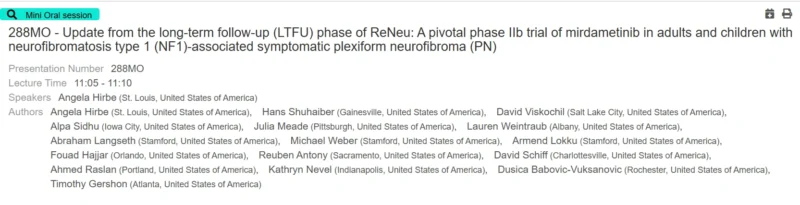
Authors: Angela Hirbe, Hans Shuhaiber , David Viskochil, Alpa Sidhu, Julia Meade, Lauren Weintraub, Abraham Langseth, Michael Weber, Armend Lokku, Fouad Hajjar, Reuben Antony, David Schiff, Ahmed Raslan, Kathryn Nevel, Dusica Babovic-Vuksanovic, Timothy Gershon.
Background
Plexiform neurofibromas are complex tumors associated with Neurofibromatosis Type 1, often causing significant morbidity due to tumor growth, pain, and functional impairment. Many of these tumors are not amenable to complete surgical resection, creating a substantial unmet medical need.
Mirdametinib, a selective MEK1/2 inhibitor, has recently received regulatory approval from the U.S. Food and Drug Administration and the European Commission for adults and children aged ≥2 years with symptomatic, inoperable NF1-associated plexiform neurofibromas.
The ReNeu trial evaluated the long-term outcomes of mirdametinib in both pediatric and adult patients with NF1-PN.
Methods
In the ReNeu study (NCT03962543), patients received mirdametinib in 3-weeks-on/1-week-off cycles within 28-day treatment cycles during a planned 24-cycle treatment phase.
After completing the treatment phase, eligible patients could continue therapy within an optional long-term follow-up (LTFU) phase. The analysis presented includes follow-up data through June 2024, approximately nine months after the primary analysis.
Results
A total of 58 adults and 56 children received mirdametinib.
The median duration of treatment was 21.8 months in adults and 25.4 months in children. Among patients eligible for long-term follow-up, 84% of adults and 86% of children entered the LTFU phase.
The confirmed objective response rate (ORR) across treatment and follow-up phases was:
- 47% in adults (27/58)
- 55% in children (31/56)
Among responders, deep responses—defined as a greater than 50% reduction in plexiform neurofibroma volume—were achieved in 18 adults and 19 children.
The median best tumor volume reduction from baseline was –41% in adults and –43% in children. The median duration of response had not been reached in either cohort at the time of analysis.Regarding safety, the most common treatment-related adverse events (≥25%) included:
- In adults: acneiform dermatitis, diarrhea, nausea, and vomiting
- In children: diarrhea, acneiform dermatitis, and paronychia
Grade ≥3 treatment-related adverse events occurred in 17% of adults and 25% of children. Dose interruptions, reductions, and discontinuations due to adverse events occurred in 9%, 17%, and 22% of adults, and 14%, 14%, and 9% of children, respectively.
Clinical Implications
Longer-term follow-up from the ReNeu trial demonstrates that mirdametinib produces durable tumor responses in both adults and children with NF1-associated plexiform neurofibromas, including deep responses in a substantial proportion of patients.
Importantly, treatment remained generally well tolerated with no new safety signals, supporting mirdametinib as an important therapeutic option for patients with symptomatic, inoperable NF1-PN.