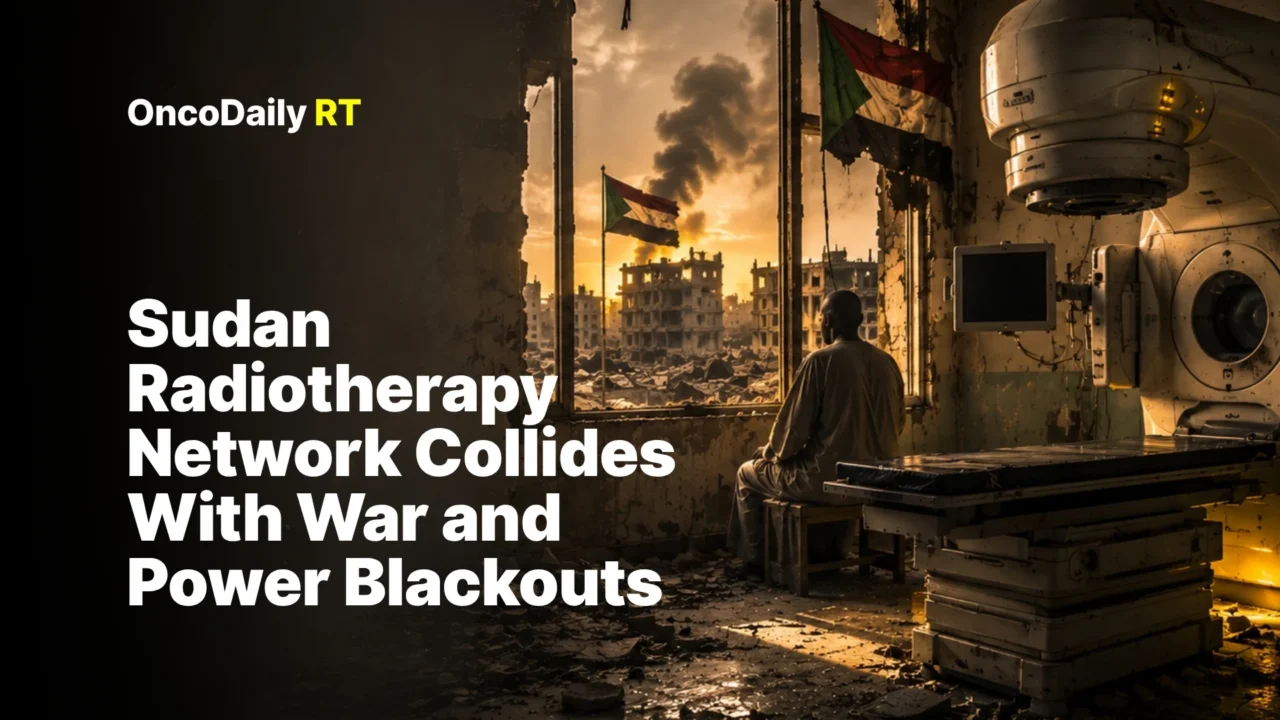
Sudan’s radiotherapy capacity has been shaped by years of limited infrastructure, uneven workforce distribution, equipment failures, and, more recently, the devastating consequences of armed conflict.
A new study published in Radiotherapy & Oncology outlines the scale of the challenge. With a population of approximately 50 million people, Sudan had only seven operational megavoltage radiotherapy units before the outbreak of conflict in April 2023. This equated to roughly one unit for every seven million people, far below the International Atomic Energy Agency benchmark of one unit per 250,000 people.
The findings show how a fragile radiotherapy system became even more vulnerable when conflict disrupted cancer services across the country.
Seven Operational Units for 50 Million People
Radiotherapy remains an essential component of cancer care, yet access in Sudan has long been severely limited.
Since 1967, Sudan has installed 13 cobalt-60 teletherapy units, eight linear accelerators, and six high-dose-rate brachytherapy systems. However, the number of installed machines does not reflect the number available for patients.
Before the conflict began in April 2023, only seven megavoltage units were operational: four cobalt-60 units and three linear accelerators.
Several cobalt-60 machines had been dismantled before the end of their expected service life. The study reported that four of the country’s 13 cobalt-60 units, representing around 30%, were removed prematurely because of inadequate maintenance and difficulties replacing radioactive sources.
This equipment gap has left many patients facing major barriers to timely treatment, particularly those living outside the capital.
Advanced Treatment Remains Concentrated in Private Centers
The availability of modern radiotherapy techniques is also uneven.
Advanced treatment approaches, including intensity-modulated radiotherapy and volumetric modulated arc therapy, were available only in private facilities. Public-sector access remained far more restricted, despite the significant need for radiotherapy across a growing cancer population.
Brachytherapy services faced similar limitations. Of the six high-dose-rate brachytherapy systems installed in Sudan over the years, only two remained operational before the conflict.
For patients with cancers such as cervical cancer, where brachytherapy can be central to curative treatment, interruptions in these services may have serious consequences.
A Workforce Concentrated in Khartoum
The study also identified major workforce imbalances across Sudan’s radiotherapy system.
The country had 52 clinical oncologists and 27 medical physicists. However, approximately 77% of radiation oncologists were concentrated in Khartoum, leaving many regions with limited specialist access.
Medical physicists were more evenly distributed across radiotherapy centers, but the overall workforce remained insufficient for the country’s needs.
The concentration of specialists in the capital created an additional challenge for patients from rural and remote areas. Travelling long distances for repeated radiotherapy sessions can be financially, physically, and emotionally demanding, especially for people already facing a cancer diagnosis.
Advancing Access to Radiotherapy in Low- and Middle-Income Countries
Armed Conflict Reduced Services to One Functioning Center
The conflict that began in April 2023 placed an already fragile cancer care system under extraordinary strain.
A follow-up survey conducted in September 2025 found that radiotherapy services had collapsed across much of the country. Merwe Medical City was identified as the only functioning radiotherapy facility nationwide, operating with a single linear accelerator.
This meant that a country of 50 million people was left dependent on one operational radiotherapy center during a period of displacement, insecurity, damaged infrastructure, and disrupted supply chains.
The impact extends beyond machine availability. Cancer care depends on uninterrupted electricity, trained personnel, reliable transportation, access to imaging, pathology services, chemotherapy, surgery, and follow-up care. When these systems are disrupted, patients can experience delays at every stage of their treatment journey.
Maintenance and Source Replacement Are Critical Priorities
The study highlights that expanding radiotherapy capacity is not only about purchasing new machines.
Reliable maintenance programs, access to spare parts, trained engineers, and timely replacement of cobalt-60 sources are essential to keeping services functional. Without these systems, equipment can become unusable long before its expected lifespan.
The premature dismantling of cobalt-60 units in Sudan illustrates the consequences of weak maintenance and source-replacement pathways. In settings with limited resources, protecting existing treatment capacity can be just as important as investing in new technology.
Rebuilding Access Requires National and International Action
The authors call for a coordinated strategy to restore and strengthen radiotherapy services in Sudan.
Key priorities include establishing a national program for equipment maintenance and radioactive-source replacement, expanding workforce training, retaining oncology professionals, improving the geographic distribution of treatment facilities, and developing international partnerships to support recovery.
The challenge is not limited to radiotherapy alone. It reflects the broader reality of cancer care in conflict-affected settings, where patients may lose access to diagnosis, treatment, medicines, specialist care, and follow-up at the same time.
For Sudan, restoring radiotherapy services will require more than reopening machines. It will require rebuilding a system capable of delivering safe, timely, and equitable cancer care to patients across the country.
Written by Aren Karapetyan, MD
Find more exclusive oncology content on OncoDaily.