Reduced-intensity conditioning (RIC) has made allogeneic hematopoietic cell transplantation (allo-HCT) accessible to older patients and those who can’t tolerate myeloablative conditioning. The trade-off is less pre-transplant cytoreduction, and relapse remains a major limitation, especially in acute myeloid leukemia with adverse molecular or cytogenetic features and in patients who are MRD-positive at transplant.
Radioimmunotherapy (RIT) is being explored as a way to intensify leukemia-directed radiation without proportionally increasing radiation exposure to nonhematopoietic organs. A monoclonal antibody recognizes an antigen expressed in the hematopoietic compartment and carries a therapeutic radionuclide to the marrow, spleen and other sites of disease. It can be incorporated into an RIC transplant regimen.
The biological rationale, clinical experience, and emerging α-emitter platforms are reviewed in Frontiers. The clinical evidence remains early phase, but it shows that substantial radiation doses can be concentrated in hematopoietic tissues with reliable donor engraftment.
Why Target Radiation Before Allogeneic Transplantation?
Radiation dose matters in AML conditioning, and conventional escalation has a narrow therapeutic window. Historical studies of total body irradiation found that increasing the dose to approximately 15-16 Gy reduced relapse but increased treatment-related mortality, eliminating the overall survival advantage. The lungs, liver, kidneys and gastrointestinal tract receive clinically relevant exposure along with malignant tissue.
RIT changes the spatial distribution of radiation. The radionuclide circulates systemically, and antibody binding concentrates its radiation in antigen-rich hematopoietic tissues. Considerably more radiation can reach marrow and spleen than would be tolerable if the same dose were delivered throughout the body.
The approach is suited to transplantation because profound marrow toxicity is less prohibitive when donor hematopoietic stem cells will restore hematopoiesis. Clinical CD45-directed studies have achieved marrow absorbed doses of 25-40 Gy or higher without graft failure. RIT does not remove the need for conventional conditioning or graft-versus-leukemia activity. Its proposed role is additional cytoreduction before donor immunity is established.
You can also read:
CD45 Provides Broad Access to the Hematopoietic Compartment
CD45 has become the principal target for RIT-based conditioning because it is restricted largely to nucleated hematopoietic cells and is expressed on approximately 85%-90% of AML cells. Expression is also generally preserved in heavily treated relapsed and refractory disease. High antigen density facilitates radionuclide retention and radiation delivery throughout the marrow compartment.
Unlike many antibody or cellular therapies, RIT doesn’t require every malignant cell to bind enough antibody for direct killing. Radiation from an antibody-bound radionuclide can travel beyond the antigen-positive cell and damage neighboring cells, the cross-fire effect, which matters when antigen expression is heterogeneous.
Clinical Experience With Beta-Emitter Radioimmunotherapy
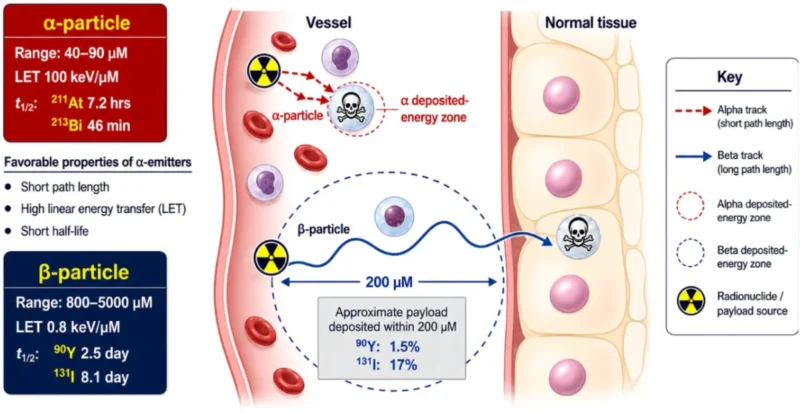
Most clinical experience has involved the β-emitters iodine-131 (¹³¹I) and yttrium-90 (⁹⁰Y). Their particles travel several millimeters through tissue. That range supplies the cross-fire effect but also exposes neighboring normal tissue.
In one study of 15 patients with advanced AML or high-risk myelodysplastic syndrome (MDS), ¹³¹I-anti-CD45 combined with fludarabine and 2-Gy TBI delivered mean absorbed doses of 27 Gy to marrow and 84 Gy to spleen, compared with 21 Gy to the liver. All patients engrafted. One-year overall survival was 73%, and 8 of 15 patients relapsed, reflecting the very high-risk population treated.
A phase I study of ⁹⁰Y-DOTA-BC8 followed by fludarabine/2-Gy TBI enrolled 15 patients with relapsed or refractory leukemia or high-risk MDS, most with active marrow disease. All engrafted, 13 of 15 achieved complete remission by day 28, and 1- and 2-year overall survival were 66% and 46%. The maximum tolerated dose was not reached despite liver doses up to 30 Gy.
These small studies establish feasibility and dosimetric selectivity. They cannot determine how much RIT itself contributed to disease control, since patient populations, disease status, conditioning regimens and administered radiation doses differed across studies, and most came from highly specialized centers.
SIERRA Brought RIT Into a Randomized AML Trial
The phase III SIERRA trial evaluated ¹³¹I-apamistamab (Iomab-B), a CD45-directed radioimmunoconjugate, as a route to allo-HCT in patients aged 55 years or older with active relapsed or refractory AML who were not candidates for conventional myeloablative conditioning.
A 6-month durable complete remission was achieved in 22% of patients assigned to Iomab-B compared with 0% with conventional care, and day-100 non-relapse mortality after transplantation was 6%. The population had active, difficult-to-control AML.
Liver Toxicity Is the Main Dose-Limiting Factor
Across anti-CD45 studies, the liver has consistently been the major dose-limiting organ. Hepatic exposure results from antibody clearance, uptake by resident hematopoietic-derived cells including Kupffer cells, and metabolism of radiolabeled antibody complexes.
The original ¹³¹I-BC8 dose-escalation study estimated a maximum tolerated liver dose of ~24 Gy. Later studies reached 28-30 Gy in selected patients without clearly identifying dose-limiting hepatic toxicity. Transaminitis, hyperbilirubinemia and sinusoidal obstruction syndrome remain clinically relevant concerns. Pulmonary and renal absorbed doses have generally been lower.
Patient-specific dosimetry is central to RIT conditioning. A tracer dose can be administered before treatment, followed by serial imaging and blood-clearance measurements. The therapeutic activity can then be selected according to the organ expected to reach its dose limit first.
Alpha Emitters as the Next Step
Newer RIT development is moving toward α-emitting radionuclides, particularly astatine-211 (²¹¹At). β-particles travel millimeters, α-particles travel only tens of micrometers and deposit much greater energy along that short path.
²¹¹At releases approximately 6-8 MeV per α-particle decay and has a tissue range of roughly 50-80 μm. Its high linear energy transfer produces dense, difficult-to-repair DNA damage. The short path length may suit small-volume residual disease or MRD.
In an early transplant study, 20 patients with AML or high-risk MDS, most with active disease, received ²¹¹At-labeled anti-CD45 antibody followed by fludarabine and low-dose TBI. Reported 1- and 2-year disease-free survival were 43% and 38%, with overall survival of 47% and 42%, respectively.
Isotope choice involves more than potency. Actinium-225 has a much longer physical half-life and can produce prolonged myelosuppression and delayed marrow recovery. ²¹¹At has a half-life of approximately 7.2 hours, which may fit transplantation better but demands complex production, radiochemistry and delivery logistics.
frontiersin.org
The Potential Role of RIT in AML Conditioning
The clinical setting most aligned with RIT is high relapse risk despite eligibility for RIC: persistent MRD, active leukemia, adverse disease biology or inability to tolerate conventional myeloablative conditioning.
Its role would be targeted pre-transplant cytoreduction within a sequence that increasingly includes molecularly directed treatment before HCT, MRD-guided decision-making, FLT3- or IDH-directed therapy, venetoclax-based regimens and post-transplant maintenance.
Evidence that RIT improves long-term survival over contemporary conditioning is much less mature, and α-emitter conditioning is earlier in development. RIT has to add enough leukemia-directed radiation to reduce relapse while preserving the low non-relapse mortality that makes RIC suitable for older, less fit patients.